



| HEADLINE |

|

English teaching trends in turbulent times showcased on EWU
Published : Saturday, 21 November, 2026 at 12:00 AM
Wahidul Islam


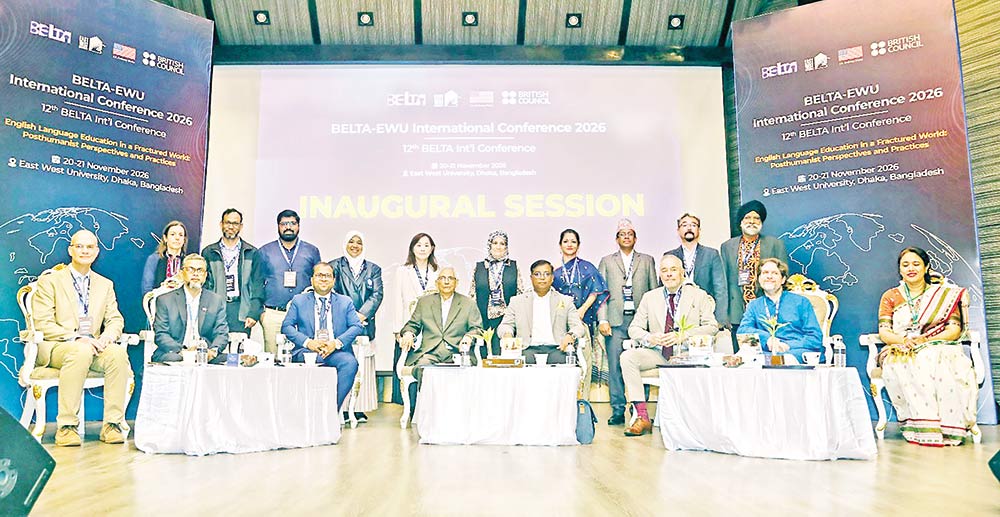 The 12th BELTA International Conference brings together more than 600 English language teachers, researchers, teacher educators and policymakers from Bangladesh and abroad to examine how English language education can respond to a world increasingly divided by technological disruption, cultural tensions, geopolitical conflicts and changing social identities.
The conference, themed “English Language Education in a Fractured World: Posthumanist Perspectives and Practices,” has brought together keynote and featured speakers from 12 countries to explore the changing relationship between language, technology, human identity, culture and education.
Sponsored by the US Embassy in Dhaka and the British Council, the international gathering seeks to rethink English language teaching and learning in response to a rapidly transforming educational landscape, particularly the growing influence of artificial intelligence (AI), multilingualism and emerging pedagogical approaches.
At the heart of the discussions is the question of how English language education can remain inclusive, relevant and responsive when traditional boundaries between humans, technology, cultures and knowledge are increasingly blurred.
The conference opened at 9:30am at the Manzur Elahi Auditorium of EWU, with University Grants Commission Chairman Prof Dr Mamun Ahmed attending as chief guest. British Council Bangladesh Country Director Stephen Forbes and US Embassy Dhaka Director for Public Engagement Scott Hartmann attended as special guests. EWU Board of Trustees Chairperson Prof Dr Mohammed Farashuddin presided over the inaugural session.
The conference is being convened by BELTA President and University of Dhaka English Department Professor Ahmed Bashir and EWU English Department Chairperson Dr Akhter Jahan.
A major focus of the conference is the application of posthumanist perspectives to English language education. Posthumanism challenges the conventional assumption that humans alone are the central agents of knowledge and learning, encouraging a broader understanding of the relationships among people, technology, the environment and other forms of agency.
In language education, this perspective raises questions about the role of AI-assisted learning, digital platforms, multilingual practices, cultural identities and the changing responsibilities of teachers and learners.
The featured sessions reflect these emerging concerns. Researchers are examining how generative AI can move beyond being a mere instructional tool to become a learning partner, while also addressing the risks of excessive technological dependence and the need to preserve learner autonomy.
A featured presentation by Dr Naureen Rahnuma of Independent University, Bangladesh, titled “From Tool to Partner: Reimagining Language Learning in the Age of Generative AI”, explores this changing relationship. Tarsame Singh Masa Singh of Malaysia’s SEGi University is also examining learner agency and speaking autonomy in AI-supported English interactions.
Other sessions are addressing English as a lingua franca and the challenges of global communication, multilingual pedagogy, teacher agency, socio-emotional well-being among university teachers and the integration of translation into English language curricula.
The Bangladesh-focused discussions are particularly significant, as researchers are examining how language education intersects with national identity, cultural diversity, state policies, market demands and minority rights.
Prof Dr Tazin Aziz Chaudhury of the University of Dhaka presented on “Rethinking English in Bangladesh: Language, Culture, Identity and Belonging”.
The conference is also exploring the relationship between language education and environmental awareness. A presentation by Dr Md Shamim Mondol of Green University of Bangladesh, titled “Mighty Rivers and Material Agency: Bringing Posthumanist Ecopedagogy to Bangladeshi EFL Classrooms”, highlights the scope for integrating ecological perspectives into English language teaching.
Dr. Ummi Khaerati Syam of APSPBI (English Language Education Study Program Association), Indonesia, presented a paper on “Learner Agency, Opportunities, and Challenges in AI-Assisted English Language Learning: Perspectives from Indonesia and the Philippines.”
International participation has broadened the discussions, with researchers from India, Malaysia, Hong Kong, China, Indonesia, Mongolia, Azerbaijan and Pakistan, among other countries, sharing their experiences and research findings.
The second day’s featured sessions will include discussions on transformative innovations for Education 5.0, intangible cultural heritage in higher education, teacher associations as agents of professional change, and linguistic identity in multilingual societies.
Beyond the presentation of research findings, the conference is expected to strengthen international academic cooperation, encourage professional exchange and generate fresh perspectives on English language teaching in Bangladesh and beyond.
As technology reshapes classrooms and cultural and linguistic identities become increasingly interconnected, the conference offers an opportunity to reconsider not only how English is taught but also whose knowledge, experiences and identities are represented in the learning process.
Its central challenge is to ensure that English language education does not become disconnected from the realities of a fractured world but instead equips learners and teachers to navigate its complexities with greater inclusiveness, critical awareness and human understanding.

Loading...
Loading...
Also read



Editor : Iqbal Sobhan Chowdhury
Published by the Editor on behalf of the Observer Ltd. from Globe Printers, 24/A, New Eskaton Road, Ramna, Dhaka.
Editorial, News and Commercial Offices : Aziz Bhaban (2nd floor), 93, Motijheel C/A, Dhaka-1000.
Phone: PABX- 41053001-06; Advertisement: 41053012; 01793317829, 01550707291, 01550707296
E-mail: [email protected], [email protected]. [email protected], [email protected], [email protected], [email protected], Online-email: [email protected]


