



| HEADLINE |

|

'Killer robots' talks run into overtime
Published : Saturday, 21 November, 2026 at 9:43 AM
Observer Online Report


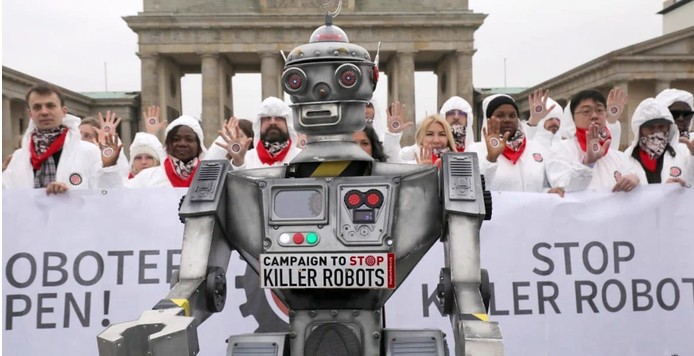
A UN conference on "killer robots" ran into overtime on Saturday after Russia in particular slowed five days of gruelling talks on whether to begin negotiating regulations for lethal autonomous weapons.
Talks at the United Nations' Review Conference of the Convention on Conventional Weapons (CCW) stretched on beyond the Friday deadline as countries sought a way through the impasse.
As warfare undergoes a radical transformation, spurred by artificial intelligence, dire warnings abound against handing power over life and death to autonomous machines.
The 128 countries party to the CCW spent the week at the UN's Geneva headquarters trying to decide whether or not to launch negotiations towards regulating the use of such weapons, and if so, under what terms.
The process has been tricky, with countries at odds and full consensus required for any decision.
While a majority of states favour a legally binding agreement, countries that have the technology, including the United States and Russia, are reluctant to have their hands tied.
"Private consultations are currently continuing with high contracting parties on the mandate and modalities of the future Group of Governmental Experts on lethal autonomous weapons systems (LAWS)," the UN said in a brief update early Saturday.
As the discussions rolled on, the talks were kicked out of the main assembly hall of the UN's Palais des Nations to make way for technicians setting up the chess world championship match's opening ceremony this weekend.
Delegates then crammed into a smaller room upstairs and carried on the negotiations behind closed doors.
Before midnight, during what was meant to be a short break in the talks, delegates spent a long period huddled tightly around Russia's representative.
Later, a group of 15 delegates broke out for hushed talks on a staircase.
Brazilian ambassador Frederico Meyer described a balancing act as "some countries have the power, some countries have the majority".
"We cannot leave the table with empty hands," he insisted to journalists, stressing that would be "terrible for the world, terrible for the United Nations, terrible for human beings".
- Russia in the spotlight -
Once activated, LAWS are capable of selecting and attacking targets without any human intervention.
According to Stop Killer Robots, a global coalition of more than 300 organisations, such systems have already been tested or deployed, including during the war in Ukraine.
As the conference opened on Monday, Russia triggered a procedural stand-off by objecting to allowing observers -- including the European Union and civil society organisations -- to participate in the debate.
That forced states to continue their discussions in an informal format behind closed doors for much of the week, with bickering over process and paragraph wording on display during a handful of public sessions.
But the week of talks brought various camps closer together, one diplomat told AFP, speaking on condition of anonymity.
"We're very close to consensus on the need to negotiate something. There is only one delegation that is actively opposing a process that is focused on negotiations."
Meyer meanwhile insisted "nobody's innocent", suggesting "other countries are behind Russia".
- 'Oppenheimer moment' -
A draft agreement seen by AFP proposes launching negotiations towards a "framework protocol" that essentially "codifies international humanitarian law applicable to LAWS", and explores ways to implement that existing law.
"Where appropriate", it could also progressively develop "further rules and other possible measures", the draft text says.
Magnus Lovold, of the Lex International philanthropic fund, warned that the draft "looks designed to keep talks on autonomous weapons trapped in the CCW dysfunctional consensus process for years to come".
He stressed there was no time for that, warning the world was reaching an "Oppenheimer moment" -- a reference to Robert Oppenheimer, the physicist who brought the world into the nuclear weapons age.
"We're really at the brink now where it may be very much more difficult in the future to actually get these rules that we need," he said.

Loading...
Loading...
Also read







Editor : Iqbal Sobhan Chowdhury
Published by the Editor on behalf of the Observer Ltd. from Globe Printers, 24/A, New Eskaton Road, Ramna, Dhaka.
Editorial, News and Commercial Offices : Aziz Bhaban (2nd floor), 93, Motijheel C/A, Dhaka-1000.
Phone: PABX- 41053001-06; Advertisement: 41053012; 01793317829, 01550707291, 01550707296
E-mail: [email protected], [email protected]. [email protected], [email protected], [email protected], [email protected], Online-email: [email protected]


