



| HEADLINE |

|

Floating farming in Pirojpur: Changing livelihoods and boosting local economy
Published : Saturday, 21 November, 2026 at 1:25 PM
Observer Online Report


Collected Photo
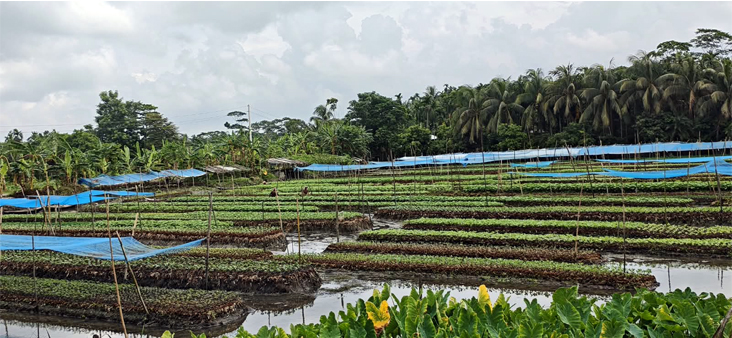
Thousands of farmers in Pirojpur, Bangladesh, are transforming their livelihoods by cultivating vegetables and saplings on floating beds made of water hyacinths and aquatic weeds. This traditional agricultural practice, centered in the vast wetlands of Nazirpur and Nesarabad upazilas, has become a booming industry, producing approximately one crore (10 million) vegetable saplings annually, generating a trade volume of roughly 10 crore BDT (100 million BDT).
The initiative is not only boosting the local economy but also creating significant employment opportunities for rural women and laborers. The method, which allows communities to adapt to climate change and rising water levels, has received international recognition from the United Nations.
The Hub of Floating Agriculture
One of the largest centers for floating farming is located in Mugarjhor village, near the Baitakata Bazar in Nazirpur upazila's Deulbarhi Dobra union, roughly 55 kilometers from Pirojpur town. The practice also extends across various villages in the Kolardoania and Malikhal unions of Nazirpur, and the Baldia union of Nesarabad.
The Cultivation Process
At the beginning of the monsoon season, farmers collect water hyacinths from local canals and beels (wetlands). After allowing them to rot, they layer the decomposing weeds to create floating beds, locally known as "dhaps." These beds are typically 2 to 3 feet thick and can range from 50 to 100 feet in length.
On these dhaps, farmers sow seeds for a variety of vegetables, including cucumber, bottle gourd, sweet pumpkin, yardlong bean, bitter gourd, tomato, ash gourd (chalkumra), and eggplant. They also directly cultivate red amaranth, spinach, Indian spinach (puishak), and stem amaranth (dantashak).
According to the Department of Agricultural Extension (DAE), approximately one crore different vegetable saplings are produced on these floating beds each season. The saplings and fresh produce are supplied to various districts and upazilas across the country during the peak season from July to November, attracting buyers from as far as northern Bangladesh. Nearly 6,000 farmers are directly involved in this agricultural system.

The Role of Rural Women
Rural women play a crucial and extensive role in the floating agriculture lifecycle. While men are primarily responsible for constructing the dhaps on the water and transporting materials by boat, women manage the collection of aquatic plants, the creation of small floating nurseries called "maedas" or "biras," seed sowing, germination, and the initial care of the saplings.
They create small, circular floating structures known as "biras" or "cradles" using a mix of aquatic weeds—such as water hyacinths, moss, and various types of duckweed (topapana, guripana)—and straw. Within these biras, seeds are germinated in a mixture of soil and rotted leaves. Once the saplings are large enough, women and adolescent girls transplant them onto the main dhaps. Despite their vital contribution, many of these women report receiving meager wages for their labor.
Historical Significance and Global Recognition
Local farmers assert that this floating cultivation method has a history spanning approximately 200 years. This centuries-old experience and innovative technique have garnered international acclaim. In 2015, the Food and Agriculture Organization (FAO) of the United Nations recognized this agricultural system as a "Globally Important Agricultural Heritage System (GIAHS)" for its effectiveness in climate change adaptation and risk mitigation. This water-dependent agriculture is now considered an exemplary model for other climate-vulnerable regions worldwide.
Economic Impact and Challenges
The trade of materials for floating agriculture fuels economic activity at Baitakata Haat in Nazirpur. On market days (Saturdays and Tuesdays), vendors arrive by boat from early morning, selling water hyacinths, moss, and other aquatic weeds. Farmers move between boats to purchase these essential materials to prepare their floating beds.
Trader Ali Hossain reported earning between 160 to 320 BDT per "kuri" (a measure of 20 bundles) of moss, with good market days seeing sales of 8,000 to 9,000 BDT.
Farmer Zakaria from Mugarjhor village has been creating floating beds and producing vegetable saplings for seven to eight years. He employs himself and involves unemployed villagers in the profession. However, he emphasized the need for interest-free loan support to provide opportunities for more people.
Female laborer Asiya Khatun from neighboring Baldia village highlighted the low wages, stating that a full day's work earns only 200 BDT, while producing 1,000 maedas pays 150 BDT. She mentioned that with no alternative employment, women are compelled to do this work and called for vocational training opportunities.
The market for the saplings has expanded across the district. Retailer Amjed Hossain from Jianagar Bazar buys saplings from Nazirpur at 5 to 7 BDT each and sells them for 10 to 15 BDT. The price fluctuates based on variety, size, demand, and market conditions. This intermediary system supports a wide economic chain involving sapling producers, wholesalers, transport workers, and retailers.
To further expand and increase the profitability of this sector, farmers are demanding increased government and non-government support. Key requests include improving transportation infrastructure for saplings and perishable vegetables to distant areas, ensuring cold storage facilities, and providing easy-access, low-interest, or interest-free loans to overcome seasonal capital crises. They also require training on modern seed preservation techniques and the use of natural pesticides.
Pirojpur DAE Deputy Director Soumitra Sarkar confirmed that saplings produced on floating beds in Nazirpur and Nesarabad are being supplied not only within the district but also to Khulna, Jessore, Dhaka, and other regions across the country. He stated that the agriculture office is providing regular advice and technical support to farmers engaged in this profession.
-EM

Loading...
Loading...
Also read







Editor : Iqbal Sobhan Chowdhury
Published by the Editor on behalf of the Observer Ltd. from Globe Printers, 24/A, New Eskaton Road, Ramna, Dhaka.
Editorial, News and Commercial Offices : Aziz Bhaban (2nd floor), 93, Motijheel C/A, Dhaka-1000.
Phone: PABX- 41053001-06; Advertisement: 41053012; 01793317829, 01550707291, 01550707296
E-mail: [email protected], [email protected]. [email protected], [email protected], [email protected], [email protected], Online-email: [email protected]


