



| HEADLINE |

|

Bangladesh must retain full control of Matarbari port: Azad
Published : Saturday, 21 November, 2026 at 4:56 PM
Observer Online Report


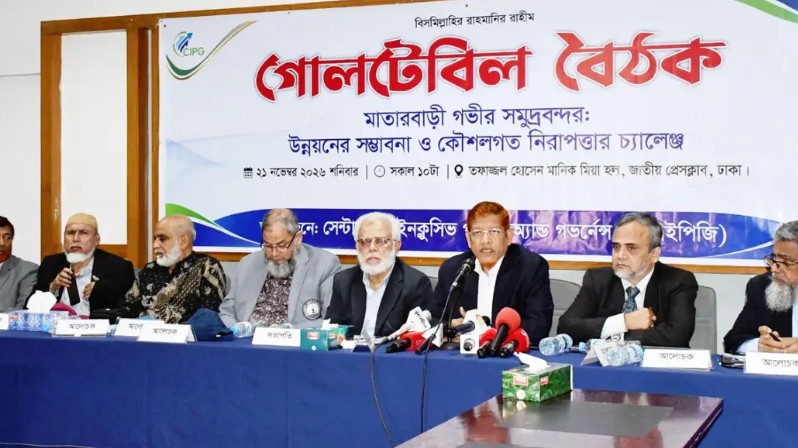
Bangladesh must retain full control over the operation, security and strategic decision-making of the Matarbari deep-sea port to protect its national interests and sovereignty, Bangladesh Jamaat-e-Islami Assistant Secretary General Dr AHM Hamidur Rahman Azad has said.
He warned that no foreign or operating company should be allowed to turn the port into an entity resembling the East India Company.
Azad made the remarks at a roundtable discussion titled ‘Matarbari Deep-Sea Port: Development Potential and Strategic Security Challenges’ at the National Press Club in Dhaka on Saturday.
The discussion was organised by the Centre for Inclusive Policy and Governance (CIPG).
Azad said seaports could be a major economic asset for a country but could also pose significant national security and geopolitical challenges.
He stressed the need to utilise the Bay of Bengal and the Matarbari port for economic development while protecting national security, local communities and their interests.
He also highlighted the difficulties faced by residents affected by the port construction project, saying many displaced people were still visiting different government offices to seek compensation.
Their rights and interests must be protected during the implementation of development projects, he added.
Commodore (retd) Syed Misbah Uddin Ahmed, former Bangladesh Navy officer, maritime researcher and director general of the Bangladesh Institute of Maritime Research and Development (BIMRAD), said Bangladesh must retain control over the movement of foreign cargo vessels through its territory.
He stressed that building a deep-sea port alone would not guarantee economic benefits without improved domestic transport infrastructure and seamless connectivity.
Former senior secretary of the government Shafiullah said Bangladesh's policies should not be directed against any particular country. Instead, economic development and strategic security should remain the central priorities.
Presenting a paper at the discussion, Dr Mizanur Rahman said the Matarbari deep-sea port could accelerate the country's import-export trade, reduce transportation costs and time, and establish Bangladesh as an important regional transshipment hub.
He said the port channel is planned to have a depth of 18.5 metres, with the aim of accommodating large vessels with a draft of around 16 metres.
However, he cautioned that the expected benefits of the investment would be difficult to achieve without sufficient cargo volumes, modern management, effective transport connectivity and port-based industrialisation.
Participants at the discussion made several recommendations, including ensuring Bangladesh's full authority over the port's operation, security and strategic decisions, avoiding foreign dominance and excessive dependence on any single country, and conducting a comparative cost-benefit assessment of the Sonadia and Matarbari projects.
They also called for transparency in loans and project expenditure.
Other recommendations included protecting Bangladesh's economic interests through fair port charges and mutually beneficial transit agreements with neighbouring countries, including India, Nepal and Bhutan.
The speakers also stressed the importance of international-standard technology, skilled management, coordination with Chattogram Port, industrialisation, employment generation and protection of coastal ecosystems and local livelihoods.
The discussion was chaired by CIPG Chairman Professor Dr Mozammel Haque and moderated by its Executive Director Dr Khurshid Alam.
The speakers said the success of the Matarbari deep-sea port should not be measured solely by infrastructure development or the volume of foreign investment.
Instead, its long-term success would depend on how effectively it contributes to economic growth, trade capacity, local employment, national security and Bangladesh's sovereign interests.
They reiterated that Bangladesh seeks friendly and mutually beneficial relations with all countries but must not compromise its national economic interests or sovereign decision-making rights to serve the strategic interests of any foreign power.
sks

Loading...
Loading...
Also read









Editor : Iqbal Sobhan Chowdhury
Published by the Editor on behalf of the Observer Ltd. from Globe Printers, 24/A, New Eskaton Road, Ramna, Dhaka.
Editorial, News and Commercial Offices : Aziz Bhaban (2nd floor), 93, Motijheel C/A, Dhaka-1000.
Phone: PABX- 41053001-06; Advertisement: 41053012; 01793317829, 01550707291, 01550707296
E-mail: [email protected], [email protected]. [email protected], [email protected], [email protected], [email protected], Online-email: [email protected]


