



| HEADLINE |

|

In tablet age, little hands still write on palm leaves
Published : Sunday, 22 November, 2026 at 12:00 AM
Abul Ahsan Titu


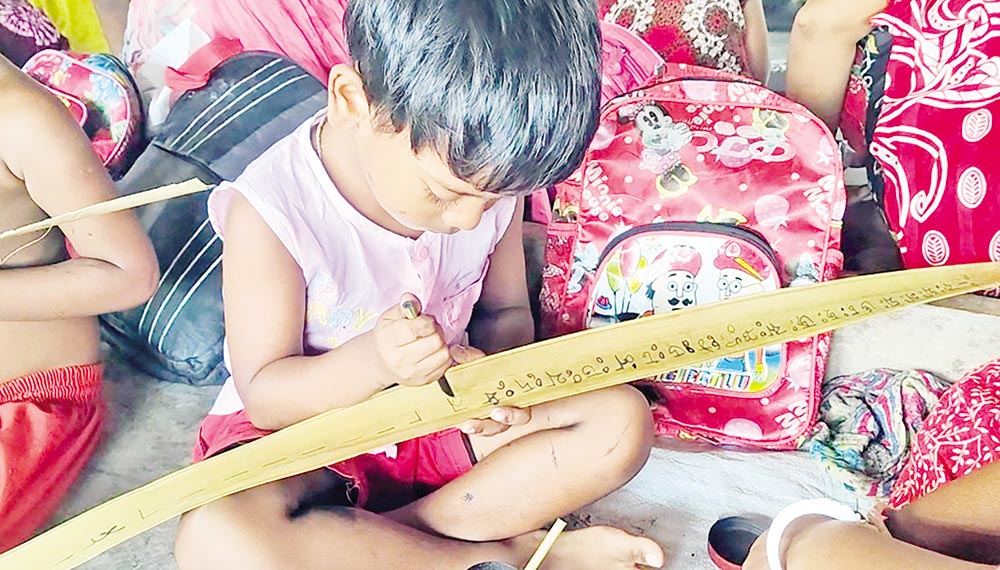 BAGERHAT, Nov 21: At a time when modern education has transformed the way children learn, a small school in a remote village of Bagerhat is holding on to a tradition that once shaped generations. At Shishu Shiksha Niketan in Dumuria Southpara of Chitalmari upazila, the familiar sight of children writing with pens made from bamboo sticks, dipping them into small pots of ink and practising their letters on palm leaves is still part of everyday life.
Established in 2005, the school now teaches around 50 children from five nearby villages. Under the guidance of its 75-year-old teacher, Pandit Kalipada Bacchar, they learn the basics of reading and writing through this traditional method. Their lessons include vowels, consonants, spelling, joined letters and multiplication tables. Alongside these, the teacher also gives them lessons in moral values.
Here, modern school supplies give way to materials drawn from nature. The children hold bamboo pens and dip their tips into ink made from charcoal before carefully tracing letters on palm leaves. As they concentrate on their writing, ink often stains their little hands and faces. They also sit together to read from traditional primers, their voices rising and falling in unison. The scene brings back memories of childhood for older people who grew up with similar ways of learning.
The school has also become a point of curiosity for parents from different areas, many of whom visit to see how children are introduced to education through a method that is rarely found in today's classrooms.
For many parents, the appeal goes beyond the novelty of the practice. They believe writing on palm leaves helps children develop neat handwriting while giving them an early connection with their roots and cultural heritage. Some send their children to the school alongside their regular modern education, hoping they will become familiar with traditional ways of life as well.
Soleman Sheikh, a resident of Southpara village, said the sound of children learning and the sight of them writing on palm leaves took him back to his own childhood.
"Watching the children write on palm leaves and hearing their voices takes me back to my early days. This traditional way of learning helps children become familiar with our old culture," he said.
But preserving a tradition has not been easy. The school faces a number of longstanding problems that affect its daily activities. The land in front of the institution remains waterlogged, making it difficult for children to reach the school during the rainy season. It also lacks proper sanitation facilities. Despite the passage of years, neither problem has received a permanent solution.
For teacher Pandit Kalipada Bacchar, however, the effort to keep the practice alive remains central to the school's purpose. He believes that children should have the opportunity to experience the traditional method of learning, even as education continues to change around them.
"We teach children to write on palm leaves to keep our old traditions alive. Writing on palm leaves helps improve handwriting. This is where children get their first formal lessons in reading and writing," he said.
Local people fear that such traditional practices are gradually disappearing as modern education spreads and older ways of learning lose their place in everyday life. To them, Shishu Shiksha Niketan is more than a small village school. It is a living reminder of the country's rural educational heritage and a link between generations.
They believe the institution needs proper care and support to continue its work. Without that, a tradition preserved for more than two decades may struggle to survive. For now, however, in this quiet corner of Chitalmari, children continue to trace letters on palm leaves, keeping alive a small but meaningful piece of the past.
Chitalmari Upazila Nirbahi Officer (UNO) Khadija Akter said the school was keeping an old system of education alive through the use of palm leaves.
"This school still follows the traditional method of teaching children on palm leaves. It helps preserve our rich history and heritage. We will take necessary steps to address the school's problems, including waterlogging and the lack of proper sanitation, as soon as possible," she said.

Loading...
Loading...



Editor : Iqbal Sobhan Chowdhury
Published by the Editor on behalf of the Observer Ltd. from Globe Printers, 24/A, New Eskaton Road, Ramna, Dhaka.
Editorial, News and Commercial Offices : Aziz Bhaban (2nd floor), 93, Motijheel C/A, Dhaka-1000.
Phone: PABX- 41053001-06; Advertisement: 41053012; 01793317829, 01550707291, 01550707296
E-mail: [email protected], [email protected]. [email protected], [email protected], [email protected], [email protected], Online-email: [email protected]


