



| HEADLINE |

|

From pavement to global stage: The story of Tiger Nazir
Published : Sunday, 22 November, 2026 at 11:44 AM
Observer Correspondent


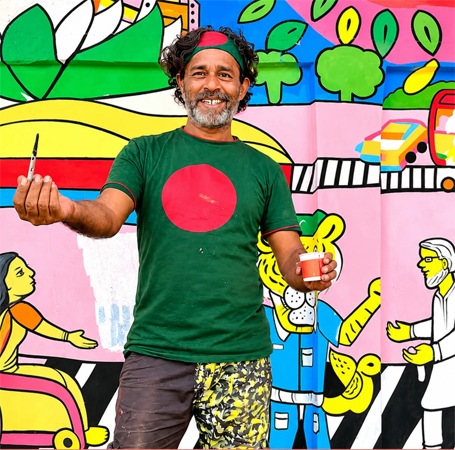
Collected Photo
Nazir Hossain, widely known in the art world as "Patua Tiger Nazir," has risen from painting on the pavements of Shahbagh in Dhaka to international recognition, bringing rural Bengal's folk traditions and everyday life to wider audiences.
Born in 1982 into a modest family in Rustam Nagar Notun Bazar village of Parbatipur upazila in Dinajpur, Nazir began drawing on the ground, walls, and whatever materials he could find around age four or five. Without formal fine arts education, he developed his craft by observing nature, people, and rural surroundings, drawing early inspiration from his mother's nakshi kantha quilts and household motifs.
In a family of eight siblings, pursuing art as a profession faced scepticism and financial hurdles. Driven by his ambition, Nazir moved to Dhaka in 1996 with a small amount of money from his mother. Facing financial strain and uncertain living conditions, he at times returned to his village before coming back to the capital, eventually making the pavement in front of the Central Public Library in Shahbagh his primary workspace and open-air display space for passers-by.
Nazir's signature style centres on multifaceted depictions of tigers portraying human professions and cultural roles—ranging from a farmer in the field or a baul minstrel with an ektara to someone steering a boat, rickshaw, train, or aircraft. He has reportedly painted more than 30,000 tigers, earning him the lasting moniker "Tiger."
His journey expanded onto the international stage when he took part in Japan's Setouchi Triennale in 2013, where his work drew attention and a tiger mascot he created was selected as a Japan-Bangladesh goodwill ambassador. He has also held solo exhibitions at home, including his 60th solo show titled Bagher Deshe Boishakh.
In 2025, Nazir led the creation of five patachitra scroll paintings with a combined length of about 100 feet for Bangla New Year celebrations—titled Patachitra Akbar, Patachitra Bangladesh, Behulapat, Bonbibi, and Gazeerpat—depicting Bengal's history, folklore, and cultural diversity. His patachitra works frequently feature marginalized and working people, including farmers, fishers, blacksmiths, potters, weavers, bauls, fakirs, boatmen, and rural women.
Alongside his own practice, Nazir teaches drawing to children free of charge to foster early appreciation for folk heritage, while calling for stronger financial security, institutional patronage, and dedicated spaces for folk artists and exhibitions so traditional art forms continue to thrive.
-EM

Loading...
Loading...
Also read









Editor : Iqbal Sobhan Chowdhury
Published by the Editor on behalf of the Observer Ltd. from Globe Printers, 24/A, New Eskaton Road, Ramna, Dhaka.
Editorial, News and Commercial Offices : Aziz Bhaban (2nd floor), 93, Motijheel C/A, Dhaka-1000.
Phone: PABX- 41053001-06; Advertisement: 41053012; 01793317829, 01550707291, 01550707296
E-mail: [email protected], [email protected]. [email protected], [email protected], [email protected], [email protected], Online-email: [email protected]


