



| HEADLINE |

|

Bangladesh's politics trapped in a cycle of violence
Published : Sunday, 22 November, 2026 at 8:13 PM
Special Analysis


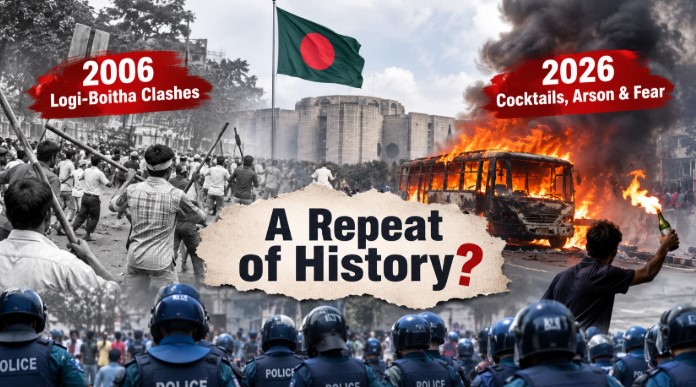
Is political violence once again becoming a permanent feature of Bangladesh's political culture? Recent incidents of cocktail explosions, vehicles set on fire, attacks on police establishments and arson attacks on the homes of political opponents have sparked fresh public concern. Questions have emerged over whether the language of resolving political differences is once again being overshadowed by fire, bombs and muscle power.
The violence of October 28, 2006, involving sticks and oars, known as the Logi-Boitha clashes, remains one of the most horrifying chapters in Bangladesh's political history. Nearly two decades later, incidents of cocktail explosions, arson and clashes in November 2026 have brought those old wounds back into focus. Times have changed and the balance of political power has shifted, but has the tendency towards political violence changed?
2006: Logi-Boitha politics and a bloodied streets
In late October 2006, tensions between the Awami League-led 14-party alliance and the BNP-led alliance reached a peak over the formation of a caretaker government and reforms to the Election Commission, as the tenure of the BNP-led four-party alliance government was nearing its end.
On October 27 and 28, clashes, bomb attacks, vandalism and arson were reported between the two sides in the capital and elsewhere across the country. The scenes of people taking to the streets with sticks and oars and the ensuing violence shocked the nation. The deaths and injuries of numerous people left a deep scar on Bangladesh's political history.
According to Human Rights Watch's World Report 2007, 28 people were killed in political clashes in October 2006, while many others were injured. The violence at the time was not confined to the two political alliances; its impact also put the lives and property of ordinary people at risk.
The violence of that period delivered an important lesson: when political leaders fail to control street clashes, ordinary people ultimately pay the price.
2026: Cocktails, fire and fear return
The current situation is also concerning. Since the beginning of November, incidents of cocktail explosions, buses being set on fire and acts of sabotage have been reported in the capital and various parts of the country.
A report published by The Daily Star on November 8 said at least 15 cocktail explosions had taken place in Dhaka since November 1. Police blamed the banned Awami League and its leaders and activists for the incidents.
Another report by The Daily Star on November 10 highlighted incidents of buses being set on fire, cocktail explosions and road blockades in different parts of the country. A bus was set on fire in Faridpur, killing its sleeping driver. Reports also detailed arrests and the recovery of explosives in connection with various incidents.
According to an analysis published by Prothom Alo on November 20, police reported 78 locations where cocktail explosions had occurred and 74 vehicles set on fire across the country in the 12 days between November 7 and 18.
Law enforcement agencies have accused the Awami League of involvement in these incidents.
Are retaliatory attacks creating another danger?
Another dangerous aspect of the current situation is retaliatory violence.
Two BNP leaders were killed in Narail.
In other words, allegations of cocktail explosions and arson on one hand, and attacks on the homes of political opponents on the other, are making the situation increasingly complex.
If any party leader or activist is involved in a crime, they must face justice. However, no one has the right to attack the family members, innocent relatives or ordinary supporters of a person because of that person's political identity.
Can political violence pave the way for a political comeback?
This brings the most important question about the current political situation to the forefront. Is the Awami League choosing violence to regain its political activities, or is a more complex political equation behind the recent incidents?
An analysis published by Prothom Alo on November 22 discussed the Awami League's recent violent activities and its strategy for making a political comeback. It examined the government's assessment, political reactions and various aspects of the law and order situation.
Meanwhile, an opinion piece published by Prothom Alo on the same day questioned the consequences of choosing political violence as a way to return to politics.
One thing, however, is clear: the right to survive as a political party or resume political activities cannot be established through violence. To regain public trust, a political party must demonstrate accountability, self-criticism, democratic conduct and respect for the law.
Similarly, those in power must refrain from retaliation, repression and partisan vengeance when dealing with opposition political forces.
2006 and 2026: A repeat of history or a new political crisis?
There is a direct organisational link between the violence involving Logi-Boitha in 2006 and the cocktail explosions and arson incidents in 2026: the Awami League. There is also a disturbing similarity between the two periods — the association of political disputes with violence and the resulting insecurity among ordinary people.
In 2006, disputes over the transfer of political power and the election turned the streets into battlegrounds. In 2026, fresh tensions have emerged over political realignment, the activities of banned political organisations, trials, a possible political comeback and the balance of power.
The question remains the same in both periods: who ultimately benefits when violence is used to serve political interests?
History shows that violence may temporarily put pressure on political opponents, but in the long run, it weakens state institutions, the economy, social harmony and the democratic environment.
How can political violence be brought to an end?
Ending political violence requires more than police operations or political statements. Several effective measures are necessary.
First, criminal evidence, not political identity, must form the basis of justice. Every incident of cocktail explosions, arson, murder and sabotage must be investigated impartially, and those responsible must be brought to justice.
Second, political retaliation must stop. The families or supporters of political leaders and activists must not be held responsible for crimes committed by individuals. Strict action must be taken against attacks on homes, business establishments and private property.
Third, dialogue among political parties is essential. Differences of opinion and political disagreements will remain, but a minimum national consensus must be established on issues concerning state stability and citizens' security.
Fourth, law enforcement agencies must remain completely neutral. They must protect citizens' lives and property without political directives or influence. At the same time, the use of extrajudicial force in the name of maintaining law and order must also be stopped.
Fifth, the culture of political violence must be abandoned. Political activists must be trained, provocative statements avoided, misinformation on social media countered and responsible conduct ensured among political leaders.
Final words: Will Bangladesh return to the politics of fire?
The people of Bangladesh have repeatedly paid the price of political clashes — sometimes through blows from sticks and oars, sometimes in the flames of petrol bombs, sometimes through gunfire and sometimes through political vengeance.
When a bus is set on fire, it is not just a vehicle that burns; a driver's livelihood, a family's dreams and a worker's assurance of returning home safely are also destroyed. When a house is set ablaze, it is not only a political opponent who suffers; innocent people living there are also affected.
From the bloody October of 2006 to the fire-ravaged November of 2026, a fundamental question stands before Bangladesh's politics: is politics about power, or is it about people?
The Awami League is not above the law. Whoever is responsible for violence must face justice. But it must also be ensured that the state does not become an instrument of political vengeance.
The people of Bangladesh no longer want to see the politics of Logi-Boitha, cocktails, petrol bombs or arson. They want safe roads, secure homes, employment, democratic rights and the rule of law.
May politics prevail, not violence. The security of the people, not the struggle for power, must be the foremost priority of the state and politics.

Loading...
Loading...
Also read



Editor : Iqbal Sobhan Chowdhury
Published by the Editor on behalf of the Observer Ltd. from Globe Printers, 24/A, New Eskaton Road, Ramna, Dhaka.
Editorial, News and Commercial Offices : Aziz Bhaban (2nd floor), 93, Motijheel C/A, Dhaka-1000.
Phone: PABX- 41053001-06; Advertisement: 41053012; 01793317829, 01550707291, 01550707296
E-mail: [email protected], [email protected]. [email protected], [email protected], [email protected], [email protected], Online-email: [email protected]


