



| HEADLINE |

|

Human traffickers rear heads in Cox's Bazar
Published : Monday, 23 November, 2026 at 12:00 AM
AH Selim Ullah from Cox's Bazar


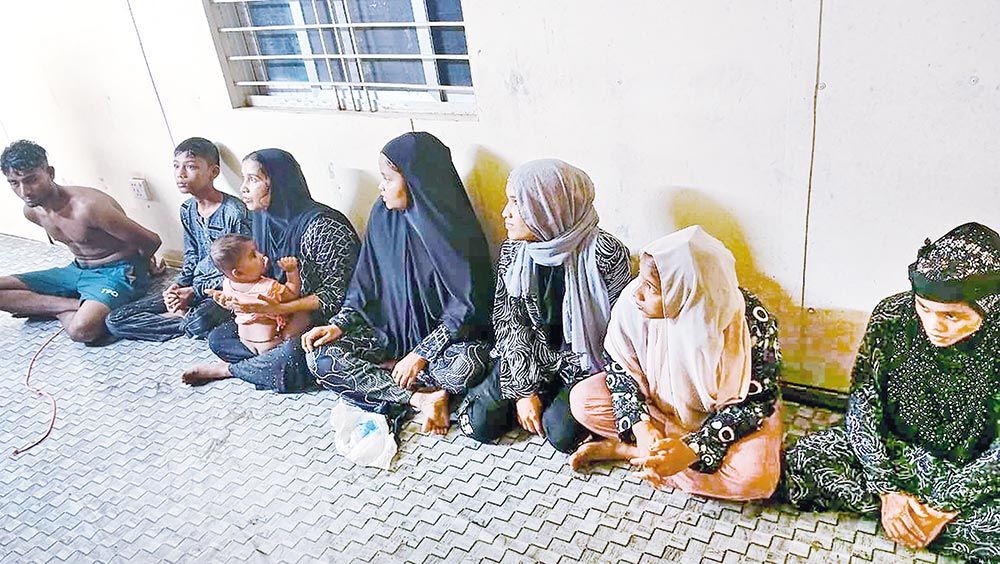 As the monsoon retreats and the Bay of Bengal becomes calmer, human trafficking syndicates become increasingly active along the Ukhiya-Teknaf border in Cox's Bazar. Luring people with promises of a better life in Malaysia, traffickers collect victims from different parts of the country and confine them in remote hill hideouts, where they are held at gunpoint, tortured and forced to pay huge ransoms.
There are allegations that members of armed groups from Myanmar also occupy some of these hideouts with heavy weapons, providing support to trafficking networks operating in the border areas.
The threat was exposed again on November 19 when a joint force operation at a trafficking hideout in the Rangikhali hills of Teknaf turned into a gunfight, leaving Army soldier Md Titas Sheikh dead. The operation rescued 56 people, including six Rohingyas.
The rescued victims said they had been lured with promises of being sent to Malaysia, abducted and confined in the hills, where armed traffickers tortured them and demanded lakhs of taka from their families as ransom. Some claimed that more than 40 heavy weapons were kept at the hideouts. Sources familiar with the situation said a significant portion of the trafficking network consisted of Myanmar nationals.
Titas Sheikh's death is the latest in a series of fatalities among security personnel tackling organised crime in the border region. On November 14, 2022, DGFI officer Squadron Leader Rizwan Rushdi, a Bangladesh Air Force officer, was killed during a joint anti-narcotics operation by RAB and DGFI at Tumbru border in Bandarban. On September 24, 2024, Army Lieutenant Md Tanzim Sarwar was stabbed to death by robbers during an operation in Chakaria, Cox's Bazar.
Despite repeated operations and sacrifices, criminal networks continue to operate across the hills and coastal areas.
Desperation fuels trafficking: Refugee Relief and Repatriation Commissioner Mohammad Mizanur Rahman said prolonged frustration and uncertainty among Rohingyas were major factors contributing to trafficking.
Nearly nine years after their arrival in Bangladesh, they have yet to return to Myanmar. Their uncertain lives in the camps push some to seek better opportunities abroad through dangerous sea journeys, he said.
Traffickers exploit their vulnerability through false promises and deception, he added.
Migration expert Asif Munier said the Bay of Bengal and the Andaman Sea generally become calmer in winter, making maritime journeys easier and encouraging trafficking networks to become more active.
He described human trafficking as an organised transnational crime involving criminal groups from several countries, often supported by armed individuals controlling border routes.
He stressed intelligence-based operations, coordination among law enforcement agencies and cooperation with neighbouring countries. However, raids alone would not end trafficking without effective investigations, prosecutions and convictions.
Lawyer Md Touhidul Ehesan said Teknaf's security problems could not be treated as an isolated local issue. Human trafficking, drug smuggling, illegal infiltration and the presence of a large Rohingya population had created serious challenges.
For the past 10 to 15 years, local residents have been living in fear of kidnapping, ransom demands and trafficking, he said, welcoming the recent joint operations.
Cox's Bazar Superintendent of Police ANM Sajedur Rahman said a special police camp had been established in Teknaf to strengthen efforts against human trafficking, drug smuggling and other crimes, particularly during winter when trafficking activities increase.
Deadly maritime journeys: According to the UN refugee agency UNHCR, 2025 was the deadliest year for Rohingyas travelling by sea in South and Southeast Asia. Of 6,501 Rohingyas who attempted to reach Malaysia by sea, 892 died or went missing.
On April 8 this year, a boat carrying around 280 people capsized in the Andaman Sea, with allegations that at least 33 passengers were killed. Two more boat accidents near Myanmar's coast in late June and on July 8 were feared to have claimed more than 500 lives.
Experts say uncertain repatriation prospects, livelihood shortages, favourable winter weather and transnational criminal networks are increasing the risks.

Loading...
Loading...
Also read


Editor : Iqbal Sobhan Chowdhury
Published by the Editor on behalf of the Observer Ltd. from Globe Printers, 24/A, New Eskaton Road, Ramna, Dhaka.
Editorial, News and Commercial Offices : Aziz Bhaban (2nd floor), 93, Motijheel C/A, Dhaka-1000.
Phone: PABX- 41053001-06; Advertisement: 41053012; 01793317829, 01550707291, 01550707296
E-mail: [email protected], [email protected]. [email protected], [email protected], [email protected], [email protected], Online-email: [email protected]


