



| HEADLINE |

|

Impact Of Cyclone Akvan
Farmers face mounting losses as harvesting comes to a halt
Rain submerges crop fields in three districts
Published : Monday, 23 November, 2026 at 12:00 AM
Our Correspondents


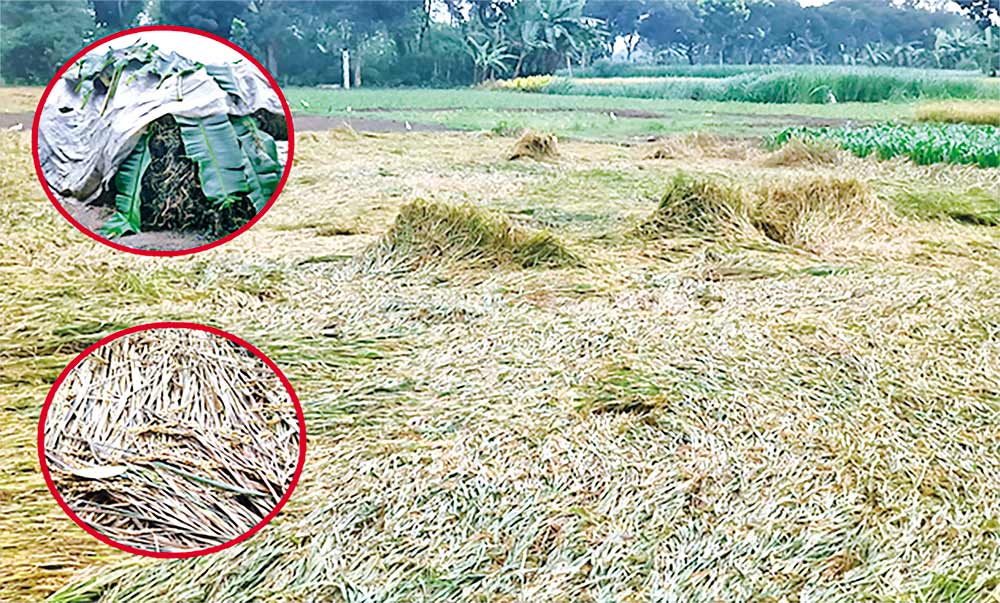 Continuous rain triggered by the Cyclone Akvan has submerged standing paddies in Jhenaidah, Joypurhat and Meherpur districts in the last few days, inflicting losses to the farmers who were hoping to harvest the produce in the meantime.
JHENAIDAH: Nearly 69,000 hectares of un-harvested paddy here have been affected by two days of continuous rain by Cyclone Akvan, leaving thousands of farmers worried about their crops.
Rainwater has submerged rice panicles in low-lying fields, forcing some farmers to cut them off to minimise losses. Light winds have also flattened standing paddy in several areas. Harvested crops left in the fields are also at risk of rotting, while water-logging has disrupted harvesting.
Farmers said they had invested months of hard work and borrowed money to cultivate paddy, hoping to repay their loans and support their families after selling the harvest. The sudden rain has disrupted those plans, increasing their harvesting and transportation costs.
According to the Department of Agricultural Extension (DAE), paddy was cultivated on 104,506 hectares in the district this season. Of the total, 68,974 hectares are yet to be harvested, while harvesting and threshing have been completed on around 30 percent of the cultivated land.
A field visit found extensive damage to ripe paddy in Sadar, Kotchandpur, Maheshpur, Kaliganj, Shailkupa and Harinakundu upazilas. Water has accumulated in many fields, and harvesting in some areas may be delayed by at least two weeks.
The delay could also affect the sowing of mustard, chickpeas, lentils and wheat. Winter vegetable growers are also concerned that prolonged waterlogging could cause their crops to rot. Mustard and wheat fields have also suffered damage.
Saidul Islam, a farmer from Ramnagar Village, said continuous rain over the past two days had submerged his paddy fields.
"Water is knee-deep in low-lying fields, and harvested paddy is under water. Paddy harvested from waterlogged fields fetches lower prices in the market. We have suffered huge losses," he said.
Hashem Ali, another farmer, said he had borrowed money to cultivate paddy and spent heavily on seeds, fertiliser, pesticides, irrigation and labour.
"Now, when it is time to bring the crops home, the rain has disrupted everything. Even if we find labourers, harvesting is impossible because of the water. We cannot protect the harvested paddy either," he said.
Nazrul Islam of Bhabanipur Village said harvesting and threshing costs for submerged paddy had doubled, adding to farmers' financial burden.
The rain has also raised concerns over livestock feed. Farmer Masud said wet paddy and straw could rot, making it difficult to prepare good-quality straw, locally known as bichhali, for cattle. This could deprive farmers of additional income and create a shortage of livestock feed.
Mohammad Anisuzzaman, additional deputy director of the DAE, advised farmers to drain water from fields where paddy had ripened and harvest crops as soon as weather conditions improve. He also urged them to move harvested paddy to elevated, dry places.
Mohammad Kamruzzaman, Deputy Director of the DAE in Jhenaidah, said officials had been instructed to collect information on crop damage.
"It is too early to determine the actual extent of the losses. Our field-level officials are working to assess the damage," he said.
JOYPURHAT: Farmers here are facing losses as continuous rainfall over the past two days has submerged ripe paddy and early-season potato fields, particularly in low-lying areas.
The water-logging has disrupted paddy harvesting and threshing, while newly planted potato seeds are at risk of rotting before they can sprout. Farmers fear further damage if the rain continues for another day or two.
According to the DAE, Aman paddy has been cultivated on 70,090 hectares in the district this season. Many farmers had already suffered crop losses due to untimely rainfall earlier in the season.
Joypurhat is now in the middle of the paddy harvesting season.
Manju Alam, deputy director of the DAE in Joypurhat, said nearly half of the paddy had been harvested and threshed.
Farmers have planted early-variety potatoes on fields where paddy harvesting has been completed. However, rainfall has caused soil to accumulate over the planted potato seeds, raising fears that the plants may fail to emerge and rot.
The district has set a potato cultivation target of 39,300 hectares this season, including 3,430 hectares for early-variety potatoes, he said.
Intermittent rainfall over the past two days has left farmers worried about both their ripe paddy and newly planted potato crops. Water has accumulated in many fields, particularly low-lying ones, hampering harvesting and threshing.
Farmers are also concerned about a possible shortage of straw for livestock feed as harvesting remains disrupted.
Meanwhile, the rain has affected daily life across the district. Rain began on Friday after Jumma prayers, and people have been avoiding going outdoors unless necessary due to the adverse weather.
The rainfall has also intensified the cold, forcing day labourers and other outdoor workers to wear warm clothes while going out to earn their livelihoods. Fewer people were seen on the streets than on a normal day.
MEHERPUR: Farmers in the district are facing potential losses after three consecutive days of heavy rain inundated croplands, disrupted harvesting and damaged standing paddy and pulse crops.
With fertiliser, seed and pesticide costs rising, farmers had hoped to repay loans and earn profits from this season’s harvest. Instead, harvested paddy has been submerged in rainwater, while strong winds have flattened ripe crops in the fields.
Water-logging has halted harvesting in many areas. Some harvested paddy has become soaked, with seedlings beginning to sprout from the grains, raising concerns about spoilage and declining quality. Continued rainfall has also delayed farmers from bringing their crops home.
Farmers said many had been preparing to harvest ripe paddy, while others had already cut their crops and left them in the fields to dry. The rain has made it difficult to dry and transport the harvested grain.
Ajmal Hossain, a farmer from Jhoraghat Village in Gangni Upazila, said he had harvested paddy from one-bigha land and left it in the field. “The crop was very good this year, and I expected to get 18 maunds of paddy per bigha. But after three days of rain, the yield may fall by half. I may not even get 10 maunds now,” he said.
Saloar Hossain, a farmer from Patkelpota Village in Meherpur Sadar Upazila, said his production costs, including irrigation, fertiliser, pesticides and seedlings, and threshing, totalled about Tk 14,000 per bigha. He expected a yield of 15 to 17 maunds but now fears it could fall to 10 maunds, resulting in a financial loss.
Another farmer, Abdul Khalek, said strong winds had flattened paddy on his 40 decimals of land, although harvesting was still about a week away. He fears the damage could cut his yield by half.
Pulse farmers are also worried. Ekram, who harvested his crop two days before the rain, said he had piled it up to protect it from the downpour but feared it would rot and lose much of its yield.
Amjad Hossain, another pulse farmer, said production had already declined. While farmers typically expect about five maunds per bigha, he said this year’s yield was between 2.5 and 3 maunds and could fall further because of the rain.

Loading...
Loading...
Also read



Editor : Iqbal Sobhan Chowdhury
Published by the Editor on behalf of the Observer Ltd. from Globe Printers, 24/A, New Eskaton Road, Ramna, Dhaka.
Editorial, News and Commercial Offices : Aziz Bhaban (2nd floor), 93, Motijheel C/A, Dhaka-1000.
Phone: PABX- 41053001-06; Advertisement: 41053012; 01793317829, 01550707291, 01550707296
E-mail: [email protected], [email protected]. [email protected], [email protected], [email protected], [email protected], Online-email: [email protected]


