



| HEADLINE |

|

Hasina to face arrest if she returns from India: Shama Obaed
Published : Monday, 23 November, 2026 at 5:43 PM
Observer Online Report


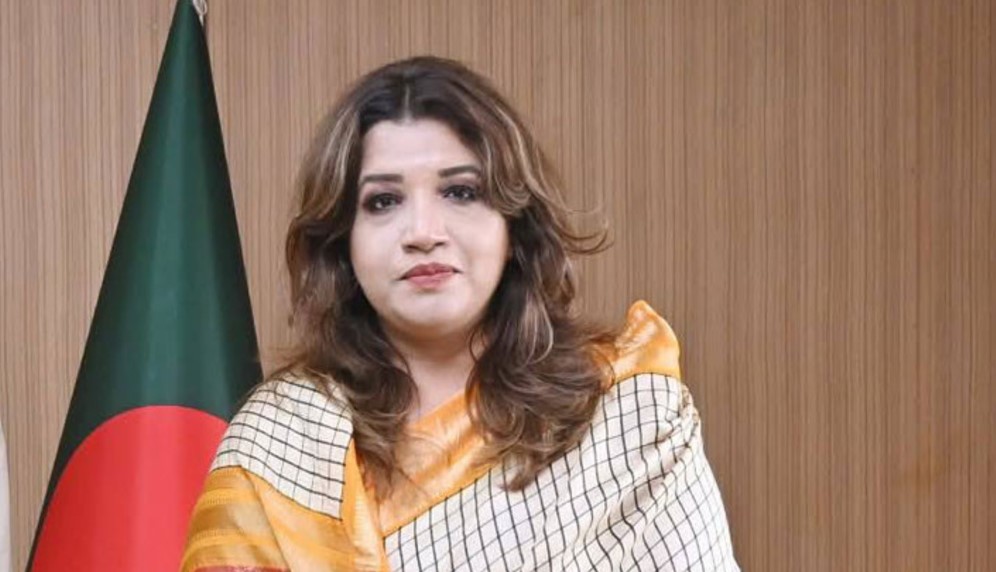
Former prime minister Sheikh Hasina will be arrested and sent to prison immediately if she returns to Bangladesh from India, State Minister for Foreign Affairs Shama Obaed Islam has said, amid rising political tensions and street violence over reports of Hasina's planned return in December.
In an interview with Reuters, Shama Obaed said Dhaka was pursuing Hasina's extradition from India and expected New Delhi to hand her over in accordance with the existing extradition treaty.
Speaking in the interview on Sunday, she said Hasina would be arrested as soon as she attempted to enter Bangladesh. She would be taken to prison and the law would take its course, she added.
"We want India to respect the extradition treaty and hand over a convicted person to Bangladesh. She has to face the law," Shama Obaed said.
Sheikh Hasina fled Bangladesh in August 2024 after being ousted from power during the mass uprising in July and has since been staying in India. She has been sentenced to death in Bangladesh, while activities of her Awami League party have also been banned following the political upheaval.
The United Nations has reported that up to 1,400 people were killed during the unrest.
Before her reported plan to return in December, Hasina applied for a new passport and national identity card, but the interim government rejected her applications.
India's Ministry of External Affairs did not immediately comment on Bangladesh's request for her extradition. In April, the ministry said it was reviewing the extradition request.
Violence surrounding Awami League programmes
Awami League supporters have been holding street programmes demanding Hasina's return. Earlier this month, the party announced a weeklong series of protests and rallies.
Citing local media reports, Reuters said police had documented dozens of cocktail bomb explosions and vehicle arson incidents in at least 28 districts over the past 10 days. Several police personnel and civilians were injured in the incidents.
Shama Obaed described the violence as an attempt by what she called Hasina's "politically bankrupt" party to survive.
However, senior Awami League leader Khalid Mahmud Chowdhury blamed the current political leadership for the violence.
The state minister also said Bangladesh had not held any formal discussions with India about sending an aircraft to bring Hasina back.
She said Dhaka wanted balanced relations with New Delhi while protecting Bangladesh's dignity, self-respect and national interests.
Bangladesh seeks stronger pressure on Myanmar over Rohingya repatriation
Shama Obaed also said Bangladesh wanted to intensify diplomatic pressure on Myanmar over the repatriation of Rohingya refugees.
The International Court of Justice (ICJ), the United Nations' highest court, has been hearing the case concerning allegations of genocide against the Rohingya, including mass killings and sexual violence by Myanmar's security forces in 2017.
Myanmar has criticised the court's proceedings, saying Rohingya refugees would be able to return only when conditions became favourable.
Shama Obaed said the court's ruling had strengthened the Rohingya community and Bangladesh in their struggle, stressing that the refugees had the right to return to their homeland with dignity and security.
Nearly 1.2 million Rohingya refugees are still living in Bangladesh after repeated repatriation initiatives failed.
The ongoing civil war in Myanmar and the Arakan Army's control over most of Rakhine State, the ancestral homeland of most Rohingya, have further complicated the repatriation process.
Calling for increased international pressure on Myanmar and the Arakan Army, Shama Obaed said Bangladesh had not created the crisis.
"Bangladesh did not create this crisis. Myanmar did, so Myanmar must resolve it," she said.
- MaT

Loading...
Loading...
Also read



Editor : Iqbal Sobhan Chowdhury
Published by the Editor on behalf of the Observer Ltd. from Globe Printers, 24/A, New Eskaton Road, Ramna, Dhaka.
Editorial, News and Commercial Offices : Aziz Bhaban (2nd floor), 93, Motijheel C/A, Dhaka-1000.
Phone: PABX- 41053001-06; Advertisement: 41053012; 01793317829, 01550707291, 01550707296
E-mail: [email protected], [email protected]. [email protected], [email protected], [email protected], [email protected], Online-email: [email protected]


