



| HEADLINE |

|

Cyclone Akvan halts fishing, threatens hilsa supply
Published : Tuesday, 24 November, 2026 at 12:00 AM
Our Correspondent


 BARISHAL, Nov 23: More than half of Bangladesh’s hilsa production comes from Barishal Division, with the Bay of Bengal accounting for nearly 68% of the division’s catch.
The region’s dependence on marine fishing has come into focus as rough seas caused by Cyclone Akvan forced fishers to suspend operations for three days.
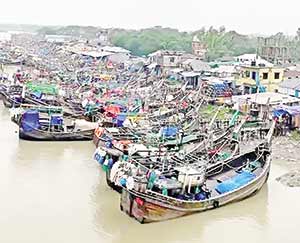
Hundreds of trawlers have taken shelter at coastal landing sites, while some fishers have moved into canals deep inside the Sundarban to escape the rough waters. The disruption has left thousands of fishing families uncertain about their earnings and raised concerns about hilsa supplies.
Bangladesh produced 518,483 metric tons of hilsa in the 2025-26 fiscal year, according to the Barishal Divisional Fisheries office. The division’s six districts accounted for 266,597 metric tons, or 51.42% of national production.
Of Barishal’s total catch, 182,360 metric tons came from the Bay of Bengal, accounting for 68.4%. Rivers contributed the remaining 31.6%.
More than 500 trawlers had reached safety by Thursday afternoon, fishers said. They took shelter at landing sites in Barguna and Patuakhali districts, including Patharghata, Taltali, Mohipur and Alipur. Others sought refuge in canals in the Sundarban.
At least 10 trawlers were anchored at the Bangladesh Fisheries Development Corporation’s fish landing centre in Patharghata on Saturday morning.
Chan Mia, skipper of the trawler FB Tarikul-4, and fisherman Abdul Khaleque said they returned to shore on Thursday morning after the sea became too rough to continue fishing. Many vessels were still at sea when they arrived, they said.
Abul Hossain Faraji, Vice-President of the Barguna District Fishing Trawler Owners’ Association, said weather warnings often reached fishers in deep waters too late. Crews frequently had to judge the danger based on changing wind and sea conditions.
Barishal Division has 423,861 registered fishers, including 161,957 marine fishers, according to Kamrul Islam, Acting Divisional Fisheries Officer.
The disruption also affects trawler owners, traders and transport workers. Owners must continue paying for fuel, food, ice and workers’ wages even when their vessels remain idle, said Prof Md Badiuzzaman, an economist at Patuakhali Science and Technology University.
At Koralia fish landing site in Patuakhali District’s Rangabali, fisherman Julhas Chowkidar said rough weather had kept him ashore for two days.
“I do not know when the weather will improve,” he said, adding that a prolonged suspension would force him to borrow money to support his family.
Md Mohsin, Deputy Director of the Department of Fisheries’ Barishal Divisional Office, said the division’s significant contribution to national hilsa production made the disruption a concern for the entire country.
He said the sector remained vulnerable to cyclones, depressions and prolonged spells of bad weather.

Loading...
Loading...
Also read



Editor : Iqbal Sobhan Chowdhury
Published by the Editor on behalf of the Observer Ltd. from Globe Printers, 24/A, New Eskaton Road, Ramna, Dhaka.
Editorial, News and Commercial Offices : Aziz Bhaban (2nd floor), 93, Motijheel C/A, Dhaka-1000.
Phone: PABX- 41053001-06; Advertisement: 41053012; 01793317829, 01550707291, 01550707296
E-mail: [email protected], [email protected]. [email protected], [email protected], [email protected], [email protected], Online-email: [email protected]


