



| HEADLINE |

|

Food Minister stresses safe food, quality testing
Published : Wednesday, 25 November, 2026 at 5:10 PM
Press Release


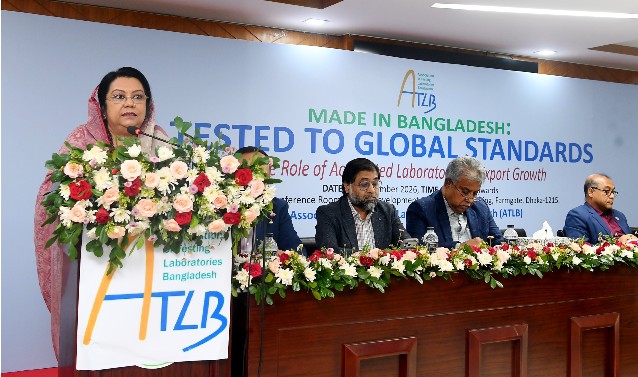
Food Minister Afroza Khanam has stressed the need to establish internationally accredited testing laboratories to boost exports and ensure safe food in the domestic market.
“Without safe food, public health cannot be protected. And without healthy people, business, the economy and state governance cannot remain sustainable,” she said.
She made the remarks while speaking as the chief guest at a seminar titled ‘Made in Bangladesh, Tested to Global Standards: The Role of Accredited Laboratories in Export Growth’, organised by the Association of Testing Laboratories Bangladesh (ATLB) at the Cotton Development Board in Farmgate, Dhaka, on Wednesday.
The minister said food safety was not the sole responsibility of the Ministry of Food. Relevant ministries, including agriculture and commerce, must work together to ensure it.
She said producing quality products for export while supplying substandard goods to the domestic market was unacceptable. She also urged businesses to act responsibly, particularly in ensuring safe food for children.
Afroza said the government was working to reduce delays in business-related services and product testing. A five-year action plan would be formulated in consultation with relevant ministries, institutions and stakeholders.
She also said plans had been taken to establish three laboratories in Dhaka, Khulna and Chattogram with funding from the Japan International Cooperation Agency (JICA). The Dhaka laboratory is planned for Ashulia and the Chattogram facility for Halishahar.
If fully operational within three years, the laboratories would reduce dependence on other institutions and ensure faster food testing, she added.
The minister stressed improving testing capacity for pesticide residues, chemicals, heavy metals, mycotoxins and microorganisms to meet export market requirements.
She also called for better coordination among public and private laboratories, the Bangladesh Food Safety Authority, BSTI and consumer rights organisations to avoid repeated testing and unnecessary costs.
Emphasising accountability, she said manipulating test reports for money or issuing certificates unethically would not be acceptable. She called for effective law enforcement against food adulteration.
Professor Noman Faruk Ahmed presented the keynote paper. FBCCI Administrator Md Fazlul Haque and Bangladesh Food Safety Authority Chairman Md Shafiqul Islam also spoke at the seminar, chaired by Ahsan Habib.
Fazlul Haque said testing costs should not contribute to higher product prices.
Stakeholders, experts, academics, businesspeople and journalists attended the seminar. The minister later visited different stalls.
-AJM

Loading...
Loading...
Also read







Editor : Iqbal Sobhan Chowdhury
Published by the Editor on behalf of the Observer Ltd. from Globe Printers, 24/A, New Eskaton Road, Ramna, Dhaka.
Editorial, News and Commercial Offices : Aziz Bhaban (2nd floor), 93, Motijheel C/A, Dhaka-1000.
Phone: PABX- 41053001-06; Advertisement: 41053012; 01793317829, 01550707291, 01550707296
E-mail: [email protected], [email protected]. [email protected], [email protected], [email protected], [email protected], Online-email: [email protected]


