



| HEADLINE |

|

Dowry Violence in Bangladesh: Gap between Legal Protection and Actual Justice
Published : Thursday, 26 November, 2026 at 12:00 AM
Farshia Jahan Mahim


 The practice of dowry is a social practice in which women are treated like chattel, which dehumanises them. One of the most severe forms of violence against women is dowry-related violence. Dowry-related violence occurs when the groom or the groom’s family pressures the bride or her family to provide additional goods or money, which the bride or her family may refuse to pay. Although the practice of dowry is illegal, it continues because of its social acceptance and economic pressures as well. This social custom has several severe consequences, including domestic abuse of women, psychological trauma and death. Calculating the number of victims is difficult because victims or their family members are afraid to file cases related to dowry violence.
Dowry-related violence has affected women in several ways. Firstly, it leads to physical violence. Studies on dowry-related violence show that women who refuse to pay dowry experience physical violence more often than women who pay dowry. The level of vulnerability increases when the demand for dowry is partially met or refused by the wife or her family. It is patriarchal attitudes that lead to dowry demands, and these demands lead to physical abuse of women. Physical violence against women includes beating and physical torture by their husbands or their husbands’ family members in connection with dowry demands.
Secondly, it leads to psychological trauma. The demand for dowry not only causes physical abuse but also mental abuse of women. Sometimes, the mental abuse is so severe that women who experience it have to suffer from long-term mental health-related issues. Thirdly, it can lead to the death of a woman. Women are sometimes abused mentally to such an extent that they commit suicide. Lastly, the practice of dowry is also linked to poverty and economic pressure. This social stigma restricts a woman from returning to her parents' home after marriage.
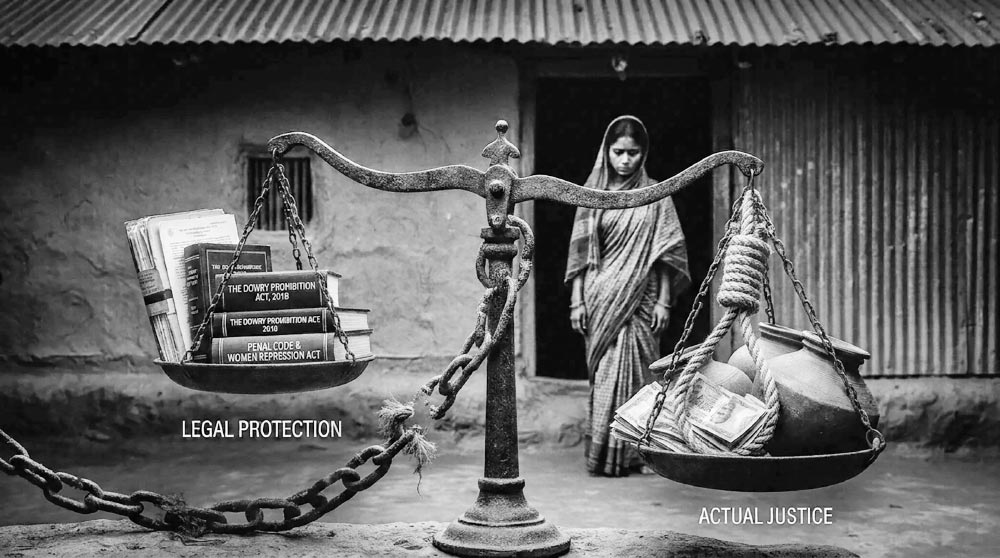 In Bangladesh, the primary law addressing dowry-related violence is the Dowry Prohibition Act, 2018. Offences committed under this Act are compoundable offences. In addition, other relevant laws related to dowry violence include relevant sections of the Penal Code dealing with extortion or cruelty, where applicable, and the Women and Children Repression Prevention Act, 2000.
In the country, it seems that due to social pressure, many cases are not even filed. Not only cultural stigma but also victim-blaming hinders access to justice. Society always pressures women to settle violence-related matters within the family. Enforcement mechanisms for these laws are weak in Bangladesh, especially in rural areas. Legal support is not easily accessible there. In Bangladesh, laws exist to address dowry-related violence, but their implementation remains ineffective. Rather, existing social norms are more influential than these laws.
The patriarchal ideologies of society always seek to subordinate women. The practice of dowry enjoys considerable social acceptance. Even though families know that the practice of dowry is illegal, there is still a tendency among the families of both brides and grooms to give and receive dowry willingly. Society pressures the bride's family to provide dowry. As a result, the actual number of dowry-related violence cases remains unknown.
Dowry-related violence in Bangladesh can be reduced by ensuring the enforcement of existing laws and spreading awareness of available legal services. This age-old custom of dowry is a continuing gender-based practice rooted in patriarchal ideologies created by society. Women are the victims of this practice, which leads to violence against them. It is crucial to eradicate this violence so that women can live with dignity and enjoy proper legal protection.
The writer is a student of law at BRAC University

Loading...
Loading...
Also read



Editor : Iqbal Sobhan Chowdhury
Published by the Editor on behalf of the Observer Ltd. from Globe Printers, 24/A, New Eskaton Road, Ramna, Dhaka.
Editorial, News and Commercial Offices : Aziz Bhaban (2nd floor), 93, Motijheel C/A, Dhaka-1000.
Phone: PABX- 41053001-06; Advertisement: 41053012; 01793317829, 01550707291, 01550707296
E-mail: [email protected], [email protected]. [email protected], [email protected], [email protected], [email protected], Online-email: [email protected]


