



| HEADLINE |

|

Six State-run Banks Drowning in Bad Loans, Failing to Lend
Published : Thursday, 26 November, 2026 at 12:00 AM
Business Correspondent


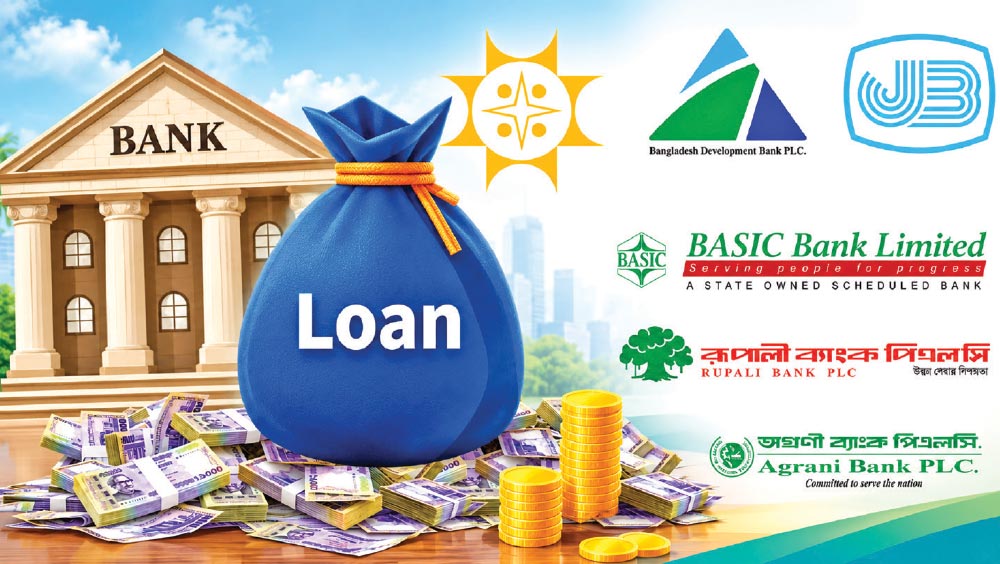 The country's six state-owned banks are piling up deposits but failing to channel the funds into productive lending, exposing deep-seated weaknesses in their financial health as nearly half of their outstanding loans have turned bad and their combined capital shortfall has ballooned to Tk 1.17 lakh crore.
The Finance Ministry has expressed strong dissatisfaction with the banks' poor performance, warning that the widening gap between deposit mobilisation and credit expansion could undermine their profitability and deprive the economy of much-needed financing at a time when business and investment activities are expected to gather momentum.
At a review meeting on Wednesday, the Financial Institutions Division (FID) of the Ministry of Finance urged the six banks to step up low-cost deposit mobilisation, improve loan quality and intensify the recovery of defaulted loans within stipulated deadlines.
The concern is underscored by a striking mismatch in their balance sheets. Deposits across Sonali, Janata, Agrani, Rupali, BASIC and Bangladesh Development Bank Limited (BDBL) surged by 11.6 per cent over the year to June 2026, while their outstanding loans grew by a mere 1.6 per cent.
The six banks attracted an additional Tk 51,784 crore in deposits during the year, but their combined outstanding loans increased by only around Tk 5,500 crore.
More alarming is the scale of distressed assets. Their combined non-performing loans (NPLs) reached Tk 1,52,509 crore by June 30, 2026, accounting for 47.25 per cent of total outstanding loans.
At the same time, their aggregate capital shortfall stood at Tk 1,17,556 crore, highlighting the enormous financial burden confronting the state-owned banking sector.
The ministry made it clear that fresh capital injections alone would not resolve the banks' financial woes. Unless the irregularities and weaknesses in loan sanctioning and disbursement that fuelled the accumulation of bad loans are addressed, additional public money is unlikely to produce sustainable improvements.
The meeting also expressed concern over sluggish private-sector credit growth, which has remained below 5 per cent for seven consecutive months. Credit growth at the state-owned banks fell to 4.17 per cent in September, marking the lowest level in the country's history, according to the meeting.
The meeting observed that credit demand is likely to rise in the coming months as the government and Bangladesh Bank undertake initiatives to stimulate economic activities. A recovery in private-sector lending is also expected to support employment generation and inject fresh momentum into business and trade.
However, the state-owned banks appear poorly positioned to capitalise on the anticipated recovery, with their deteriorating loan portfolios, capital deficiencies and weak recovery performance constraining their lending capacity.
The combined deficit of all six banks stood at Tk 1,17,556 crore, although Sonali Bank and BDBL maintained capital surpluses of Tk 1,127 crore and Tk 418 crore respectively. Among the six state-run banks, Janata Bank accounts for the largest share of the capital deficit, with a shortfall of Tk 66,811 crore and recorded the highest NPL ratio at 69.97 per cent, meaning nearly seven out of every 10 taka it lent had become non-performing.
Around 59.8 per cent of the six banks' total NPLs were concentrated among the top 20 defaulters of each bank. The combined defaulted loans of these 120 major borrowers stood at Tk 91,165 crore. The concentration was particularly severe at Janata Bank, where its top 20 defaulters accounted for 77.47 per cent of the bank's total NPLs.
Recovery efforts have also fallen far short of expectations. The six banks recovered only Tk 2,156.80 crore in cash from defaulted loans during January-June 2026, achieving just 17 per cent of their recovery target. Their recovery from written-off loans amounted to Tk 171.15 crore, equivalent to 29 per cent of the target.
The widening deposit-credit mismatch also carries a direct cost for the banks. While they have to pay interest on deposits, their inability to deploy the funds through sound lending restricts interest income and puts additional pressure on profitability.

Loading...
Loading...
Also read



Editor : Iqbal Sobhan Chowdhury
Published by the Editor on behalf of the Observer Ltd. from Globe Printers, 24/A, New Eskaton Road, Ramna, Dhaka.
Editorial, News and Commercial Offices : Aziz Bhaban (2nd floor), 93, Motijheel C/A, Dhaka-1000.
Phone: PABX- 41053001-06; Advertisement: 41053012; 01793317829, 01550707291, 01550707296
E-mail: [email protected], [email protected]. [email protected], [email protected], [email protected], [email protected], Online-email: [email protected]


