



| HEADLINE |

|

Workers, owners welcome wage deal
Published : Thursday, 26 November, 2026 at 12:00 AM
Mizanur Rahman


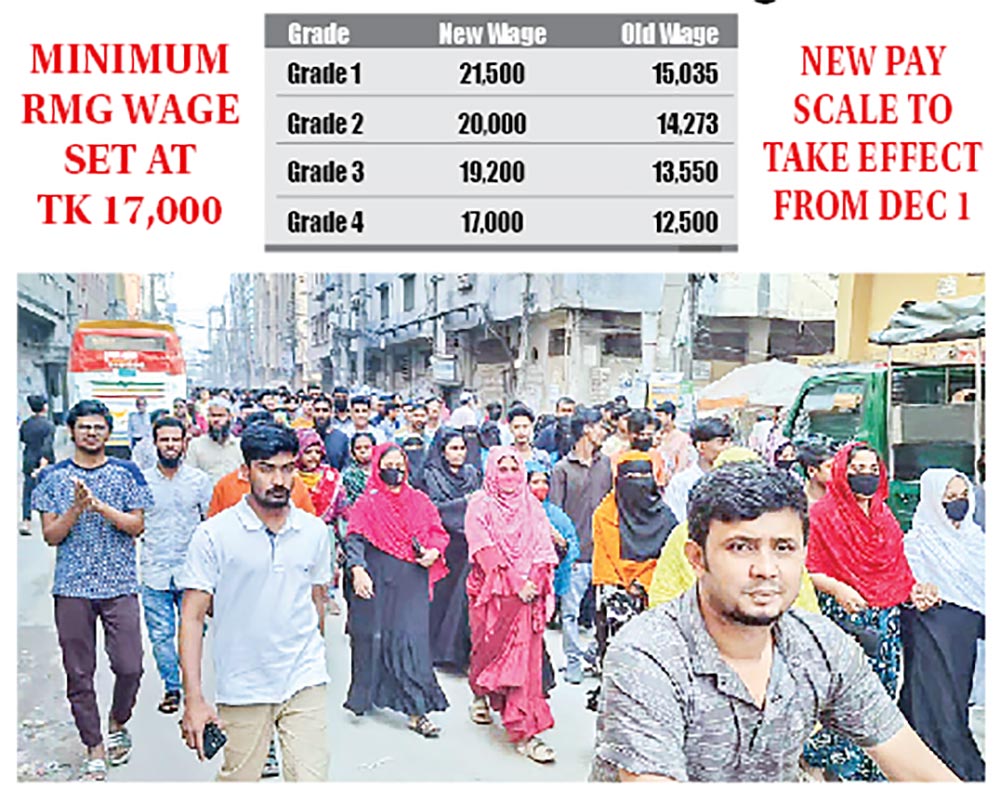 The newly settled minimum wage of Tk 17,000 for garment workers has drawn a broadly positive response from workers and factory owners, with most readymade garment (RMG) factories across the country remaining operational on Wednesday despite sporadic protests and dissatisfaction in some industrial areas.
Although some workers feel their expectations have not been fully met, many have welcomed the 36 per cent increase as a positive step towards improving their livelihoods. Factory owners have also accepted the decision, while expressing concern over the additional production costs, particularly for smaller manufacturers.
The new minimum wage, Tk 4,500 higher than the existing Tk 12,500, was finalised through voting at a six-member Minimum Wage Board meeting. Four members supported Tk 17,000, while the remaining two favoured Tk 18,000.
The revised structure will take effect from December 1, with workers expected to receive salaries under the new rates in January.
Under the new arrangement, monthly wages have been fixed at Tk 21,500 for Grade 1, Tk 20,000 for Grade 2, Tk 19,200 for Grade 3 and Tk 17,000 for Grade 4, the lowest grade.
Wage Board Chairman Syed Azad Subhani presided over the meeting, which followed several rounds of discussions that failed to bridge the gap between labour and employers' representatives. Workers' representatives had demanded Tk 18,000, while employers proposed Tk 17,000.
The decision comes amid prolonged labour unrest in industrial zones, particularly Gazipur and Savar, where workers had demanded higher wages to cope with rising living costs. Their initial demand was Tk 32,000, against the previous minimum wage of Tk 12,500 introduced in 2023.
Meanwhile, factories in major industrial hubs, including Narayanganj, Gazipur, Ashulia and Chattogram, largely maintained normal operations on Wednesday.
In Narayanganj, workers attended factories in the BSCIC Industrial Estate, Kathar Pool, Shibu Market and Adamjee EPZ, with production continuing normally.
Several workers said they were satisfied with around 70 per cent of their demands being addressed, although they had hoped for a higher adjustment. They also expressed concern that increased wages could trigger further rises in house rents and the prices of essential commodities.
Superintendent of Police of Industrial Police-4 Abdullah Al Mahmud said around 600,000 workers were employed in approximately 1,680 garment factories in Narayanganj.
"The overall situation in Narayanganj remains normal. There is no particular security concern at present. The cordial relationship between factory owners and workers has helped maintain a peaceful environment," he said.
He added that police had spoken with workers in different industrial areas and found many satisfied with the revised arrangement.
Six platoons of Border Guard Bangladesh (BGB) and four platoons of Ansar members have been deployed in Narayanganj, alongside district police, industrial police and Special Reserve Force teams.
However, labour leaders said the revised wages remained inadequate compared with the rising cost of living. They stressed the need for fair differences among wage grades and better healthcare, hospital and educational facilities for workers.
Nazma Akter, president of the Sammilito Garments Sramik Federation, said workers had expected a higher adjustment but their immediate priority was to ensure proper implementation of the new structure and fair wage differences among grades.
She urged workers to resume normal production, warning that disruption could affect export orders, international buyer confidence and workers' regular earnings.
Babul Akter, general secretary of the Bangladesh Garment and Industrial Workers Federation and a workers' representative on the wage board, also called for maintaining production, saying further demands should be raised through bilateral discussions between employers and workers.
Taslima Akter, president of the Bangladesh Garment Sramik Sanghati, urged workers to remain calm and pursue their demands through democratic and peaceful means.
Meanwhile, manufacturers acknowledged the need for higher wages but warned of increased operating costs.
Mohammad Hatem, president of the Bangladesh Knitwear Manufacturers and Exporters Association (BKMEA), said the revised structure would put pressure on manufacturers, particularly smaller factories.
"Since the decision has been finalised, we have to accept the new reality and move forward. Increasing productivity will be essential to absorb the additional costs," he said.
He urged the government to ensure uninterrupted gas and electricity supplies, improve infrastructure, resolve banking and revenue-related complications and facilitate access to financing.
Mohiuddin Rubel, former director of the Bangladesh Garment Manufacturers and Exporters Association (BGMEA) and additional managing director of Denim Expert Ltd, said wage increases were a natural consequence of rising living costs and should not be viewed negatively.
However, he cautioned that higher labour costs could intensify competitive pressure in international markets, where buyers increasingly demand quality products at lower prices and shorter lead times.
He stressed the need to improve industrial productivity, ensure reliable energy supplies, upgrade port services, simplify customs procedures and reduce business costs.
The RMG industry, which employs millions and generates the bulk of Bangladesh's merchandise export earnings, now faces the dual challenge of ensuring fair wages and maintaining international competitiveness.
With most factories continuing operations, workers' concerns over living costs and manufacturers' worries about production expenses remain central to the successful implementation of the new wage structure.

Loading...
Loading...
Also read



Editor : Iqbal Sobhan Chowdhury
Published by the Editor on behalf of the Observer Ltd. from Globe Printers, 24/A, New Eskaton Road, Ramna, Dhaka.
Editorial, News and Commercial Offices : Aziz Bhaban (2nd floor), 93, Motijheel C/A, Dhaka-1000.
Phone: PABX- 41053001-06; Advertisement: 41053012; 01793317829, 01550707291, 01550707296
E-mail: [email protected], [email protected]. [email protected], [email protected], [email protected], [email protected], Online-email: [email protected]


