



| HEADLINE |

|

US Army declares lowa explosives blast 'a success'
Published : Thursday, 26 November, 2026 at 10:10 AM
Observer Online Desk


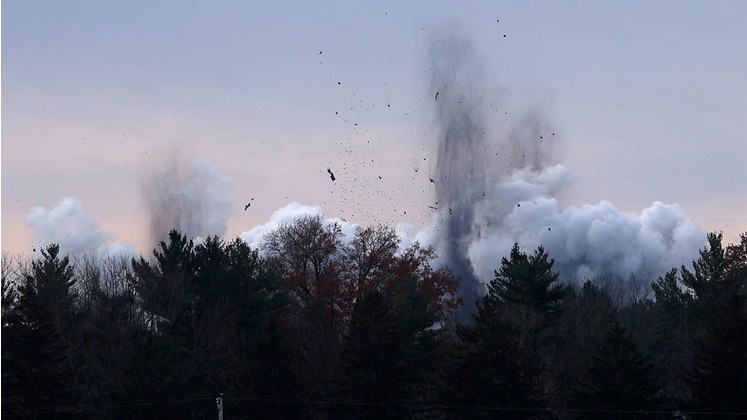
The US Army blew up an ageing stockpile of lead-based explosives in rural Iowa on Wednesday, declaring the "controlled detonation" a success in safely destroying the dangerously unstable material while minimising toxic fallout.
Residents of the Iowa farm town of Middletown closest to the adjacent munitions depot were evacuated ahead of time as a precaution, while others hunkered down inside their homes to avoid exposure to any lead dust emitted from the blast.
The Army and the US Environmental Protection Agency said emission monitors detected zero levels of airborne lead in the surrounding region after the explosion. Still, residents were told to remain indoors until officials gave the all-clear hours later, and some expressed doubts about official reassurances.
The Federal Emergency Management Agency issued a mobile phone bulletin in the late afternoon, more than six hours after the blast at the Iowa Army Ammunition Plant, advising all residents that it was "safe to resume normal activities."
The detonation at 9am CST (1500 GMT) followed days of public rancour and legal wrangling over the controversial disposal plan, which authorities said was far safer than waiting for the deteriorating chemical drums to eventually blow up on their own. That possibility was growing more likely with the recent arrival of cold weather in Iowa, experts had warned.
Within an hour of the blast, acting Army Secretary Adam Telle declared that the "controlled, mitigated detonation," designed to dispose of nearly 5 tonnes (4,500kg) of highly volatile lead azide stored in 68 degrading plastic barrels, had "exceeded all expectations and was a huge success."
"The threat of a spontaneous detonation has been eliminated," he said on X.
Containment Measures Muffled Blast
In a videotaped public service message posted online afterward, Army Colonel Aaron Teller, a munitions specialist who oversaw the operation, said the demolition and the array of containment measures to muffle the blast and emissions had worked.
"All of the lead azide barrels were definitively removed," Teller said, adding there were no secondary explosions or infrastructure damage in or around the installation.
"We reduced as close to zero as is absolutely humanly possible the risk to the health and safety of the people of Middletown and the extended communities throughout Iowa," Teller said.
In a television feed from the site recorded from a considerable distance, an explosion could be heard, and a cloud of grey smoke was seen rising into the dawn-lit sky behind a line of trees before quickly dissipating.
Public safety concerns had focused on expectations that the explosion would send a plume of toxic lead dust over homes, crops and livestock beyond the detonation site about 150 miles (241km) southwest of the state capital Des Moines.
Lead exposure can cause a range of health problems, particularly in children, in whom it can interfere with cognitive development. Once it settles in the environment, it does not break down.
The EPA said one hour after the blast that "real-time air monitors are reporting zero detection of airborne lead throughout the region." The agency said it would continue taking air, soil and water samples throughout the day to compare with more than 1,200 samples collected the day before the blast.
Residents in the area expressed relief mixed with scepticism about the government's candour about emissions from the exploded chemicals.
"If you’re going to blow them up, there are going to be some particles," said Rhonda Woodson, a former employee of the ammunition plant who lives in nearby Burlington, Iowa.
Woodson said she thought the detonation may have been "too hyped up" but also said she did not fully trust information coming from the federal government. Woodson's neighbourhood appeared deserted some three hours after the blast. "Nobody's outside," she said.
What Does 'Zero' Mean?
One independent expert, Jun Wu, an environmental health professor from the University of California at Irvine, said the early airborne readings were encouraging but "cannot alone tell us how much lead settled" on the ground.
"A monitor can be accurate where it sits and still miss a brief spike, or lead passing somewhere else," Wu told Reuters. "It also matters how small an amount of lead the instruments can detect, how often they take measurements, and what a zero actually means. A zero could mean the instrument found too little lead to detect, or that it measured a small amount that was displayed as zero."
An EPA air-sampling map posted online showed readings taken about every five minutes by four monitors spaced out in a straight line along a corridor roughly 25 miles long and running southwest from Middletown.
Wu said she would be more reassured "if the monitors covered the plume well and dust and soil samples taken after the blast show no meaningful increase over baseline."
Army projections released on Tuesday had shown that lead dust could settle on surfaces as far as 40 miles southwest of the blast site, extending through southeastern Iowa into northern Missouri. Airborne particles could travel nearly 100 miles within eight hours, according to projections.
US and Iowa agriculture officials estimated that 350 farms might be affected by lead fallout, based on pre-detonation forecasts.
Lead azide has long been used as the chief detonating material in military ordnance. The explosive was deemed largely obsolete years ago, and the Army brought unused stockpiles from bases around the country to Iowa in 2009.
The crisis in Middletown started after an inspection in March discovered a dangerous crystallisation of the storage drums and material in them, a sign that it had become dangerously unstable, the Army said.

Loading...
Loading...
Also read









Editor : Iqbal Sobhan Chowdhury
Published by the Editor on behalf of the Observer Ltd. from Globe Printers, 24/A, New Eskaton Road, Ramna, Dhaka.
Editorial, News and Commercial Offices : Aziz Bhaban (2nd floor), 93, Motijheel C/A, Dhaka-1000.
Phone: PABX- 41053001-06; Advertisement: 41053012; 01793317829, 01550707291, 01550707296
E-mail: [email protected], [email protected]. [email protected], [email protected], [email protected], [email protected], Online-email: [email protected]


