



| HEADLINE |

|

Cancer changed forever: Just a girl from Berkshire learning to live again
Published : Sunday, 29 November, 2026 at 7:15 PM
Sakia Kawser Siddique


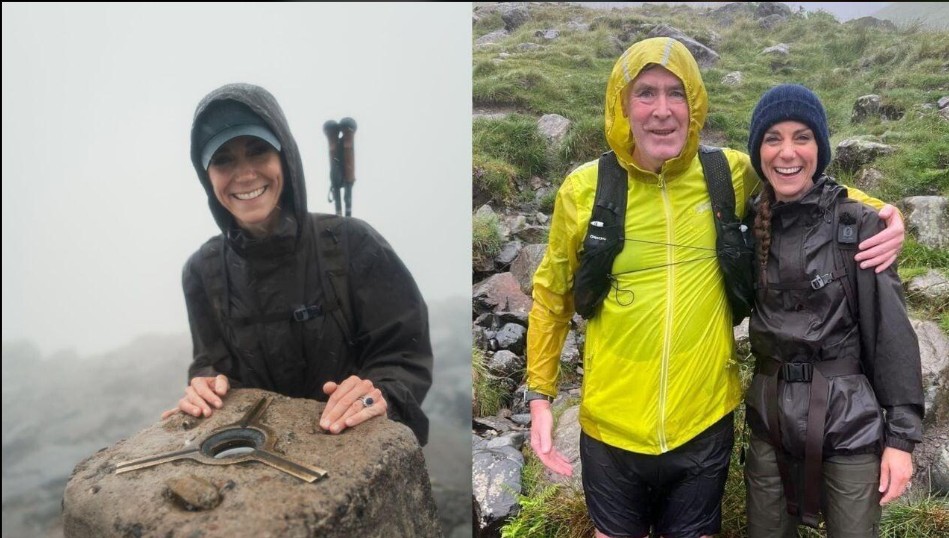
With her father, Michael Middleton
Sometimes, the greatest strength does not come from standing tall, winning a battle or reaching the top of a mountain. Sometimes, it comes from finding a reason to get out of bed, taking one more step when the body feels exhausted and hearing the voices of the people who make life worth living.
For Britain's Princess of Wales, Catherine, that reason came in the voices of her three children. But behind the emotional moment that has moved viewers to tears lies a much deeper story — one of frightening hospital nights, an unfinished goodbye to cancer treatment, a brother who stood beside her, and a woman discovering that surviving an illness is not the same as finding her way back to life.
In her deeply personal 30-minute documentary *Heal*, Kate reveals a side of herself rarely seen beyond royal appearances and carefully composed public photographs. This is not simply a story about a princess climbing mountains. It is about a mother who feared what illness might take away, a patient who experienced the darkness of hospital treatment and a woman trying to understand what healing really means.
The documentary follows her National Three Peaks Challenge, during which she climbs Britain's highest mountains in Scotland, England and Wales within 24 hours. Accompanied by her younger brother, James Middleton, for much of the journey, she undertakes the challenge both to raise funds for The Royal Marsden Cancer Charity and to mark a personal milestone in her recovery.
Yet the most powerful moments happen far away from the royal spotlight.
The hospital nights she had never spoken about
Kate publicly revealed her cancer diagnosis in March 2024, following tests after major abdominal surgery. She subsequently underwent chemotherapy and announced in January 2025 that her cancer was in remission.
But 'Heal' offers a more intimate account of what happened beyond those public announcements.

For the first time, she speaks about the frightening experience of being in and out of consciousness in hospital. She describes the environment as "stark and alien and stripped back", recalling a period when darkness and disorientation made everything feel uncertain.
One of her most poignant recollections is not about medical treatment but about a person who stayed beside her.
She remembers becoming aware of someone holding her hand. That person was not speaking, offering explanations or trying to find a solution. They were simply there.
She does not identify who held her hand. It could have been a family member, a nurse or someone else who stood beside her during those difficult moments.
But the significance of that memory is unmistakable.
Sometimes, people cannot remove another person's pain. They cannot promise that everything will be fine or make the fear disappear. All they can do is remain present.
For someone lying in a hospital bed, that presence can mean more than words.
Kate also recalls imagining the outdoors while she was unable to get outside herself. Nature, which later becomes an important part of her recovery, was something she could only picture from her hospital bed.
It is a striking contrast: a woman who would eventually climb three of Britain's highest mountains once had to find comfort in imagining the world beyond hospital walls.
She never rang the bell. Her brother gave her another way to say goodbye
One of the most revealing exchanges in the documentary takes place between Kate and James.
In many cancer treatment centres, patients ring a bell to mark the completion of treatment. It is a symbolic moment of celebration, relief and recognition of everything they have endured.
But Kate reveals that she did not ring the bell after leaving The Royal Marsden.
Her cancer journey had been intensely private. During treatment, she had attended the hospital discreetly, avoiding the public attention that would later surround her diagnosis and recovery.
When James raises the subject of the bell, Kate confirms that she did not ring it.

He then offers a different interpretation of the mountain challenge.
Perhaps this, he suggests, could be her way of ringing the bell.
The exchange gives the entire expedition a deeper meaning. The climb is not simply an athletic achievement or a charity initiative. It becomes a personal way of marking the end of one difficult chapter and recognising the life she is gradually reclaiming.
There is also something particularly touching about the fact that James is beside her.
The siblings have shared a love of walking and climbing over the years, including family holidays. James has also spoken publicly about his own mental health struggles, making his presence more than just that of a brother accompanying his sister on a demanding journey.
He understands something about difficult personal battles, even if their experiences are different.
At the summit of Scafell Pike, however, he has one surprise that Kate is not prepared for.
Three little voices, one mother's tears
As they reach the summit of Scafell Pike, James tells Kate that he has something to show her.
She immediately senses that the moment may be emotional.
"Oh, no. Don't. You're gonna make me cry. No, please don't," she tells him.
James then plays messages from her three children, Prince George, Princess Charlotte and Prince Louis. The recordings were arranged by Prince William, who had sent them to James to play at the right moment.
Prince Louis, the youngest, tells his mother how much he loves her and reminds her that she is always in his heart.

Prince George offers encouragement, saying the family is thinking of her. In a particularly sweet moment, he jokes that he is tracking her progress on Flightradar and tells her she looks strong.
Princess Charlotte adds that she and her siblings are proud of their mother and will be cheering her on.
Kate struggles to hold back her tears as she listens.
"They gave me the reason to get out of hospital. They're going to give me the reason to finish this challenge," she says.
For a moment, the mountain, the cameras and the physical achievement seem almost irrelevant.
There is simply a mother listening to her children.
Before leaving the summit, Kate places a small pebble among the rocks, saying it is for her children. It is a tiny gesture, but one that gives the moment an extraordinary tenderness. She has reached the summit, yet she wants to leave something there for the people who gave her the strength to keep going.
At the end of the challenge, she is reunited with William, their children and her parents, Carole and Michael Middleton.
The embrace of family becomes the emotional conclusion to a journey that began in the uncertainty of illness.
Healing is not a lonely mountain to climb
The documentary does not limit its message to Kate's own experience.
In another deeply meaningful sequence, she meets patients and cancer survivors from Shine Cancer Support at a gathering in Richmond-upon-Thames.
She admits that she has not really explored her experience of cancer outside the walls of her family.
Meeting people who have travelled through similar experiences gives her an opportunity to share her story while listening to theirs.
She recognises that navigating cancer or another long-term illness can be a lonely road, even when family members are supportive.
Ceinwen Giles, co-founder of Shine Cancer Support and a cancer survivor, speaks about the importance of connecting with people who have received a diagnosis themselves.
She highlights how difficult it can be to tell others that you are frightened of dying.
It is an important part of the documentary because it moves beyond the familiar image of a royal figure overcoming adversity. Kate is not presented as someone whose experience makes her an authority on everybody else's suffering. Instead, she is someone learning from people whose journeys may be very different from her own.
The film also highlights a wider truth about cancer care: treatment does not end with medicine alone. Psychological support, opportunities to talk, companionship and access to complementary forms of care can all matter during recovery.
The proceeds from the documentary's distribution are being directed to The Royal Marsden Cancer Charity, supporting its work for people living with and beyond cancer.
A mountain, a tired body and a different kind of victory
The physical challenge itself is demanding. Kate takes on Ben Nevis in Scotland, Scafell Pike in England and Snowdon in Wales, completing the three climbs within 24 hours.
As she approaches the final summit, exhaustion becomes increasingly apparent.
"Come on, leggies. You're nearly there," she tells herself.
When she finally reaches the top, she looks back at what her body has accomplished and says: "Oh my gosh. Well done, body."
Those simple words may be among the most meaningful in the entire film.
After surgery, chemotherapy and the uncertainty of a cancer diagnosis, the body can become something a patient struggles to recognise or trust. Recovery is not always a straightforward return to physical strength.
For Kate, reaching the summit is a personal milestone — a reminder that her body can still carry her towards something she once might have thought impossible.
But she is also clear that her experience cannot represent every cancer patient's reality. Not everyone has the same support, resources or opportunities. Not everyone will experience recovery in the same way.

Her story does not suggest that surviving cancer means conquering mountains or that determination alone can defeat illness.
Rather, it asks people to recognise the value of standing beside someone during the most difficult periods of their life.
The woman who returned is not quite the woman who left
Perhaps the most profound part of *Heal* is Kate's reflection on how cancer changes a person.
She speaks about confronting her own vulnerability and mortality, accepting that life is not infinite and understanding that she cannot simply return to the person she was before.
The experience, she suggests, has softened her heart and opened her to a different understanding of life.
There is no suggestion that the difficult memories have disappeared. Instead, she is learning to live with what happened and to appreciate what remains.
Her journey is not about returning to royal duties as though nothing happened. It is about discovering what matters beyond public expectations, professional responsibilities and the constant attention that comes with her position.

In her closing reflections, she expresses gratitude to the people she has met and those who have navigated their own challenges with courage.
She hopes her story will remind others that whatever road they face, they are not alone, and that beauty and joy can still exist in the darkest of times.
That is perhaps the most powerful message of the documentary.
Cancer may have changed Kate's body, her priorities and her understanding of life. It may have taken away the certainty that tomorrow would look like yesterday. But it also brought into sharper focus the people and moments that make life meaningful.
A brother who walks beside her. A person who quietly holds her hand. A husband who arranges a surprise. Three children whose voices reach her at the top of a cold, mist-covered mountain.
The world may see a princess completing an extraordinary challenge. But beneath the royal title is a woman who once lay in a hospital bed imagining the outdoors, who did not ring the bell after treatment and who found the strength to take another step because her children were waiting.
And perhaps that is what healing really looks like.
Not forgetting the darkness, not pretending the pain never happened, but finding enough light to keep moving.
Sometimes, the greatest victory is not reaching the top of a mountain.
It is having someone waiting at the bottom, ready to embrace you when you come home.

Loading...
Loading...

Also read





Editor : Iqbal Sobhan Chowdhury
Published by the Editor on behalf of the Observer Ltd. from Globe Printers, 24/A, New Eskaton Road, Ramna, Dhaka.
Editorial, News and Commercial Offices : Aziz Bhaban (2nd floor), 93, Motijheel C/A, Dhaka-1000.
Phone: PABX- 41053001-06; Advertisement: 41053012; 01793317829, 01550707291, 01550707296
E-mail: [email protected], [email protected]. [email protected], [email protected], [email protected], [email protected], Online-email: [email protected]


