



| HEADLINE |

|

Bangladesh, Pakistan Open G2G Trade Channel for Essential Commodities
Published : Monday, 30 November, 2026 at 12:00 AM
Business Correspondent


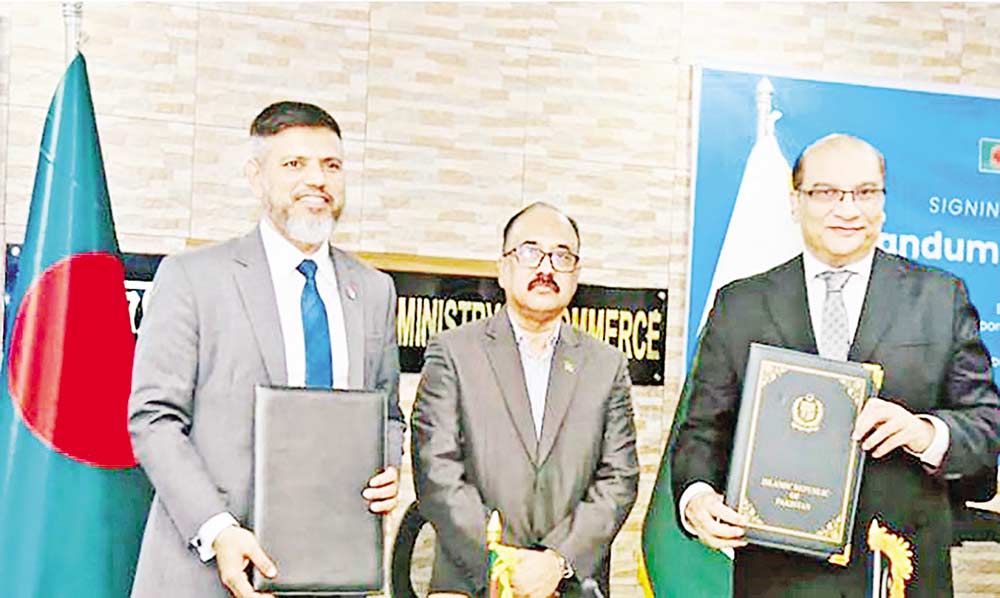 Bangladesh is opening a new government-to-government import channel with Pakistan to diversify supplies of essential commodities, strengthen food security and reduce dependence on traditional sourcing markets amid growing concerns over supply disruptions and price volatility.
The Trading Corporation of Bangladesh (TCB) and the Trading Corporation of Pakistan (TCP) signed a five-year Memorandum of Understanding (MoU) on Sunday, creating a framework for direct trade in rice, wheat, sugar, edible oil, pulses and a wide range of agricultural products and inputs.
The agreement offers Bangladesh an additional sourcing option for essential food items, while providing Pakistan with expanded access to the Bangladeshi market. Its actual benefits, however, will depend on competitive pricing, product quality, supply capacity and timely delivery.
The MoU was signed at the conference room of the Ministry of Commerce at the Secretariat. TCB Chairman Brigadier General Mohammad Faisal Azad signed on behalf of Bangladesh, while Pakistan High Commissioner to Bangladesh Imran Haider signed for Pakistan. Commerce Secretary Sharif Uddin Ahmed Chowdhury and officials from both countries attended the ceremony.
Under the agreement, the two state-owned trading organisations can undertake imports and exports based on mutual demand and consent. The potential trade basket includes different varieties of rice, wheat, refined and raw sugar, soybean, sunflower, canola and palm oil, sesame, potatoes, onions, lentils, chickpeas, tea, pineapples, jackfruit, dates and fertilisers.
The agreement does not, however, constitute an immediate commitment to purchase or supply any specific commodity. Individual transactions will require separate agreements following negotiations over quality, quantity, specifications, prices and delivery schedules.
Commerce Secretary Sharif Uddin Ahmed Chowdhury said the MoU would establish direct and structured commercial relations between the two state-owned trading organisations, opening new opportunities for cooperation in essential commodities and agricultural trade.
Pakistan High Commissioner Imran Haider said his country had surplus stocks of basmati rice, onions, potatoes and spices and was ready to supply them according to Bangladesh's requirements.
He also highlighted expanding bilateral economic cooperation, citing Pakistan's withdrawal of anti-dumping duties on Bangladeshi hydrogen peroxide and the continuation of a duty-free annual quota of 10,000 tonnes for Bangladeshi tea.
TCB Chairman Faisal Azad said the two organisations would work closely to identify suitable products, secure competitive prices and ensure quality and timely deliveries.
For Bangladesh, the agreement comes as import-source diversification has become increasingly important for maintaining adequate domestic supplies and containing pressure on commodity prices. Direct procurement through state-owned trading agencies could provide an alternative to conventional private-sector sourcing, particularly when international supply chains face disruptions.

Loading...
Loading...

Also read



Editor : Iqbal Sobhan Chowdhury
Published by the Editor on behalf of the Observer Ltd. from Globe Printers, 24/A, New Eskaton Road, Ramna, Dhaka.
Editorial, News and Commercial Offices : Aziz Bhaban (2nd floor), 93, Motijheel C/A, Dhaka-1000.
Phone: PABX- 41053001-06; Advertisement: 41053012; 01793317829, 01550707291, 01550707296
E-mail: [email protected], [email protected]. [email protected], [email protected], [email protected], [email protected], Online-email: [email protected]


