



| HEADLINE |

|
“The reader is his or her own message”... Kristian Carlsson
Published : Tuesday, 6 February, 2018 at 12:00 AM
Takir Hossain


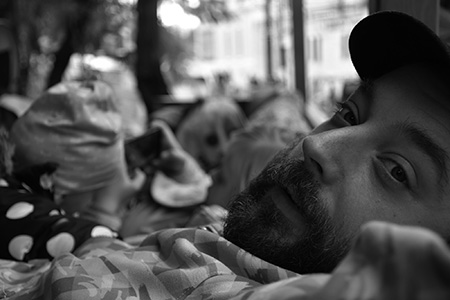 Writer-translator-video artist-cultural curator, Kristian Carlsson was born in 1978 in Malm�, Sweden, and began writing poetry at fifteen. He made his publication debut in 1996 and has published more than 30 books in genres-- ranging from poetry to prose to conceptual pieces. He also writes original fiction in English that have been published in several magazines in England, USA and Canada, and in 2013 the thematic prose collection "Small Press, or Else" (Dracopis Press) was published. As a translator he has mainly worked in the field of poetry; translating to and from English, such as by introducing contemporary Swedish poetry in English and women beat poets from the US in Swedish. Having translated into Swedish nearly thirty volumes of poetry and prose he has penned above four-thousand pages in his literary career. He has also translated accomplished Bengali poet Anisur Rahman's first collection of poems in Swedish "Sex �rstider" [Six Seasons] in 2012. Among his most recent translations into Swedish are, "Bengaliska Moln" [Bengal Clouds] introducing 17 contemporary Bengali poets and a new volume of Rabindranath Tagore's poetry.
Kristian's themes include a personal and psychological journey, spirituality, childhood, nostalgia and more. He also works for the reform of language. Architecture and painting are his pet subjects and he has taken many of his symbolic articulation from them.
The poet visited Dhaka to take part in the National Poetry Festival held on February 1 and 2 by Jatiya Kabita Parishad. Before leaving the country Kristian Carlsson spoke to The Daily Observer on aspects of poetry and translational work.
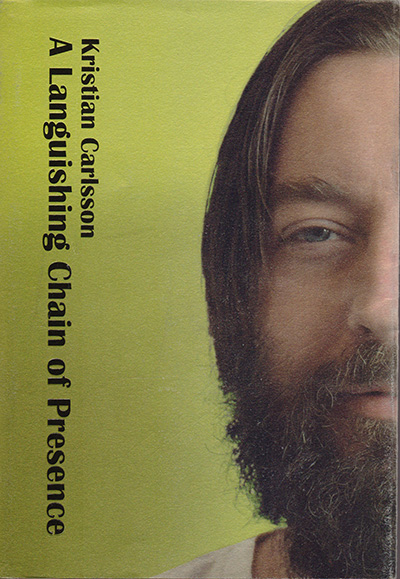
In the current Ekushey Book Fair, your selection of poems has been published from noted publishing house Journeyman. The book has already received a high acclaim. What type of poetry has been included in the publication?
Kristian Carlsson--This selection features both poetry written directly in English, and poetry I have written in Swedish and now translated into English. One example is the Dhaka Poems, written in Dhaka in 2014 and 2017, and first published in the USA before being included in this new book. On the whole my selected poems in "A Languishing Chain of Precense" is an unique project, gathering poems from many years and many publications, and at the Book Fair in Dhaka it has met its readers for the first time. That is very suitable, as my writings reflect on many parts of the world, and not only typically Swedish issues. The reader will find a wide range of expressions in the book. There is social realism, life observations, multiple voices, humorous pieces, and completely wild concrete poems. I work a lot with language and the alphabet as iconic imagery. I want to explore the boundaries of language through communication. At the same time I keep focus on social injustices and language as the foremost important element for interaction between people. So in many ways it is a balance act for me to express both a message and the underlying structure that is language itself and the individual letters that we use to pronounce and understand both agony and joy.
 How do you begin a poem? Could you please provide me the details of the mechanism?
 Kristian Carlsson--I have heard of poets positioning themselves every morning at the desk to "create"� by mimicking an ordinary job. And I have heard of poets only writing during a life crisis, or others only when in love, or when not in love, and so on. To me when to write, and when to not to write, isn't a dominating factor for the creation of poetry. I would say for a poem my time is spent in the following way: 85% is only thinking and following my mind wherever it takes me. 5% is writing down what there is to write. And the remaining 10% is reserved for editing the text. In this sense writing a poem seems to be rapidly done, as only 5% of the time is spent on obvious and factual writing. But poems take their time. And I would say that each and every percent of this time is crucial to the completion of the poem. If I haven't thought things through, I won't write. And if I haven't edited properly, I won't publish. Naturally, this isn't a method that was clear to me when I started publishing poetry twenty years ago. But over time I have found this to be my way of mastering my creativity. One has to remember that the poet also has to live a life as any other individual. To write things down, that aren't good enough, is just a waste of time. For a poet to keep on thinking on a subject, however, is to keep the poem open in all directions, welcoming new input wherever it might be found in everyday life. As soon as the poem is being written down, the poet begins to close the poem, subconsciously rejecting new input that isn't in the line of what has been concretisised on the page.
The structure and form of poetry is gradually transforming in the world particularly in Europe. What's your opinion about this particular point and how do you explain it? Is it demand for time, or political and economic unstable situations in world?
Kristian Carlsson-- I believe it is possible to sum it up like this: In earlier times a poem was a poem if it looked like a poem. Nowadays a poem is a poem if the poet says it is a poem. The same shift is seen in visual art, and in theatre. Means of expressions that once upon a time (that is, in the mid 20th century, or so) were called "experimental", positioned themselves against the consensus of what a poem, or a painting, or a stage play should look like, what it were supposed to consist of, etcetera. Nowadays there is no consensus, we don't have a single voice or a single group of people that can put themselves in the power to decide what is right and what is wrong. The poet decides. If we want to listen to the poet we need to abide by the rules of that poet, we have to accept that the poet is in charge of the poem at hand. We don't have to listen, but people are curious creatures, so we want to listen - and for that reason this new order works. And in the end it has to do with the world becoming smaller, people around the world coming closer to each other. The venue of a poet has expanded.
Some poets feel writing poetry helps them to remove emptiness and depression? Is it at all relevant to the contemporary time? Does poetry assist you to remedy your mental pain and agony? How do you get in the mental place where you find this deeper interior and write?
Kristian Carlsson-- It has been interesting to me to compile this selection of poems for Journeyman. I have had the opportunity to go back in time and revisit my old work. And what I see in it is that it is also in a way my private journal. I can find my struggles in life by reading the poems. One good example is the poem "The Daughter", it was written after a miscarriage at a time when my wife and I were really looking forward to having a second child. Pretty much the poem is a true story from my personal feelings of sadness as a father, but it also relates to the fears of putting a child into the world, when the world looks like to be at odds. There is the fear of rapes, of unsuccessfulness, of a child making the wrong choices. At the same time there is the strong manifestation of fatherhood, as I once dreamt of being told the name of that child, and me having that name to cherish, and in the end losing my child for her own life adventures. So yes, this was therapeutic to me. Hopefully it can be therapeutic to others as well. I put my feelings in the poems, and the poems are giving me a mirror of myself that I can relate to, and either distance myself from or approach. I know that I am alive (and sane) thanks to my ability to write.
What structural or stylistic techniques does a poet use in present times?
Kristian Carlsson--I would say that just because the appearances of poems have changed, and are now more varied, there are not less structural and stylistic intentions. Each poem, or rather in my case each poetry collection and suite of poems, has its own rhythm, intonation and pace. I find that to be very clear when I read poems out loud at festivals and events. I can't read two poems in the same way if they are from different times. But it isn't just something that is dependent on me as a poet. It is a structure that is built and maintained within each poem, by the choice of words and phrasings, by the line brakes, by the values and meanings of the words. When a poet chooses to write a traditional verse, like a sonnet or a limerick, or even just by using rhyming lines or one of the ancient meters counting the syllables, it is also a convenient way to write poetry while having something to lean on - there is a comfort in reading according to a verse and meter that is familiar to the readers, they will know how many lines to expect and where the rhymes should appear if you are reading a Shakespearean sonnet, for instance, and likewise the poet or poetry reciter also knows that all there is to do is to follow the same old rhythm. Of course, I am simplifying things, to make my point. But on the whole this is true. In the free verse, on the other hand, the poet is expected to find the rhythm within the language itself, to find it and make it a stylistic ornament that is available to both the reader and the listener. Any difficulty in understanding either classical verse or contemporary free verse is dependent on what the reader is used to and comfortable with. When it comes to reading poetry out loud, the free verse doesn't demand of the poet to be a reciter in the same way as before, rather it is crucial for the poet to be a performer. There is a need for the poet to have "feeling" in the way we speak about certain musical artistes having "feeling" when they sing. In Swedish I always describe it with the word "iscens�tta", which is more on the point than the English equivalent, "to stage" something. You need to bring the poem to life. And in order to do that you need to write a poem in which life can be found. And structure and style are the tools that give life to language in contemporary poetry of free verse. There is nothing new there. Yes, the rhymes are gone. The themes are new, sometimes preposterous or uncomfortable. The appearances on the pages are different. The language might seem colloquial, but it is not by mistake. The boundaries of what is "allowed" have expanded immensely. And still, there is nothing new. Just structure and style, and a poet who knows how to handle these new conditions in writing and on stage.
What is the message of your poetry and any other poetry that is mandatory?
Kristian Carlsson--I would say that the poet has no clear message; it is the reader who is obliged to find the message. That might sound a bit harsh, but as a poet I have to take into consideration that all readers are individuals with unique experiences of their own. I don't want to tell another person what to think. I want to place my poetry inside a person, to make that person think in new ways, but in ways that are in tune with the kind of individual that person is. The highest goal for my poetry is to reach out to the reader and open up an inner world that no one has seen and that I can't know anything about. Then I clearly can't have a message as well. I am only the messenger. The reader is his or her own message, that is delivered through my poem, but that has been there all along, somewhere in the mind or in the memories or in the sub-consciousness.
Loading...
Loading...
Also read



Editor : Iqbal Sobhan Chowdhury
Published by the Editor on behalf of the Observer Ltd. from Globe Printers, 24/A, New Eskaton Road, Ramna, Dhaka.
Editorial, News and Commercial Offices : Aziz Bhaban (2nd floor), 93, Motijheel C/A, Dhaka-1000.
Phone: PABX- 41053001-06; Advertisement: 41053012; 01793317829, 01550707291, E-mail: [email protected], [email protected] Online: email: [email protected] 41053014; 01550707297 Advertisement: 01550707296
Published by the Editor on behalf of the Observer Ltd. from Globe Printers, 24/A, New Eskaton Road, Ramna, Dhaka.
Editorial, News and Commercial Offices : Aziz Bhaban (2nd floor), 93, Motijheel C/A, Dhaka-1000.
Phone: PABX- 41053001-06; Advertisement: 41053012; 01793317829, 01550707291, E-mail: [email protected], [email protected] Online: email: [email protected] 41053014; 01550707297 Advertisement: 01550707296


