



| HEADLINE |

|
Glimpses of Contemporary Trends
Duaree’s exposition ends tomorrow
Published : Tuesday, 27 February, 2018 at 12:00 AM
Takir Hossain


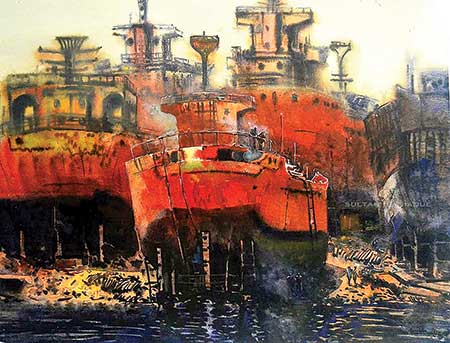
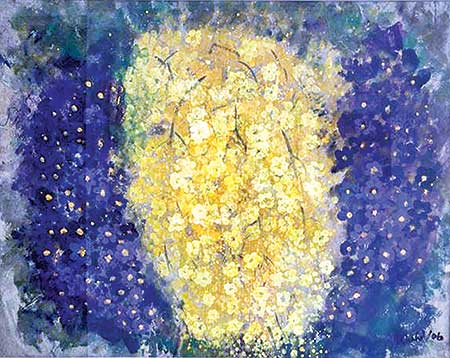 Duaree Gallery---a newly established art hub at Dhanmondi in the city has organised a group art exhibition featuring the artworks of eleven contemporary artists from different periods in the country.
 The group show has been dedicated to artists Aminul Islam, Syed Abdullah Khalid and Fokhrul Islam who have passed away in recent years.
Participating painters include established figures of the art arena like Monirul Islam, Abdus Shakoor Shah, Tajuddin Ahmed, Nasima Khanom Queenie, Mohammad Iqbal, Anisuzzaman Anis, Rashid Khan, Shahanoor Mamun, Kamruzzaman Sagor, Mohammad Razwanur Rahman and Sultan Ishtiaque.
Aminul Islam made an immense contribution by introducing modern paintings in Bangladesh. He grew primarily as a non-figurative painter in the early 1960s and started to experiment with different mediums and art forms. Besides painting, Islam was also inclined towards drawing. In the course of his career, he developed several styles, particularly in his drawings and sketches.
Syed Abdullah Khalid is mainly recognised for his "Aparajeyo Bangla", one of the most familiar sculptures, and considered a landmark in Dhaka University campus.
A multi-talented artist, Khalid has not only excelled in sculpture but also made an impression with his paintings. The painter mainly dealt with the seasonal flowers of Bangladesh. He was overwhelmed by the vivid colours of spring flowers, especially Sonalu, Radhachura and Krishnachura. His very picturesque and appealing natural observation is profoundly embedded in Khalid's psyche and his acrylic and mixed media (a few done in oil) based paintings are created spontaneously by his skilled hands brushed with colours in the easels.
Fokhrul Islam is considered as one of the significant painters of Bangladesh who has established his individual style and technique. Throughout his illustrious career, he gradually transformed his working style into pure abstract expressionism. His artworks plunged deep into dots, points and monochromic images. His works are immersed with rich textured patterns and the paintings are technically sophisticated. In his life time, the painter had been working on a continuous series and developing himself with innovative techniques and use of materials.
The outstanding career of Monirul Islam is one of the most influential artists of the twentieth century of Bangladeshi art. His vast oeuvre encompasses printmaking (as diverse as etchings, linocuts, lithographs, and aquatints), painting, watercolour, drawing, mixed media, collage and more. This is undeniably truth that he has introduced a new language and technique for printmaking in our country.
Monir symbolically portrays nature and its mysterious phases through his personal notion, experience and thought process. The abstraction in his works comes naturally as he has adopted a unique language for his own way of expression. His prints are chronicles of his inner feelings and intense observation of his living space, life and reminiscence. His manipulation of forms, scattered drawings and polished brush strokes create a language simultaneously natural and contrived.
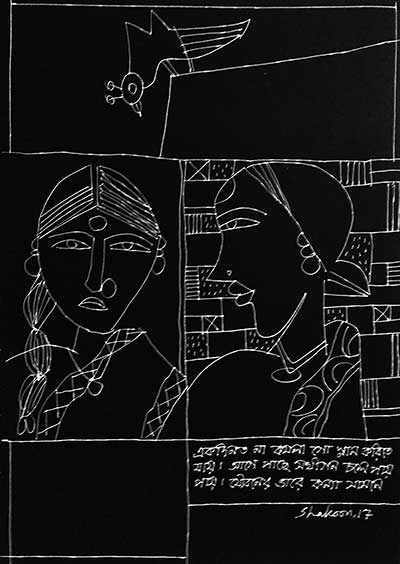
For over a large span of his career, Abdus Shakoor Shah has been working on folk motifs and ancient ballads. Folk ballads of Mymensingh-the famous Mahua and Malua love stories, Nakshi Kanthar Maath, Gazir Pata, Manasha Pata have found prominent places in his works. In his works, different types of birds have been featured on a large scale. When he started to work on folk motifs, the painter occupied himself with animal forms such as elephants, bulls, dogs, cats, tigers, birds, serpents and reptiles-all as pleasant and decorative motifs.
Shakoor's lines are very simple but have a lyrical appeal. It has also been easily comprehended that the lines are not time-consuming at all but give us a cerebral look.
Tajuddin Ahmed is one of the earnest painters who has been quite active in the Dhaka art circuit since 1980s. He regularly paints and has established his personal language through art. His paintings have a true touch of aestheticism which is superb and tinged with simplicity. Tajuddin works on several themes and his focal point is on mythological resemblance, flora and fauna, vivacious culture of Old Dhaka, nostalgia, nature and human relationships.
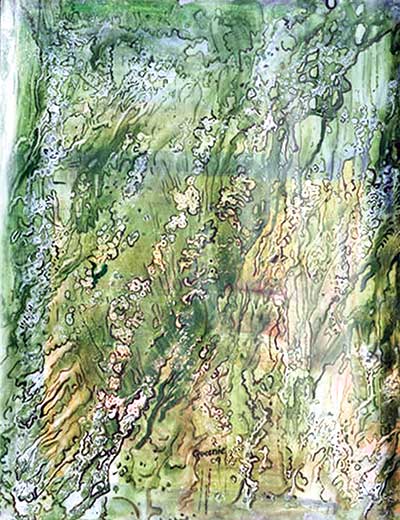
Nasima Khanom Queenie portrays nature and its mysterious phases through her private surveillance. Most of her acrylic based paintings have been adorned by her intense observation of her living space, life and reminiscence. Her manipulation of forms, lines and refined brush strokes create a language simultaneously natural and contrived. Her palette swings between mellow and bold, strokes between rugged and controlled conjuring up a visual playground for joy and ecstasy.
Mohammad Iqbal appeared in the Dhaka art scene in the 1990s with his strong philosophical themes and experimental paintings. He was recognised for his skilled drawings and impulsive spirit. He is mainly distinguished for his theme-based paintings. His canvases are engrossed with various visible and shadowy figures. His protagonists on canvas are usually exploited people and mystics. The difference between the economic structures of different communities leads him into portraying their lifestyles. From the onset, his works have mirrored the bitter realities of the society. His paintings effectively touched the heart of art enthusiasts because of his sensible approach. The subject has been addressed at times with abhorrence against injustice and often with anxiety and rage caused by it. This is the grist to the mill in Mohammad Iqbal's case. His other pet subject is children, whom he regards as neglected and mistreated. The painter has also painted bearded faces, along with red clothing, beads, horns of buffalo, animals, talisman and trident. Some of the other motifs in his paintings are middle-aged figures, ancient edifice, rivers, vessels, hills and sky.
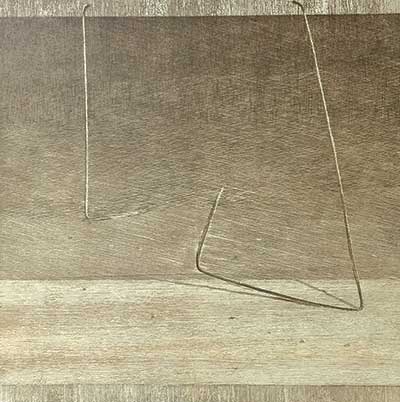
Anisuzzaman Anis has now become one of the significant woodcut printmakers in our country and his work zooms in on urban architecture, construction of human accommodation, urban constructions, and a city's structural design. His prints are closely related to geometrical and structural elements where one can easily sense his passion for the language of architecture. He has his own perception and thinking process to view the capital city. He also keeps his eyes on a city's socio-economic and political conditions which are very much connected to his works and it can be easily said his prints are truly the reflection of the society.
Rashid Khan is an amateur painter--- this is not at all a proper introduction for a creative personality. His umbilical cord with art has seemingly been intact since his childhood. He is simultaneously a figurative, objective and naturist painter. All of his images pulsate with life provocatively and dramatically. These elements make his paintings seem an authentic part of our surroundings with all our conflicts and achievements. His figures hint at many untold stories. His thought process is seemingly eloquent and has a touch of contemplation.
Mohammad Razwanur Rahman is one of the earnest printmakers and has always involved himself with new thinking process. He always likes to play with subdued hue and his paintings accommodate with many tiny compositions and forms. He has a great fascination for geometric forms which have been hugely occupying his paintings. In variation of colours---sometimes he uses bright and sometimes he remains occupied with quiet colours. The painter has been greatly influenced by two famous Spanish painters Antoni T�pies and Joan Mir�.
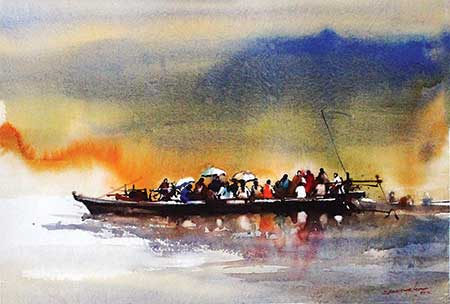
Shahanoor Mamun is a nature watercolourist. His keen aptitude is to draw the philosophical aspect of nature, its volume and colour to create sensitive vibes. He has painted different types of boats in different localities of the country. The painter continues to work on this significant subject as he feels that the diminishing style of different types of traditional boats requires prominent focus. Besides these, Mamun ardently paints Old Dhaka with its vivacious activities, downtrodden people, rickshaws, traditional horse carts, narrow alleys, condensed habitations, wrecked buildings, cluttered wires scattered across roads, etc.
Isolation and tranquility are two vital apparatus in the works of Kamruzzaman Sagar, one of the noted contemporary Bangladeshi printmakers. His works delve deep into complexity of human life and he has made a great attempt to blend surrealistic metaphors in his prints. All of his single prints can be divided into several segments and each section denotes a story which is dissimilar to other. His prints explore different avenues of humankind. Aves and human motions are very recurrent features in his prints and his prints are laborious, exhilarating and thought-provoking. The subjects of his works are sometimes in solemn mood and their characteristics are highlighted.
Sultan Ishtiaque is one of the earnest followers of realism in our country and his thinking process and belief engulfed the genre of art. It has been deeply observed his capability to draw mass and their unending struggle, deep pain, surrounding dimension, textural malleability and he constructs sensitive compositions, which are really remarkable. Sultan elaborately portrays the ship building process, drudgers engrossed with works, upside down ships and cargos under repair, scrap metals of ships scattered on the ground and plying ships on docks. He also portrays small and big boats in all their possible varieties as well as repairing and maintenance activities around the banks of the rivers.
The exhibition was inaugurated on January 27 and will continue till tomorrow.
Loading...
Loading...
Also read



Editor : Iqbal Sobhan Chowdhury
Published by the Editor on behalf of the Observer Ltd. from Globe Printers, 24/A, New Eskaton Road, Ramna, Dhaka.
Editorial, News and Commercial Offices : Aziz Bhaban (2nd floor), 93, Motijheel C/A, Dhaka-1000.
Phone: PABX- 41053001-06; Advertisement: 41053012; 01793317829, 01550707291, E-mail: [email protected], [email protected] Online: email: [email protected] 41053014; 01550707297 Advertisement: 01550707296
Published by the Editor on behalf of the Observer Ltd. from Globe Printers, 24/A, New Eskaton Road, Ramna, Dhaka.
Editorial, News and Commercial Offices : Aziz Bhaban (2nd floor), 93, Motijheel C/A, Dhaka-1000.
Phone: PABX- 41053001-06; Advertisement: 41053012; 01793317829, 01550707291, E-mail: [email protected], [email protected] Online: email: [email protected] 41053014; 01550707297 Advertisement: 01550707296


