



| HEADLINE |

|
Iqbal’s narrative art headed for an authentic world
Exposition jointly exhibited at Courtyard in Dhanmondi and Edge Gallery in Gulshan
Published : Monday, 30 April, 2018 at 12:00 AM
Takir Hossain


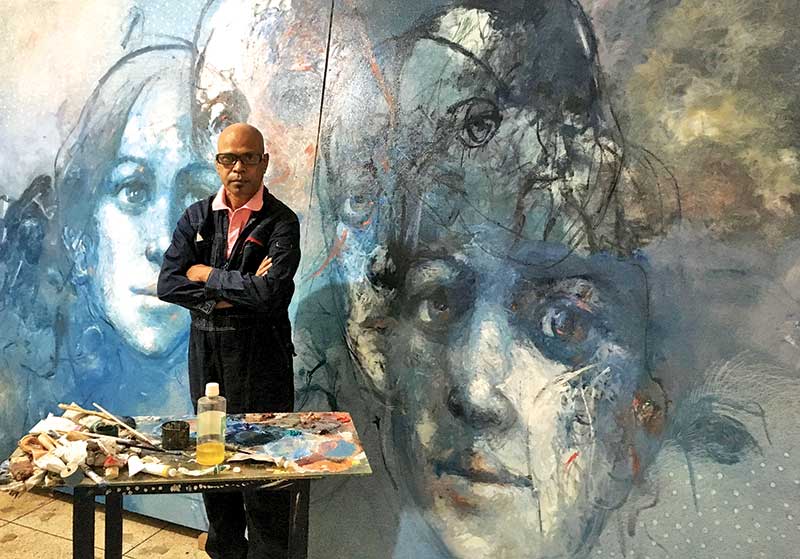
Celebrated artist Mohammad Iqbal at his studio
Likewise Mohammad Iqbal also provides a pleasing look through his art and at the same time his works are narrative-based in the sense of his making of the protagonists of his canvas. Narrative art is particularly a genre of art that tells a complete story, either as a moment in an ongoing story or as a sequence of events unfolding over time. This forms the first basic characteristic of his art.
Second comes, Iqbal's social and political consciousness in which his thinking process is very lucid and coherent. He is very much concerned about the turmoil of world politics where even an innocent child gets bluntly affected. In recent years, Iqbal's pet subject has become children, whom he regards as neglected and mistreated. The artist has developed a fondness for children. When the artist was a student of PhD of the Faculty of Fine Arts, Hiroshima City University from 2003 to 2005, he first concentrated on the subject. Afterwards when he completed his PhD from the Tokyo University of The Arts in 2010, he further extended his skills in the subject and he still constantly explores the varied facets of the theme. The artist has portrayed many faces of children in approximately the same disposition. Through the oval shaped faces, the artist seeks to convey the innocent and unaltered dreams and yearnings of children. Their eyes are the predominant aspects of these paintings. The eyes express surprise, pain, longing, puzzlement and panic. The artist feels all children look the same and their desires and expressions are also similar.
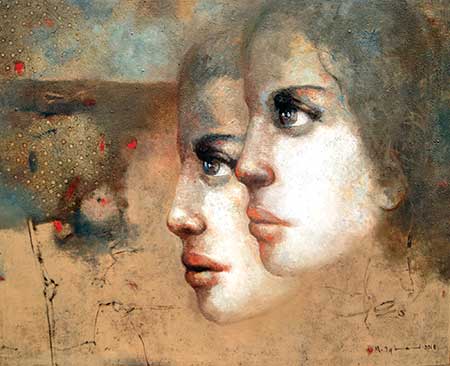
Silent Revelations 1
At his current exhibition, Iqbal focuses on a number of themes. Several works reveal that Iqbal's protagonists are oppressed people and sages. Several of his works focus on the lives of Bauls. The series of works on the subject has given us a novel look in every one of his solo exhibitions held in different periods of time. The Baul's way of life and philosophy attract him the most as he finds spirituality and sanctity in them. The differences prevailing within the economic structures of a capitalistic habitat leads him to portraying their lifestyles. From his very beginning, his works have mirrored the bitter realities of the society. The subject has been addressed at times with abhorrence against injustice and often with anxiety and rage caused by it. The figures sometimes in the middle of the canvas, sometimes on the sideways- always turn up in the foreground taking the prominent place with strains of agony getting the focus.
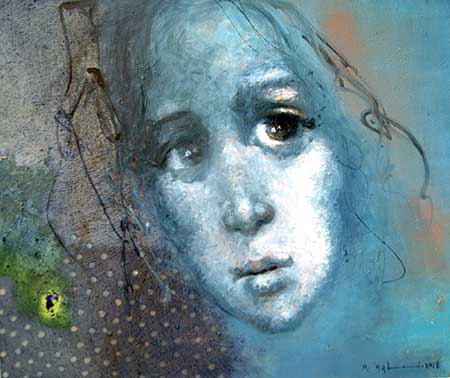
Silent Revelations 2
Before doing the series of works, the artist collected information from newspapers and journals on child abuse, trafficking, killing and rape. It makes him cry when he observes children in inhuman conditions. Memories from childhood are also important to him. He cherishes those carefree days with endless possibilities.
During the Liberation War Iqbal was just four years old. Many lost their entire families to the war. Children lost their parents. War has now become a recurrent feature in the world. We remain insecure and unsafe. Children grow up amidst terror and panic -- some survive on the streets or orphanages. Many of them don't get to enjoy their fundamental rights. Thus the artist developed his preference on children as the theme of his artworks.
At the exhibition, some of his paintings clearly highlight pure compositions that convey his fondness for translucent lines and tiny forms. Lines play a significant role in many of his paintings particularly in such kind of paintings. The light and shade superbly convey the seasons of the country but very emblematically. Some of other motifs in his paintings are ancient edifices, rivers, vessels, hills and sky. From these latter themes it can easily be said that Iqbal has tried to depict universal nature in his works. Iqbal's search for a more sublime world devoid of the present ongoing rush for materialistic benefits, by returning to one's original state regardless of whether it constitutes savageness or childhood can certainly be termed as impragmatic by post modernists. Iqbal like the Victorians craves for returning to the past. But in modern times the only option suggested by sociologists so far is, a compromise achieved collectively which though might always be precarious and, in most cases, unattainable provides the only background for dreams of a better future. It is evident that Iqbal does not necessarily ruminate on these issues. But it cannot be declared that what he deals with is of any smaller significance.
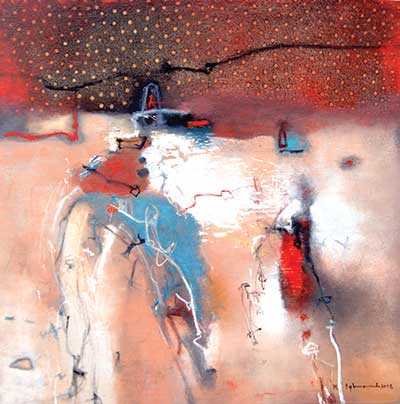
Silent Revelations 3
Mohammad Iqbal has used oil and acrylic on canvas, Japanese paper specially washi paper, pastel on paper at the exhibition. In the current show, Iqbal has appeared with collage (he has pasted washi papers on canvas) on a number of his works. Collage is a medium which provides him with a refreshing mood. Besides painting, he has also been engaging himself with this medium in the last couple of years. His collages have carried technical excellence. The painter cannot continue to work with the same medium for a long time. He takes pause and then delves deep into different medium, as a part of experimentation. When he muses on a particular medium, he continuously works on this to explore the pros and cons of the medium. The artist has been experimenting with varied kinds of pieces of washi papers, fragments of papers and rag paper. It is easily discernable that his collages (very little portions of the canvas) are technically phenomenal, time consuming and cerebrally sound.
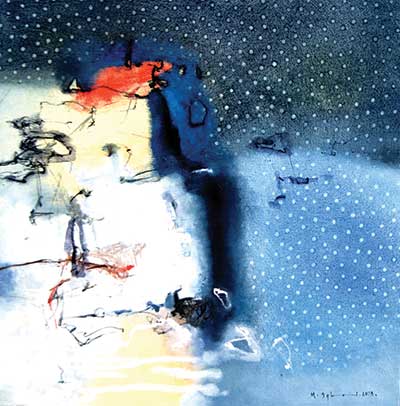
Silent Revelations 4
Iqbal is very meticulous about creating the ground of the canvas. To create the background for his paintings, the artist layers eight to ten times before making a level satisfactory enough for plunging deep into his subject easily. He has created varied kinds of dots, tiny round and oval sized forms with different shades. Some of his canvases are engrossed with vague forms, compositions and shadowy figures. Sometimes the painter applies colours directly -- piling them up faintly thick, and at times thin -- on the canvas, and tries to create an image that is dynamic and has appealing texture and sensuous tones. The backgrounds of most of his compositions are occupied by abstract forms, soothing colours and soft tones. Some works include engraved ambiguous forms while others are populated by scribbles and amorphous forms. Iqbal invests considerable time on each painting. The most significant feature of his paintings is that the surfaces of his paintings appear to us in same tone in every spaces of his paintingn
The "Silent Revelations" series has been jointly exhibited at both Edge Gallery, Gulshan and the Courtyard, Dhanmondi. The exhibition was officially inaugurated on April 21 and will continue till May 5.
Loading...
Loading...
Also read



Editor : Iqbal Sobhan Chowdhury
Published by the Editor on behalf of the Observer Ltd. from Globe Printers, 24/A, New Eskaton Road, Ramna, Dhaka.
Editorial, News and Commercial Offices : Aziz Bhaban (2nd floor), 93, Motijheel C/A, Dhaka-1000.
Phone: PABX- 41053001-06; Advertisement: 41053012; 01793317829, 01550707291, E-mail: [email protected], [email protected] Online: email: [email protected] 41053014; 01550707297 Advertisement: 01550707296
Published by the Editor on behalf of the Observer Ltd. from Globe Printers, 24/A, New Eskaton Road, Ramna, Dhaka.
Editorial, News and Commercial Offices : Aziz Bhaban (2nd floor), 93, Motijheel C/A, Dhaka-1000.
Phone: PABX- 41053001-06; Advertisement: 41053012; 01793317829, 01550707291, E-mail: [email protected], [email protected] Online: email: [email protected] 41053014; 01550707297 Advertisement: 01550707296


