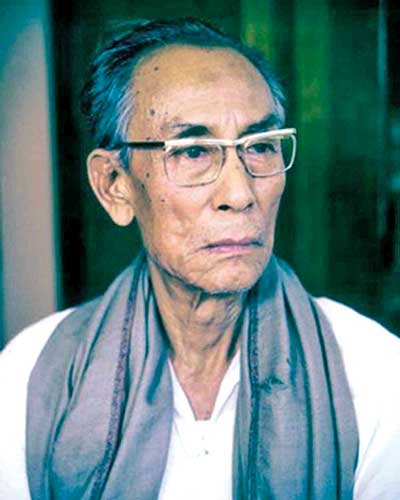
Sachin
Dev Burman was one of the great Bollywood music directors in the early
days of India's film industry. He was a much sought after composer from
the 1940's up until his death in 1975. He was born on October 1, 1906
in Comilla. His mother's name was Nirmala Devi and his father's name
was Nabadwipchandra Dev Burman. His father was the second son of
Ishanachandra Dev Burman, the Raja of Tripura; so SD Burman is descended
from a royal family. SD Burman was one of nine children and the
youngest of five boys.
Sachin Dev Burman also recognised as 'Sachin
karta', was one of the most celebrated music composers for Hindi movies
and a Bengali singer and composer. Sachin composed music for 100 movies,
including Bengali films. The legendary figure was born into Nirmala
Devi and Nabadwipchandra Dev Burman. He began his training in classical
music under his father, who was a sitarist and dhrupad singer. He did
his B.A. from Calcutta (now Kolkata) University and started his formal
music education under K.C. Dey. In 1932 he came under the tutelage of
Bhismadev Chattopadhyay. This was followed by training from Kahifa Badal
Khan (sarangi player) and Ustad Alauddin Khan. Sachin started
working as a radio singer on Calcutta Radio Station in 1932, where his
early work was based on East Bengali folk music, and soon made a
reputation for himself in folk and light classical music. His film
compositions were often influenced by his huge repertory of folk tunes
from the Bhatiali, Shari and Dhamail traditions. In the following
decade he reached his peak as a singer, cutting as many as 131 songs in
Bengali, and also sang for composers like Himangsu Dutta, RC Boral, Kazi
Nazrul Islam and Sailesh Das Gupta. In 1934, Sachin attended the All
India Music Conference, at the invitation of Allahabad University,
where he presented his Bengali Thumri, to an illustrious audience, with
the likes of Vijaya Lakshmi Pandit and the inimitable Abdul Karim Khan
of Kirana Gharana. As a music composer, Sachin started with Bengali
plays, "Sati Tirtha" and "Janani", and eventually gave his first score
in film, "Rajgee" in 1937. He continued composing music for Bengali
films, even after he moved to Bombay (now Mumbai) in 1944. In 1950s,
SD Burman teamed up with Dev Anand's Nav Ketan Productions to create
musical hits like "Taxi Driver" (1954), "Nau Do Gyarah" (1957) and
"Kalapani" (1958). With the success of their second film, Baazi (1951)
he made it to the top. While every song in the film was a hit, one stood
out for special appeal -- "Tadbir se bigdi hui taqdeer", a ghazal that
was occidentalised into a seductive song. Sachin's thin yet powerful
voice was often used as bardic commentary to haunting results -- a
typically Bengali trait -- as in "Orey maajhi mere sajan hai uss paar"
(from "Bandini", 1963), "Wahaan kaun hai tera" (from "Guide", 1965) and
"Saphal hogi teri aradhana" (from "Aradhana", 1969), for which he
received the National Film Award for Best Male Playback Singer for the
year 1970. Bengali music and sensibilities remained Sachin's muse
throughout his illustrious career in the Bombay film industry. In 1963,
he composed songs for "Meri Surat Teri Aankhen" and Manna Dey sang the
song "Poochho na kaise maine" in raaga Ahir Bhairav. The song was based
on a Bengali composition by Kazi Nazrul Islam, "Arunokanti ke go jogi
bhikaari". Burman died in 1975 in Bombay in India. Today marks the 43rd death anniversary of Sachin Dev Burman.
Published by the Editor on behalf of the Observer Ltd. from Globe Printers, 24/A, New Eskaton Road, Ramna, Dhaka.
Editorial, News and Commercial Offices : Aziz Bhaban (2nd floor), 93, Motijheel C/A, Dhaka-1000. Phone: PABX- 41053001-06; Online: 41053014; Advertisement: 41053012.
E-mail: district@dailyobserverbd.com, news@dailyobserverbd.com, advertisement@dailyobserverbd.com, For Online Edition: mailobserverbd@gmail.com