



| HEADLINE |

|
Poets from the 60s
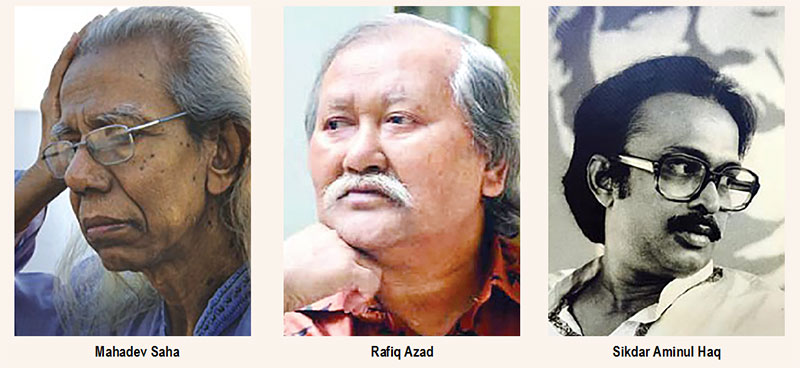
Mahadev Saha, Sikdar Aminul and Rafiq Azad
Published : Saturday, 2 January, 2021 at 12:00 AM
Takir Hossain


 Poetry plays a significant role in shaping the literary landscape of a nation. Bangladeshi poetry has a significant presence in the history of Bangladeshi literature and the 1960s, in particular, was a landmark for Bengali poetry. During that period, many poets started their voyages through new trends and novel approaches. Over the last few decades, Bangladeshi poetry went though a number of changes in the fields of theme, subject-matter as well as technique. The transformation of Bengali poetry also happens for socio-political and economic reasons. And the transformation has been a continuing process for Bangladeshi poetry.
 Mahadev Saha, Sikdar Aminul Haq and Rafiq Azad are among the most significant poets of the 1960s in our country. Their poems are strong, contemplative and very contemporary in their ways of expressions, articulations of dictions and structures. In my article, I have tried to focus on their genres, inherent thought-processes and lyrical contents.
Mahadev Saha is one of the foremost poets of the late '60s, an era marked with accomplishments and revolutionary ideas. He claims to be introverted and has no interest in personal relationships. Saha is also one of the leading romantic poets in contemporary Bengali literature. He is also a poet of mystery and muted ambiance. Since he took to poetry, he has carefully removed himself from any disquiet and unsteadiness. His love for beauty and nature comes through in a very animated and intimate manner in his canvas of poetry.
Mahadev Saha was born on August 5, 1944 in Dhanghara, Sirajganj. The only child of parents Godadhor Saha and Birajmohini, Mahadev completed his primary and high school education in his village. For higher education he went to Dhaka College, Bogra College and Rajshahi University.
The main elements in Saha's poetry are solitude, love, yearning, the Liberation War, scenic beauty, poverty, secularism and equal rights. The struggles and sorrows of the deprived spur him to write. The poet is deeply moved by the ravages of poverty. His style is unquestionably unique and evocative. His words and verses articulate the torments of a lonesome soul and a mourning heart.
Mahadev Saha is dreamy and given to flights of poetic fantasy. Besides being a visionary, the poet has regularly tried to express his personal feelings and observations in romanticism. One will read "Prem O Bhalobashar Kobita" avidly; and out of that experience one can easily read the poet's mind and bore into his soul. It is true that the meaning of love differs from one individual to another. Expressions of love come to poetry, indeed hold it aloft, in various forms. The rendering of love is very clear in the poems. His love for feminine beauty and natural objects comes in tandem with the frustrations and dissatisfaction associated with modern life.
After a close perusal of Saha's poetry, though it is very difficult to trace the exact silhouette of the poet's mind, one is quite clear about the fact that he is a modernist in the complete sense of the meaning. In his poems, one feels the lament of a lonely soul, an underlying sorrow, a feeling of emptiness but not without a tinge of hard realities and other realisations that one can call forth only from life itself.
Mahadev's first book "Ei Griha Ei Sannyas" was published in 1972. His second book "Chai Bish, Amorata" was published in 1975. He has published 130 books including poetry, essays, books for children, compilations of poems and a number of volumes of selected poems. The 'magician of words' has won many prestigious awards like Ekushey Padak, Bangla Academy Award, Zebunnesa-Mahabubllah Award, Alaol Shahitya Award and Khalekdad Chowdhury Smriti Padak.
 Sikdar Aminul Haq is generally a modernist Bangladeshi poet. He is also a prolific poet and his poems are of outstanding intellectual quality. Incidents of everyday life can be found in much of his poetry but in a very symbolic and complicated way. He frequently experiments with form and content. He often approaches surrealism and expressionism in his works. He uses the imagery of varied urban motifs and infrequently rural motifs like moon, sun, sky, lush greenery, clouds and other natural wonders in his poetry. His poetry shows a considerable degree of social awareness and a sense of satire. His works also focus on Dhaka's contemporary life and times.
Sikdar Aminul Haq was born on December 6, 1942. He is a recipient of the Bangla Academy Award in 1994 for poetry and many other prestigious awards. His breakthrough came with his commendable work "Satata Danar Manush". The poet is popular for the handling of unusual, whimsical and innovative imagery in his creations.
Aminul Haq's poetry has superbly documented pains, agonies, weal and woe of human beings, historical and political episodes in our country. His poems are distinguished for their highly expressive and communicative, poignant and symbolic traits. For inspiration, Aminul Haq veers towards human life and their varied social and cultural aspects, patriotism, political ups and downs. Aminul Haq's poems are courageous, thought-provoking and intellectually rich. His protest against religious intolerance has been reflected in his poetry.
Several of Aminul's poems are conceptual and some deal with death, romance and at times the absurd. As an experimental poet, he frequently changed his technique, mode and overall substance.
Aminul Haq's notable works are 'Duurer Karnish', 'Teen Papreer Phul', 'Parabat Ei Pracheerer Shes Kabita', 'Ami Sei Electra', 'Bohudin Upekhae Bohudin Aundhokarey', 'Patrey Tumi Protidin Jol', 'Ek Ratri Ek Writu', 'Satata Danar Manush', 'Suprobhat Hei Varanda', 'Kafkar Jama', 'Sulata Amar Elsa', 'Rumaler Alo O Onnanno Kabita', 'Lorkakey Jedin Ora Niye Gelo', 'Bimorsho Tatar', 'Ishitar Ondhokar Shue Ache'. The poet died in 2003.
One of the most brilliant stars to have emerged in the tumultuous environment of the post-liberation era, Rafiq Azad forged a unique voice. The Liberation War in 1971 remained a focal point for this rebel who never flinched from critiquing the misrules and inhumanities he was witness to. As a voice against injustice his poetics relied on familiar themes echoing a constant craving for a just society while his form was fragmentary and was easily accommodative to invectives. His strong, intense verses often dealt with political, social issues seen through the prism of the personal. A freedom fighter, he developed a signature style, distinguished by simple linguistic constructions where there were no division between high and low art sensibilities.
As a man Azad was liberal-minded - an amicable secularist. Though a diehard atheist he believed in the rights of believers in all religions. As a poet he was out-spoken, bold and uncompromising in his stance.
Azad is most renowned for his poem "Bhaat De Haramjada". The inflammable verses of the poem, especially the fiery last line 'Bhaat Dey Haramjada, Ta Na Hole Maanchitro Khabo' (Give me food bastard, or, I will gobble up the map!) sparked controversy immediately after it was published in 1974. The insinuation of the poem was that the newly independent country failed to feed its own people and the famine that had struck the Northern region was a man-made one. There were clear hints that the poet responded to pictures of the emaciated Rangpur girl Basanti found wrapped in a fishing-net alongside a hungry beggar eating vomit of an alleged cholera patient, who were all over the media.
Azad was born on February 14, 1943, in a remote area called Guni, under Tangail district. He completed his primary education under the British-Indian education system from Sadhuty Middle English School. He developed a keen interest in writing poems since his early childhood. On completion of school certificate exam, Azad enrolled at Government Saadat College, Karotia.
His first book of poetry "Ashombhober Paye" was published in 1973. Since that first spark of self-confessional poetics, Azad's style of expression went through changes in the course of the next forty or so years. It became more personal, lyrical and romantic. However, a greater portion of his work depicts poverty, sufferings, injustice, inhumanity, collapsing of urban and rural lives as well as the political turmoil, social and economic crises that rocked the region.
Rafiq has fourty-four publications under his name, including an autobiography. His notable works include 'Prokriti O Premer Kabita', 'Shahasra Shundor', 'Haturir Nichey Jibon', 'Khub Beshi Dureo Nai', 'Khama Karo Bahoman Hay Udar Omiyo Batas', 'Apar Arannya, Karo Ashuro Paat', 'Moulobir Mon Bhalo Nay' and 'Pagoler Thekay Premikar Chithi'.
Azad received Ekushey Padak in 2013 and Bangla Academy Award in 1984 for his outstanding contributions to poetry. The poet died in 2016.
Takir Hossain is an art critic and cultural curator
Loading...
Loading...



Editor : Iqbal Sobhan Chowdhury
Published by the Editor on behalf of the Observer Ltd. from Globe Printers, 24/A, New Eskaton Road, Ramna, Dhaka.
Editorial, News and Commercial Offices : Aziz Bhaban (2nd floor), 93, Motijheel C/A, Dhaka-1000.
Phone: PABX- 41053001-06; Advertisement: 41053012; 01793317829, 01550707291, E-mail: [email protected], [email protected] Online: email: [email protected] 41053014; 01550707297 Advertisement: 01550707296
Published by the Editor on behalf of the Observer Ltd. from Globe Printers, 24/A, New Eskaton Road, Ramna, Dhaka.
Editorial, News and Commercial Offices : Aziz Bhaban (2nd floor), 93, Motijheel C/A, Dhaka-1000.
Phone: PABX- 41053001-06; Advertisement: 41053012; 01793317829, 01550707291, E-mail: [email protected], [email protected] Online: email: [email protected] 41053014; 01550707297 Advertisement: 01550707296


