



| HEADLINE |

|
All the Aljazeera’s Men
Published : Monday, 15 February, 2021 at 12:00 AM
Shahriar Feroze


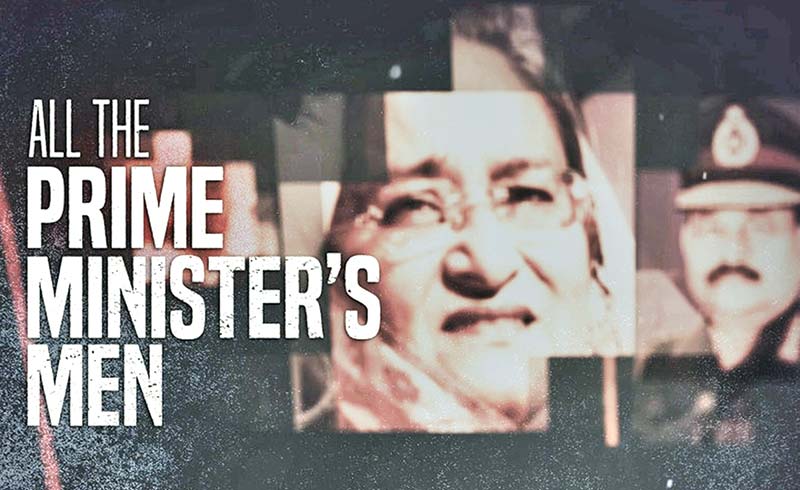
 I can't recall, when was the last time an international news report had divided the country into two, but the recently aired "All the Prime Minister's Men" by Aljazeera has surely divided Bangladesh into two.
However, when it comes to take part in the talk of the town - the problem in today's Bangladesh is that I am for it or I am against it - there is no place in between.
A point of view in this regard, what appears eye-opening to the general public is a lot different to how we journalists react to a media bombshell.
The Aljazeera video documentary had been intended to generate two types of impact, targeting two separate audiences.
The first category is our domestic audience, and the second is an international audience. And "All the Prime Minister's Men" is actually meant for the international audience to have an understanding of our politics, corruption and power-play through the Aljazeera lenses. The lenses are definitely not clear, nor clean.
Nepotism, practised in whatever capacity, was never a new phenomenon in Bangladesh. Quite reasonably, I wasn't surprised at all while watching it in "All the Prime Minister's Men".
Ranging from clandestine dubious business meetings held abroad among powerful individuals, rampant abuse of political clout, fugitive criminals roaming about scot-free, millions of dollars paid to in-between brokers in government contracts to availing fake passports to a controversial presidential pardon, nothing appeared astonishing to this writer.
Are Bhai, within this sub-continent, blood is not only thicker than water but most reliable and valued compare to the most expensive liquid available on earth.
I am a frequent follower of Aljazeera's 'elite' investigative team's work in other countries and on different topics.
The team followed the same techniques applied on "All the Prime Minister's Men" - technical finesse in making by using drones , secret video recordings with whatever devise available at hand, presenting reliable images of documents , inviting commentators to buttress their purpose, quoting social media posts, adding video footages of personal gatherings to whatever is possible to accumulate.
First, I couldn't help marking the timing of airing this video reporting. It had to be aired while the army chief was on an official visit to the USA, why, wasn't the media network not aware of his trip?
Second, most of the information and enacted video-clips used in the documentary on Aziz & Co, scandalous or not, remained open secrets in our society for too long.
 Third, hours-long interaction coupled with secret video recording between the star witness Sami with Harris & Co, clearly smacks of known and unknown personal feuds.
 Reflecting back to Sami's engagement in the video making, at least I have plenty of reasons to believe that he was operating as a covert Aljazeera man. Then again, he did whatever suited him best.
Another important point here is that any form of journalism has its limits, investigative journalism included. Meaning, an investigative journalist can't actually go too far since watchdog journalism can't deliver much without a set of subjective and objective conditions. More to it, since a media house journalist lacks government identity that of a secret service or intelligence officer, the journalist is dependent on all types of sources.
However, today's Bangladesh offers an abundance of breakthrough routes, where insiders and enemies of your subject are enough to conduct the so-called investigation for you.
Also, unless you don't have enough active enthusiasts to vilify your central character, you won't head far. That said - Aziz coupled with Harris & Co ultimately ended up making far too many enemies at home and abroad. And Aljazeera had benefitted from them. Unquestionably, without their enemies' active participation, it wouldn't have been possible for Bergman & Co to produce such a report.
Mr. Sami is no exception either, and it would be dim-witted to think that he had teamed up as a business partner with the band of brothers without knowing their past.
The billion dollar questions, however, what turned Sami into a rebellion, break up business ties with Aziz brothers while teaming up with Aljazeera? Why did he have to leave the country and choose an off-beat destination as Budapest earlier sometime between 2002 and2003? And why did he set up business ties with Harris in the first place?
My simple reading is that a series of internal clashes and bitter disputes between the disturbing band of brothers and their enemies have ultimately triggered the making and airing of "All the Prime Minister's Men".
I found it to be driven out of a strange mixture of political as well as personal motivation.
But wait that's not all, in order to attract a larger international audience, one needs a globally renowned and also a globally followed media platform too. And Mr. Bergman has successfully managed Aljazeera to serve his purpose with the help of Mr. Sami and others.
But who is going to take Aljazeera to task for its series of professional flaws and limitations, noticeably exposed in the video documentary?
My curiosity shoots up every now and then to know about the entire group of men and women engaged in preparing this video documentary - All the Aljazeera Men - or men and women both.
Even though I liked the tech-savvy presentation, but the selection of analysts, journalists and commentators in the documentary actually hadn't added much value.
DW or BBC does a better job with their investigative reports.
This piece would remain incomplete without saying a few words on our Fourth Estate, and how they have responded by uniting to ban Aljazeera in Bangladesh.
In less than a week from airing of the video documentary, the so-called majority of our Fourth Estate responded by slamming the Aljazeera report while calling to ban its English broadcast in Bangladesh.
A Supreme Court lawyer has even filed a writ petition with the High Court seeking its directive on the government to ban broadcast of Al Jazeera Television in Bangladesh.
Find out for yourself, has the PM for once voiced her clear intent to ban Aljazeera in Bangladesh - No she hasn't. What's the cause behind the hype on banning?
Strictly a personal opinion, majority of us journalists seem to have turned into Chameleon lizards - with a highly developed ability to change our opinions or behaviour according to the situation.
Whatever reactions have been recorded at home and abroad, at least this journalist will never condemn and support to ban Aljazeera for whatever has been published under the banner of "All the Prime Minister's Men".
But the ramifications of "All the Prime Minister's Men" (Assuming it to be the first part) have already hit the Aljazeera media network as well as our government hard.
As said before, "All the Prime Minister's Men" is likely to have a huge impact on the outside world more than here, but what purpose does it actually serve?
If it is meant to detailing out history on the role of gangsters, killers in our overtly corrupt political system, it's okay. If it is about exposing secret business dealings of a dubious individual, his sibling's abuse of public office and how the culture of impunity is mushrooming in Bangladesh that's okay too.
But the documentary has largely been a one family oriented while involving a number of issues - ultimately leading to nowhere.
At the most, what 'All the Aljazeera's Men' have successfully done is to have triggered our curiosity for the next episode, if there is one.
Let's wait and watch.
The writer is Assistant Editor,
The Daily Observer
Loading...
Loading...
Also read



Editor : Iqbal Sobhan Chowdhury
Published by the Editor on behalf of the Observer Ltd. from Globe Printers, 24/A, New Eskaton Road, Ramna, Dhaka.
Editorial, News and Commercial Offices : Aziz Bhaban (2nd floor), 93, Motijheel C/A, Dhaka-1000.
Phone: PABX- 41053001-06; Advertisement: 41053012; 01793317829, 01550707291, E-mail: [email protected], [email protected] Online: email: [email protected] 41053014; 01550707297 Advertisement: 01550707296
Published by the Editor on behalf of the Observer Ltd. from Globe Printers, 24/A, New Eskaton Road, Ramna, Dhaka.
Editorial, News and Commercial Offices : Aziz Bhaban (2nd floor), 93, Motijheel C/A, Dhaka-1000.
Phone: PABX- 41053001-06; Advertisement: 41053012; 01793317829, 01550707291, E-mail: [email protected], [email protected] Online: email: [email protected] 41053014; 01550707297 Advertisement: 01550707296


