



| HEADLINE |

|
Homage To Syed Abdullah Khalid
Creator of Aparajeyo Bangla-the symbol of our identity and sovereignty
Published : Saturday, 22 May, 2021 at 12:00 AM
Takir Hossain


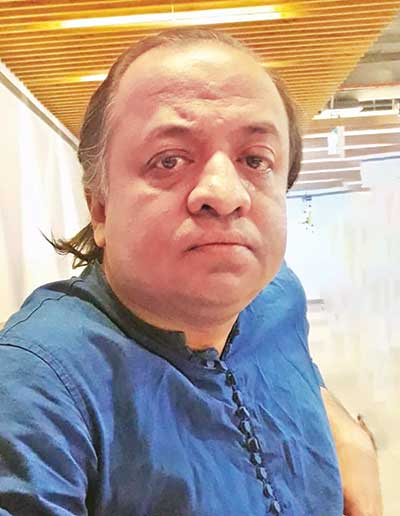 On a winter rainy day in the year 2003, I with some significant painters had an adda at Shilpangan Gallery at Road 5 in Dhanmondi. The adda was lively and our attention was suddenly grabbed by a man who came wearing a gamcha-turned-shirt. The man was restless and occupied with the phone. He was Syed Abdullah Khalid. Sculptor Hamiduzzaman Khan introduced me to him and that night Khalid brought us to his residence in Elephant Road. The apartment was full of different sizes of realistic sculptures and vibrant paintings. A collection of books was also at the corner of the room where he lived.
After that our friendship grew stronger and I met many people at his house in many social gatherings like the levelheaded persons- social activist late Sir FazleHasan Abed, late National Professor Anisuzzaman, architect and art critic Professor Shamsul Wares, architect Ziaul Huq Chowdhury, banker Anis A Khan and many more. Khalid was amicable and maintained close ties with his preferred persons. This amicability earned him friendships with several legendary personalities of the country. He created busts of Dr. Motahar Hossain Chowdhury, Professor Abdur Razzaque, folklorist Monsur Uddin Ahmed and poet Jasimuddin, among others.
As he was passionate and introvert, I always observed him evading human preoccupations, publicity, newspaper coverage, fame and domination. He was a foodie and deeply observed the people around him and spoke very significantly that is to say, if he ever did. We have a circle where most of them are architects and Khalid was one of the only two sculptors amidst us. Syed Abdullah Khalid is regarded as one of the most brilliant sculptors of our country. He is mainly recognised for his "Aparajeyo Bangla", one of the most familiar sculptures, and considered a landmark in Dhaka University campus.
The sculpture is a reflection of the Bengali vigilance and indomitable yearning for freedom. The project was launched in 1973 when this artist was a young teacher at the Department of Fine Arts, Chittagong University. Throughout the making of the sculpture, Khalid had to face opposition from religious fanatics.
In the midst of 1973, when Khalid was working as a young faculty member at the department of Fine Arts in Chittagong University, the DUCSU (Dhaka University Central Students' Union) committee commissioned him to build a monument that would depict the glory of the Liberation War. During that time, he started looking for people who would model for his miniature scale structure. In his layout, he planned for three figures where the centre one would be a farmer with a rifle on his shoulder and grenade in his hand. On the left side there would be a lady with a first aid box in her hand and on the right side there would be a student who would represent the young student body who took part in the war.
Hasina Ahmed, Syed Hamid Moksood and BadrulAlamBenu, who were very close to Khalid, modelled for "Aparajeyo Bangla". He used to work 12-14 hours on average everyday to create his three-foot miniature scale model. His models would dedicate three hours for this project everyday for three months. The sculptor closely observed the models' personalities and his close association with them enabled him to do justice with his portrayal.
On August 15, 1975, the work suddenly came to a halt because of the heinous murder of Bangabandhu Sheikh Mujibur Rahman. Political instability and the arrest of the then Vice-chancellor of Dhaka University, Abdul Matin Chowdhury, also disrupted the work. The project remained incomplete till the end of 1978. Some fundamentalist groups tried to demolish the sculpture in 1977. However, the brave students of Dhaka University fiercely guarded the work. After a long hiatus, the work began once more in the beginning of 1979 -- with a new vision. At last the project was finished on December 16, 1979. The sculpture was inaugurated by wounded freedom fighters.
There are monuments recognised and commissioned by the government, and then there are those made by the people. "Aparajeyo Bangla" falls in the latter category. The sculptor wanted to do something for the country and fellow citizens. After the Liberation War, he contemplated a plan to create a symbol which would inspire generations of Bangladeshis.
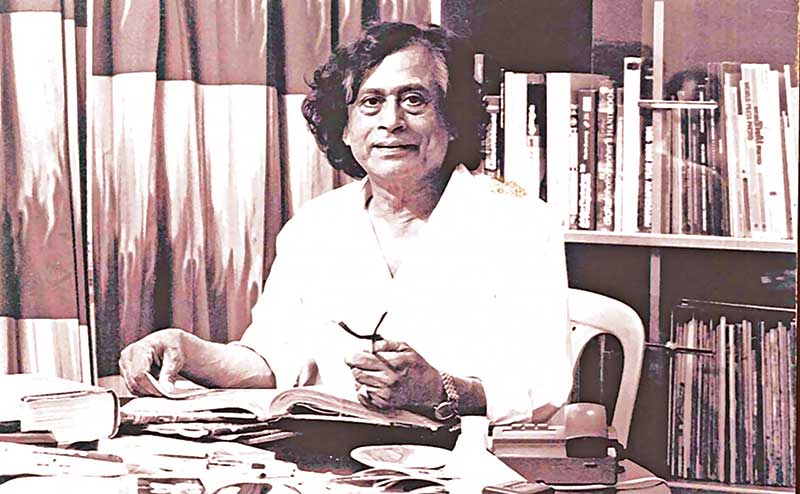 Throughout his artistic journey, the cerebral sculptor has created sculpture of different shapes and sizes, using different kinds of material like cement, stone, fiber glass, ceramic and clay and a variety of processes and techniques. Many of them depict our glorious history of the Language Movement and Liberation War. Besides those, his unique murals in pottery, metals or mosaic can be seen on the walls of many residences and office buildings of the country.
A multi-talented artist, Khalid has not only excelled in sculpture but also made an impression with his paintings. Throughout the '80s and '90s and first decade of 21st century the artist had been active. Khalid is inclined to use a large canvas for depicting untamed nature, landscapes and still life (flower based). Losing himself in the natural world, the artist frequently takes themes from this affluent source and plays with shades and textures on canvas. He occasionally likes to experiment with diverse vague and plain forms, and enjoys breaking and constructing them in many ways. Blossoming and budding flowers as well as dense forests are recurring features in his paintings. In many of Khalid's works, one finds a great interchange between abstract and realistic forms.
Khalid mainly dealt with the seasonal flowers of Bangladesh. He was overwhelmed by the vivid colours of spring flowers, especially Sonalu, Radhachura and Krishnachura. His very picturesque and appealing natural observation is profoundly embedded in his psyche and his acrylic and mixed media (a few done in oil) based paintings are created spontaneously with his skilled hands brushing colours in the easels. The painter uses close-up views of the branches of trees containing patches of flowers of different colours and then distorts the work by splashing colour pigments.
As an abstract expressionist, the painter's focus is on colour and its various facets. He also experiments with unstructured forms and vague compositions, which are scrupulously used in his works. The artist has applied colours directly piling up thick and at times thin layers on the canvas, and has created images that are bold and dynamic. Strong brush strokes make a textural state in his works which have not been intentionally done. At times, he deliberately creates a texture according to the paintings' distinctive requirements. He concentrates more on the application aspect and this trait creates a personal hallmark for his creations.
In his long chequered life, Khalid gradually transformed his style into pure impressionism, where colour is the main focal point in his paintings and forms have been diluted there appropriately. In his use of materials and tints, he frequently went for the bold and natural. Khalid's paintings generally symbolise the romantic notion that the delights of this world have short shelf life. The paintings with flowers by Khalid are sometimes characterised by loose brushstrokes, simple forms and contrasting colours. He has discarded the careful shading and colour transitions of botanical illustrations in favour of a fresh look that unabashedly declares the role of artistic interpretation to be more important than careful accuracy.
The artist also used outlining (the shapes) and strong lighting contrasts in his paintings and he also rejected the tradition of profound space and viewpoint that have been prominent in art for centuries. His works stay near the surface of the painting, emphasising on the materials of art rather than the illusions of art. The result is a shimmering effect that has helped to keep his paintings amongst the most recognisable images in the contemporary art scene.
Some of his notable works include "Ankur" at the factory premises of Squibb Pharmaceuticals, a mural called "Abahaman Bangla" inside the premises of the Bangladesh Television Center in Rampura, a monument for martyrs called "Angikar" in Chandpur, the ShahidMinar of Chittagong University and a terracotta relief mural called "Toiling Masses" in the conference room of the Daily Ittefaq. His other noteworthy sculptures are "Eternal Bengal", "Dolphin" and "Mother and Child".
The artist received many prestigious awards in his long chequered life. He received 'Shilpakala Award', 'Ekushey Padak' for his outstanding contributions to Bangladeshi art.
May 20 marked the fourth death anniversary of Syed Abdullah Khalid.
The writer is an art critic and cultural curator
Loading...
Loading...
Also read



Editor : Iqbal Sobhan Chowdhury
Published by the Editor on behalf of the Observer Ltd. from Globe Printers, 24/A, New Eskaton Road, Ramna, Dhaka.
Editorial, News and Commercial Offices : Aziz Bhaban (2nd floor), 93, Motijheel C/A, Dhaka-1000.
Phone: PABX- 41053001-06; Advertisement: 41053012; 01793317829, 01550707291, E-mail: [email protected], [email protected] Online: email: [email protected] 41053014; 01550707297 Advertisement: 01550707296
Published by the Editor on behalf of the Observer Ltd. from Globe Printers, 24/A, New Eskaton Road, Ramna, Dhaka.
Editorial, News and Commercial Offices : Aziz Bhaban (2nd floor), 93, Motijheel C/A, Dhaka-1000.
Phone: PABX- 41053001-06; Advertisement: 41053012; 01793317829, 01550707291, E-mail: [email protected], [email protected] Online: email: [email protected] 41053014; 01550707297 Advertisement: 01550707296


