



| HEADLINE |

|
Mega-projects moving Bangladesh forward
Published : Monday, 18 March, 2024 at 12:00 AM
Anika Fatima


 Multiple mega-projects were initiated over the past years with high expectations. In pursuit of these ambitious endeavours, Bangladesh has placed strong emphasis on careful decision-making, adopting a forward-thinking approach, engaging in extensive long-term planning, and ultimately formulating a comprehensive strategy for social integration. Through this integration, a significant portion of our large population struggling to achieve a quality of life, will need to quickly absorb new technologies, facilities, lifestyles, and amenities. Faster absorption into society will hasten the economic returns of investments.
In the coming years, we anticipate stronger efforts, aiming to realize both national and global aspirations. We have to transform into a society in which techno-economic advancement will address the societal needs of the twenty-first century. Deep integration of physical space with digital cyberspace is on the horizon. For this to be achieved, several critical factors are meticulously weighed to ensure the optimal success of our mega-projects. Support for the agro-economy will be a focus.
What may be deemed crucial infrastructure today might be obsolete in the next century. Without foresight, projects run the risk of becoming obsolete before their intended lifespan concludes. This underscores the importance of adaptability and forward-thinking in infrastructure planning to ensure relevance and sustainability over time.
In Bangladesh, mega-projects are developed strategically, anticipating future requirements in a phased manner. For instance, in the construction of a large bridge, provisions are made for cars and trains. The primary framework of these mega structures is built robustly for long-term durability, whereas consumable features designed for shorter life cycles are considered for eventual replacement with more substantial structures. The consumable parts of the design are adapted to the present vehicle types, allowing for modifications if heavy vehicles of a different kind emerge in the next two decades. This approach prevents economically unviable investments, such as installing heavy auxiliary elements prematurely.
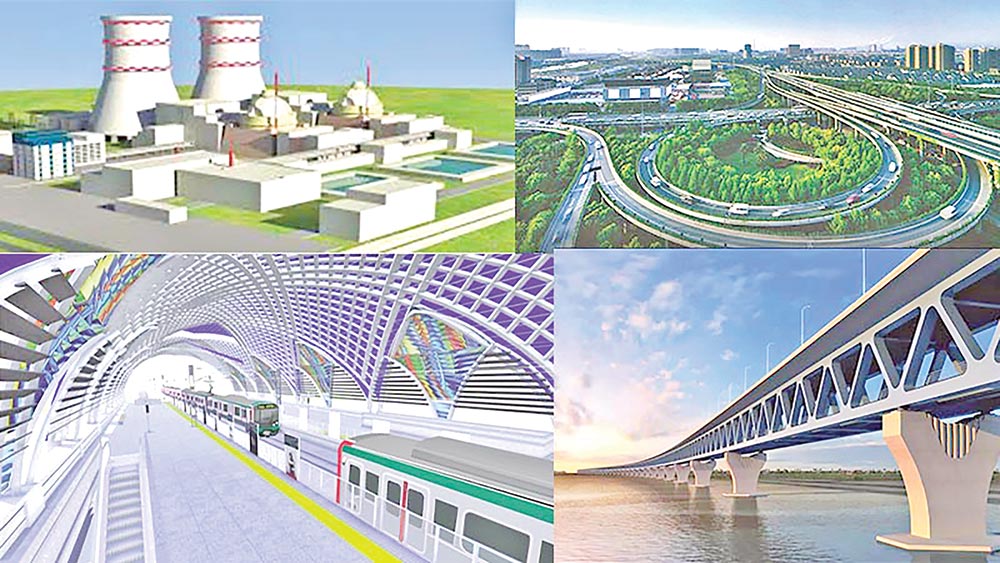
In recent years, several infrastructure initiatives have been undertaken using public-private partnership (PPP) models, providing flexibility in execution through diverse approaches. In one scenario, the private sector covers construction costs through toll collections for a specified duration. Alternatively, the public partner may reimburse construction costs to the private investor in instalments, contingent upon adherence to agreed-upon performance criteria. When examining the terms and conditions of PPP projects, investments are consistently rooted in financial viability. Strategic investments are made, considering the significance of the national assets envisioned to be acquired through a PPP project with the foresight of its service lifetime.
Social viability is an important aspect. Mega-projects, introduced through what we term soft openings and gradual launches, execute a dual integration strategy: technical and social. For example, the metro rails user base is steadily growing after overcoming the initial wave of use based on curiosity, reflecting a solid rising trend. This presents the possibility of faster social integration of the next metro lines, which are now under construction. Understanding rules, maintenance, and safety measures have become integral to the operation. It is crucial that mega-projects, such as the metro rail, are not planned exclusively for a specific societal class; integration across all strata is essential. Rushing the integration process, akin to introducing a new house or car, risks a sunk investment. Therefore, a gradual approach, familiarizing people over time, is pivotal.
The integration strategy extends also to projects such as the Padma Bridge and the Bangabandhu Sheikh Mujibur Rahman Tunnel. The goal is to avoid immediate saturation upon opening, signalling a projects limitations in meeting future demands. The successful launch of Bangladeshs mega-projects aligns with demand predictions, but the challenge lies in societal adaptation which the nation is now overcoming.
In the realm of larger projects, meticulous planning becomes imperative. As society increasingly relies on this infrastructure, secondary and tertiary alignments in mega-planning take precedence. An exemplary illustration is the Bangabandhu Bridge, where foresighted leadership included a railway track provision along with the roadway. Initially, it was a single-track railway; subsequently, a completely new double-track bridge on the same alignment is being constructed because train frequency rose through social acceptance, leading to demand saturation which proved astute planning.
The forward-looking approach extends to future scenarios. If the rail track is removed from the existing Bangabandhu Bridge, conversion of the space to roads could expand lane capacities for a larger throughput. This stepwise investment strategy allows for adaptability and optimal resource utilization.
We are currently working with the City Corporation, and our plan is to improve footpaths for pedestrians. To enhance the productivity of the Mass Rapid Transit (MRT) line and make metro projects suitable for wider user groups and income levels, it is crucial to widen footpaths, providing sufficient space in front of and behind them for people to walk comfortably. Pedestrian-friendly footpaths will enhance access to MRT stations.
Footpaths in Dhaka have yet to receive adequate attention for uninterrupted door-to-door pedestrian friendliness. Without providing decent space for people to walk, it is difficult to encourage footpath usage and keep pedestrians away from the vehicle carriageway. Our objective is to make footpaths social activity- and pedestrian-friendly. We aim to ensure a minimum footpath width suitable for comfortable walks, alone or in groups. We are adopting a comprehensive approach by including amenities such as benches, accommodating social activities, and providing users with free spaces to walk.
With the gradual adoption of a mass transport system for a broader user group, the need for a vehicle carriageway is expected to diminish. Plans should be in place to enhance the adaptation of the mass transport system beyond the MRTs.
Most existing constructions may not withstand a strong earthquake, and our goal is for facilities in redeveloped spaces to be earthquake resistant. In addition to earthquake-resistant structures, we must establish a warning system for earthquakes. Warnings will be sent to mobile phones before an earthquake, with specific messages sent to designated places, resulting in the closure of national assets, such as electricity and gas transmissions, as well as rail and metro operations. However, care must be taken to ensure that the message is reliable and that false shutdowns do not occur. Casualties can also be reduced through preparedness for disasters.
Many major development projects have been completed in Bangladesh in recent years, and it is time to see the returns from these projects. The returns need to be calculated carefully with justifiable accuracy, avoiding underestimation and overestimation. Short-term vision or exaggeration can be problematic. In 2024, we need to focus on this meticulous calculation-a self-assessment. At the moment, gauging the breadth and depth of the impact is challenging, but it is undoubtedly showing positive results.
With the soft opening of the First Dhaka Elevated Expressway, the city is now gaining some breathing space for several routes. After the projects completion, a positive outcome is expected beyond the current experiences, as the road capacity of Dhaka city for various origins and destinations will significantly increase. In the long run, a bypass facility over Dhaka City is expected. Savings in fuel costs from the use of the expressway are much lower than the gain in time savings for the users, contributing directly to the national inputs.
Sometimes, we had to accept construction defects within a tolerable range because there was already an investment there, and the identified defect did not compromise safety. The Bangabandhu Bridge was repaired after many years of severe use, but it has truly served for decades, operated and maintained efficiently without compromising safety. Social integration took place, contributing to unfathomable economic growth by bonding the north with the rest of Bangladesh. Considering the life cycle cost, the project was very beneficial because it achieved the desired objectives and earned enough money for its own treatment.
We should not be short-sighted in our vision. Integration between projects in partially or fully complete states is crucial; with integration, our infrastructure as a system will be increasingly effective. Integration between our physical spaces and a secured cyberspace will make the infrastructure system more robust, safer, user-friendly, and sustainable. When infrastructures are connected, a dramatic change must manifest to achieve social transformation. The dynamics of demand and supply are essential and produce positive results. In the next cycle of our development, faster transformations can occur in a society where deeper and broader roots of education will exist. People will use infrastructure to have sweet dreams at night, but daydreams are the gears that motivate the next cycle for social emancipation.
The writer is an Editorial Assistant at The Daily Observer
Loading...
Loading...
Also read





Editor : Iqbal Sobhan Chowdhury
Published by the Editor on behalf of the Observer Ltd. from Globe Printers, 24/A, New Eskaton Road, Ramna, Dhaka.
Editorial, News and Commercial Offices : Aziz Bhaban (2nd floor), 93, Motijheel C/A, Dhaka-1000.
Phone: PABX- 41053001-06; Advertisement: 41053012; 01793317829, 01550707291, E-mail: [email protected], [email protected] Online: email: [email protected] 41053014; 01550707297 Advertisement: 01550707296
Published by the Editor on behalf of the Observer Ltd. from Globe Printers, 24/A, New Eskaton Road, Ramna, Dhaka.
Editorial, News and Commercial Offices : Aziz Bhaban (2nd floor), 93, Motijheel C/A, Dhaka-1000.
Phone: PABX- 41053001-06; Advertisement: 41053012; 01793317829, 01550707291, E-mail: [email protected], [email protected] Online: email: [email protected] 41053014; 01550707297 Advertisement: 01550707296


