



| HEADLINE |

|
When it comes to helping those with impairments, appropriate recognition is key
Published : Monday, 18 March, 2024 at 12:00 AM
Golam Hafiz Fahim & Raiyana Ahammed


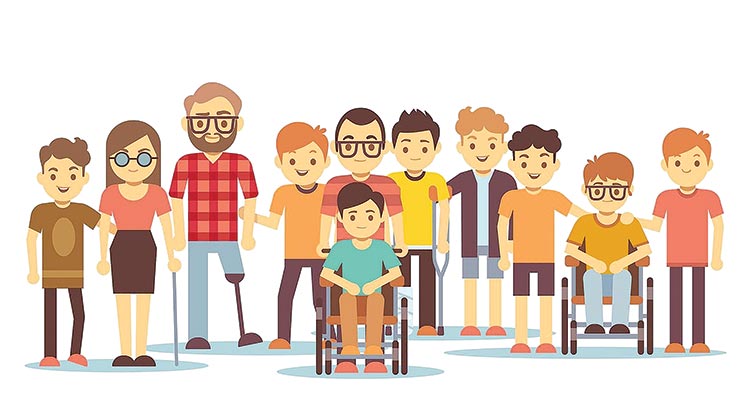 The government of Bangladesh has taken several decisions and is actively trying to protect the rights of people with disabilities. A National Executive Committee and a National Coordinating Committee were established under the Rights and Protection of Persons with Disabilities Act of 2013.
A few years ago, we saw a kid in the movie "Taare Zameen Par" who had trouble reading, writing, spelling, and doing math. He also had difficulty paying attention to what was going on around him. We saw that Ishaan Awasthi, a kid, has been identified with dyslexia. Dyslexia is a genre of learning disability. If Ishaan Awasthi had been born in Bangladesh, he would never have been recognised as a child for having learning disabilities. Because learning disabilities are still not seen as legalized disabilities in our country. So, he was always treated as stupid, a fool, uninformed, a lousy student, etc. Hundreds of kids in our society, like Ishaan Awasthi, don do as well in school as they should, even though they work very hard.
Disability is a multifaceted, ever-changing, and contentious issue. Different people experience disability in different ways, much like snowflakes. A persons structure, talents, and needs are unique from one another when they have a disability. According to Rights and Protection of persons with disabilities Act 2013 The term "disability" refers to a persons inability to fully and effectively participate in society equally due to a long-term or permanent impairment or disadvantage affecting their physical, mental, intellectual, developmental, or sensory abilities. This impairment can be caused by any reason, including the mutually reinforcing impact of environmental and attitude barriers. In the estimation of the World Health Organization (WHO), almost 1.3 billion individuals experience significant disability. One in six of us, or sixteen percent of the global population, falls into this group of individuals and one in every ten children is a child with a disability. The developing countries hold over 80% of total population of person with disabilities.
There are an estimated 27.168 million people living with one or more significant disabilities in Bangladesh, representing 16% of the total population, according to norms. Interestingly, the National Survey of Persons with Disabilities (NSPD) found that there are 4.62 million people with disabilities, or 2.8% of the overall population, according to a survey released in December 2022. To what extent is the countrys disability population much lower than average?
Legalized in Bangladesh, there are twelve different types of impairments as per the Rights and Protection of Persons with Disabilities Act 2013. However, there are a variety of impairments that are both common and not addressed by legislation; for example, those with communication, language, or speech difficulties; those with emotional or behavioural issues; and learning disabilities.
The government of Bangladesh has taken several decisions and is actively trying to protect the rights of people with disabilities. A National Executive Committee and a National Coordinating Committee were established under the Rights and Protection of Persons with Disabilities Act of 2013. It is within the authority of the national coordinating committee to recognize additional impairments as disabilities to provide interventions. The United Nations recognizes that 10% of the worlds children have some kind of disabilities.
Although conditions such as dyslexia, executive function disorder, perceptual difficulties, brain damage, developmental aphasia, minimum brain dysfunction, emotional and behavioural disorders, and so on are acknowledged worldwide. But the greatest tragedy is that in our country with a specific learning disability, a person is never able to know that they have some disability, and they, at times, start to believe that they are a blockhead, good for nothing, or won be able to study. In their later lives, they face frustration and extreme levels of depression that lead to suicidal attempts. Students with these issues are sometimes referred to as "different to normal children. Here being different means, "A child is not able to receive information through the normal senses, is not able to express himself or herself, or process information to slowly or two quickly, special adaptation in the education program and necessary." (by Samuel krick)
A learning disability is defined as a lack of proficiency in listening, thinking, speaking, writing, spelling, or doing basic arithmetic calculations as a result of a problem with one or more of the fundamental psychological processes involved in comprehending and using spoken or written language (IDEA 2004). Problems with information reception, processing, or elicitation can be symptoms of a learning impairment in children.
Processing and eliciting might be hindered if a youngster encounters difficulties in the initial step of acquiring information. Very seldom, a youngster may absorb knowledge and be able to understand it, but they may struggle to articulate themselves perfectly. When there are more than forty kids in a classroom in Bangladesh, instructors are unable to pay attention to the smallest details, and some might not even be aware that one of their pupils has a learning handicap. By recognizing these limitations, the intervention procedure may go without a hitch and the rights can be surely preserved.
The writers are B. ED students in Institute of Education and Research (IER) at Jagannath University
Loading...
Loading...
Also read




Editor : Iqbal Sobhan Chowdhury
Published by the Editor on behalf of the Observer Ltd. from Globe Printers, 24/A, New Eskaton Road, Ramna, Dhaka.
Editorial, News and Commercial Offices : Aziz Bhaban (2nd floor), 93, Motijheel C/A, Dhaka-1000.
Phone: PABX- 41053001-06; Advertisement: 41053012; 01793317829, 01550707291, E-mail: [email protected], [email protected] Online: email: [email protected] 41053014; 01550707297 Advertisement: 01550707296
Published by the Editor on behalf of the Observer Ltd. from Globe Printers, 24/A, New Eskaton Road, Ramna, Dhaka.
Editorial, News and Commercial Offices : Aziz Bhaban (2nd floor), 93, Motijheel C/A, Dhaka-1000.
Phone: PABX- 41053001-06; Advertisement: 41053012; 01793317829, 01550707291, E-mail: [email protected], [email protected] Online: email: [email protected] 41053014; 01550707297 Advertisement: 01550707296


