



| HEADLINE |

|
Bangladesher Chalacchitre Deshatmobodhok Gan
Published : Saturday, 26 October, 2024 at 12:00 AM
Ahasan Uddin Bhuiyan


 �Let a little song appeal to the ear, or a noble book to the heart to discover a new world�- William J. Long
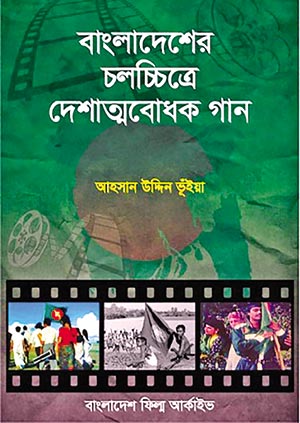
�Beyond every book is a man; beyond the man is the race; and behind the race are the national and social environments whose influence is unconsciously reflected in films". Ahsan Uddin Bhuiyan's Patriotic Songs in Films of Bangladesh (Bangladeshser Chalacchitre Deshatmobodhok Gan) is a notable scholarly contribution to both film studies and musicology. It is based on his research titled "Characteristics Analysis of Patriotic Songs in Post-Independence Bangladeshi Films" (Swadhinotattor Bangladeshser Chalacchitre Deshatmobodhok Ganer Boishisthya Bishleshon), conducted under the guidance of Dr. Sayem Rana of Dhaka University's (DU) Music Department. Bhuiyan, a post-graduate in Public Administration from DU, journalist in The Daily Observer, independent filmmaker, and young lawyer, provides a nuanced analysis of how patriotic songs have shaped the national identity of Bangladesh in the wake of the independence.
By critically engaging with the interplay of cinema, music, and nationalism, the book offers a rich examination of cultural narratives in the post-colonial Bangladesh.
Published by the Bangladesh Film Archive (BFA), the monograph of the book is the result of a rigorous empirical researchcombing historical inquiry with theoretical analysis. This is "a must read" for scholars and students of films and music.
The book is divided into eight chapters, each delving into different facets of the subject. It opens with a historical overview of Bengali patriotic songs, tracing their origins and evolution from the East Pakistan era to independent Bangladesh.
Chapter-1 provides a historical overview of the integration of songs in early films and its gradual development, while Chapter- 2 meticulously traces the genealogy of Bengali patriotic songs. Bhuiyan's work in this chapter traces the origins and evolution of Bengali patriotic songs, offering insights valuable for both musical and historical studies. The first signs of patriotism in Bangladesh appeared in the late 18th century, sparked by the spread of English education, leading to Swadeshi consciousness.
Reviewed by Arnab Ashraf
Cultural activists promoted political awareness, starting with the Hindumela fair (1867-1899), where Bengali patriotic songs emerged, highlighting the people's lack of freedom. These songs gained momentum during the Swadeshi Movement (1905-1911), inspiring love for Bengal and self-sacrifice. Later, patriotic songs were central in movements like the Peasant Movement (Tevaga Andolon), the 1952 Language Movement, the 1971 Liberation War, the Anti-autocratic Movement in the 1990s, and the Shahbag Movement in 2013.
Chapter- 3 runs a robust theoretical framework, utilising musical semiology, particularly the work of Thomas Turino, alongside narrative theory as articulated by Richard Barsam and Dave Mohan. By employing these frameworks, the author effectively decodes the multilayered meanings embedded within the musical compositions and their cinematic deployment. Turino's semiological approach allows Bhuiyan to dissect the symbolic, emotional, and socio-cultural resonances of the patriotic songs, revealing them not merely as cinematic tools but as active agents in the construction of national and cultural memory.
A significant portion of the book is chapter-4, which is devoted to analysing the musical features of these patriotic songs, focusing on elements such as scale, rhythm, and playback styles. Bhuiyan also delves into the visual representation of these songs in Chapter- 5, offering a multimodal analysis of how sound and image work together to enhance the narrative. His comparison of Bangladeshi patriotic songs with those in international war films (from countries like Ireland, Bosnia, Algeria, and India) provides a transnational perspective, situating Bangladeshi cinema within global cinematic and cultural movements.
Chapter-6 compares patriotic songs in Bangladeshi liberation films with those from war films of other countries, which achieved independence by bloody wars including Ireland, Bosnia, Algeria, and India.
Bhuiyan's study incorporates the concept of 'third cinema,' a politically-driven film movement from Latin America that challenges Hollywood commercialism and European auteurism. In Chapter-7, he shows how songs in these films express revolutionary and anti-imperialist themes, focusing on class struggle, resistance, and social justice. His comparison with Latin American cinema places Bangladeshi patriotic songs within a broader global movement of revolutionary filmmaking, emphasizing their role as cultural artifacts that oppose both foreign and domestic hegemonies.
The study goes beyond theoretical analysis by incorporating both public reception and expert testimonies. It examines how patriotic songs in Bangladeshi films resonate with the general public, offering insights into their socio-cultural impact. This approach bridges the gap between academic analysis and popular culture.
In addition, the author focuses on the perspectives of prominent figures in Bangladesh's music and film industry, such as Sabina Yasmin, Khan Asifur Rahman Agun, lyricist Mohammad Rafiquzzaman, director ShameemAkter, and music director Emon Saha.
Their contributions provide insider insights to the creative processes behind these songs, enriching the study and validating Bhuiyan's findings.
In the concluding chapter, Bhuiyan synthesizes his findings, critically reflecting on the limitations of his study and proposing future avenues for research. His nuanced approach to the subject matter, blending historical contextualization with rigorous theoretical analysis, positions the book as a seminal work in both film and music studies within the Bangladeshi context.
The book's cover is visually striking, with reference photos that mix contextual and antique imagery, adding to its unique appeal.
Patriotic films and songs have the potential to serve as important soft power tools in a world full of conflict, though there is a shortage of well-crafted presentations. By exploring the intersection of nationalism, music, and cinema, Bhuiyan contributes to a deeper understanding of how cultural products, specifically patriotic songs, function as agents of ideological transmission and identity formation in postcolonial nations.In a short of span six months' fellowship for the research awarded by the BFA under a regular fellowship programme, this book is undoubtedly an oasis in the desert of research on films and patriotic songs in Bangladesh.
The writer is a journalist with The Daily Observer
Loading...
Loading...



Editor : Iqbal Sobhan Chowdhury
Published by the Editor on behalf of the Observer Ltd. from Globe Printers, 24/A, New Eskaton Road, Ramna, Dhaka.
Editorial, News and Commercial Offices : Aziz Bhaban (2nd floor), 93, Motijheel C/A, Dhaka-1000.
Phone: PABX- 41053001-06; Advertisement: 41053012; 01793317829, 01550707291, E-mail: [email protected], [email protected] Online: email: [email protected] 41053014; 01550707297 Advertisement: 01550707296
Published by the Editor on behalf of the Observer Ltd. from Globe Printers, 24/A, New Eskaton Road, Ramna, Dhaka.
Editorial, News and Commercial Offices : Aziz Bhaban (2nd floor), 93, Motijheel C/A, Dhaka-1000.
Phone: PABX- 41053001-06; Advertisement: 41053012; 01793317829, 01550707291, E-mail: [email protected], [email protected] Online: email: [email protected] 41053014; 01550707297 Advertisement: 01550707296


