



| HEADLINE |

|
BNP demands swift justice for uprising killings, urgent reforms, democratic transition
Published : Tuesday, 29 July, 2025 at 8:56 PM
Shakib Ahmed


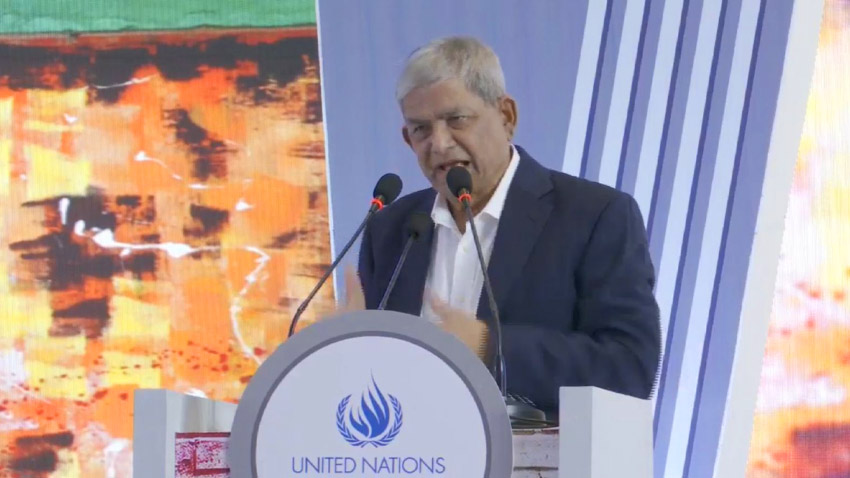
Bangladesh Nationalist Party (BNP) Secretary General Mirza Fakhrul Islam Alamgir on Sunday called for the immediate trial of those responsible for last year's deadly crackdown during July Revolution, while pressing for comprehensive reforms and a transition to a truly representative government.
Speaking at a commemorative event titled Commemoration and Dialogue at Dhaka’s Hotel Intercontinental—marking the anniversary of the July 2024 uprising—Fakhrul underscored the urgency of delivering justice and restoring democratic norms.
“We want a swift and transparent trial for the killings that occurred during the mass uprising,” Fakhrul stated. “At the same time, the long-overdue reforms must be implemented without delay.”
He reiterated the BNP’s stance that Bangladesh requires a government backed by a genuine public mandate. “There is a fundamental difference between governing with the people’s consent and without it,” he said, warning against any attempts to prolong unrepresentative rule.
Fakhrul expressed confidence in Chief Adviser Professor Muhammad Yunus, saying he hopes Yunus will fulfill his promise to hold free, fair, and inclusive elections. “Only through such an election can we establish a government and parliament that truly reflect the will of the people.”
The BNP leader also emphasized the need to rebuild national institutions, which he alleged were systematically dismantled under what he described as a “fascist regime.”
“Our institutional breakdown is at the root of many national problems,” he said. “Reconstruction will not be easy—it will take time, patience, and public resolve.”
He further pointed to the growing lack of tolerance in the country, warning that this could hinder the democratic transition. “If we’ve endured so many storms in the past, we can overcome this as well. But we must remain patient and united.”
The event also highlighted the findings of an independent fact-finding mission by the Office of the United Nations High Commissioner for Human Rights (OHCHR), which investigated the July–August 2024 events. The report, released on February 12, 2025, documented widespread violence and made recommendations aimed at preventing future abuses.
Speaking at a commemorative event titled Commemoration and Dialogue at Dhaka’s Hotel Intercontinental—marking the anniversary of the July 2024 uprising—Fakhrul underscored the urgency of delivering justice and restoring democratic norms.
“We want a swift and transparent trial for the killings that occurred during the mass uprising,” Fakhrul stated. “At the same time, the long-overdue reforms must be implemented without delay.”
He reiterated the BNP’s stance that Bangladesh requires a government backed by a genuine public mandate. “There is a fundamental difference between governing with the people’s consent and without it,” he said, warning against any attempts to prolong unrepresentative rule.
Fakhrul expressed confidence in Chief Adviser Professor Muhammad Yunus, saying he hopes Yunus will fulfill his promise to hold free, fair, and inclusive elections. “Only through such an election can we establish a government and parliament that truly reflect the will of the people.”
The BNP leader also emphasized the need to rebuild national institutions, which he alleged were systematically dismantled under what he described as a “fascist regime.”
“Our institutional breakdown is at the root of many national problems,” he said. “Reconstruction will not be easy—it will take time, patience, and public resolve.”
He further pointed to the growing lack of tolerance in the country, warning that this could hinder the democratic transition. “If we’ve endured so many storms in the past, we can overcome this as well. But we must remain patient and united.”
The event also highlighted the findings of an independent fact-finding mission by the Office of the United Nations High Commissioner for Human Rights (OHCHR), which investigated the July–August 2024 events. The report, released on February 12, 2025, documented widespread violence and made recommendations aimed at preventing future abuses.
Fakhrul thanked the UN for the report, calling it a “valuable document,” but added that it only captured a fraction of the suffering endured by the people.
“The scale of torture, repression, and state brutality was far worse,” he said. “Let us unite to write the full truth of what happened, and to honor the sacrifices made by so many.”
Calling for unity and democratic commitment, Fakhrul said, “Real change won’t come overnight. There will be no sudden miracle. But I firmly believe that only democracy can guide us forward.”
He also cautioned the media against exaggerating political differences, noting that disagreements among parties are natural in a functioning democracy. “By amplifying these divisions, we risk deepening polarization that serves no one,” he warned.
Fakhrul welcomed recent political consensus on 12 key issues, as reported in the media, and expressed optimism that outstanding matters could be resolved by the next elected government through goodwill and commitment.
He concluded with a call to the youth to help build a nation where human rights are protected and no child ever again has to die for justice.
Loading...
Loading...
Also read






Editor : Iqbal Sobhan Chowdhury
Published by the Editor on behalf of the Observer Ltd. from Globe Printers, 24/A, New Eskaton Road, Ramna, Dhaka.
Editorial, News and Commercial Offices : Aziz Bhaban (2nd floor), 93, Motijheel C/A, Dhaka-1000.
Phone: PABX- 41053001-06; Advertisement: 41053012; 01793317829, 01550707291, E-mail: [email protected], [email protected] Online: email: [email protected] 41053014; 01550707297 Advertisement: 01550707296
Published by the Editor on behalf of the Observer Ltd. from Globe Printers, 24/A, New Eskaton Road, Ramna, Dhaka.
Editorial, News and Commercial Offices : Aziz Bhaban (2nd floor), 93, Motijheel C/A, Dhaka-1000.
Phone: PABX- 41053001-06; Advertisement: 41053012; 01793317829, 01550707291, E-mail: [email protected], [email protected] Online: email: [email protected] 41053014; 01550707297 Advertisement: 01550707296


