



| HEADLINE |

|
RU withdraws summons of 91 female students over late dorm entry
Published : Tuesday, 2 September, 2025 at 9:52 PM
Observer Correspondent


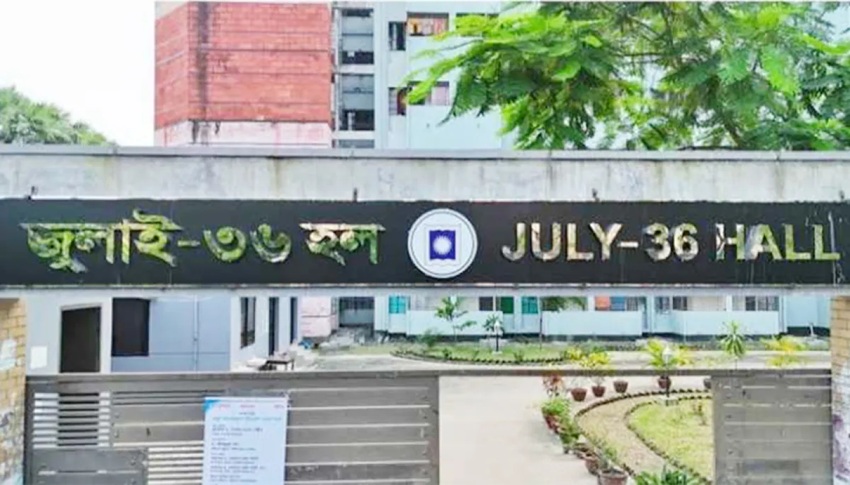
Rajshahi University authorities have withdrawn a controversial notice summoning 91 female students for returning late to their dormitory, following intense criticism on social media and among students.
The notice, issued by the administration of July-36 Hall, sparked a debate on gender discrimination and student autonomy.
The original notice, signed by Hall Provost Professor Lovely Nahar, directed students numbered 1 to 45 to appear at provost’s office on Tuesday (September 9) and students numbered 46 to 91 to appear on Wednesday (September 10). The reason cited was their return to the hall after designated curfew.
Once the notice went viral on social media Monday night, it triggered widespread criticism, with many calling the decision “discriminatory,” “unjustified,” and “paternalistic.” Others, however, defended the move, citing safety concerns and the need for accountability.
In response to the controversy, Professor Lovely Nahar clarified on Tuesday that the decision to summon students was made purely out of concern for their safety, especially in light of the upcoming RUCSU (Rajshahi University Central Students' Union) elections and reports of untoward incidents in other universities.
“They are like our own children. It’s our responsibility to ensure their safety and well-being,” she said, confirming that the notice had been officially withdrawn. “There was no punitive intent behind the summons; it was just a precautionary measure.”
The provost emphasized that the university aimed to prevent any potential threats to students, especially with politically sensitive RUCSU election approaching.
Reactions from students were mixed.
Mohammad Anwar Hossain, a student of Economics department, criticized the hall administration’s approach in a post on Facebook group “Rajshahi University Family.” He wrote, “The issue could’ve been handled differently. Issuing a public notice like this was irresponsible. The administration should act more sensibly.”
However, Anwar also posed a thought-provoking counterpoint, “What if all such restrictions are lifted and something tragic happens to one of our sisters? Who would we hold responsible then? We would still demand accountability from the same administration.”
On the other hand, Shah Poran, a student of Mass Communication and Journalism, criticized the gendered nature of the university's rules. Sharing the notice on his timeline, he asked, “Why does the university continue to differentiate between male and female students? Why can’t we just be treated as students; regardless of gender, religion or background?”
Although the notice has been withdrawn, the incident has reignited broader debates about campus freedom, safety and gender equity in Bangladesh’s higher education institutions.
RHF/SH
The notice, issued by the administration of July-36 Hall, sparked a debate on gender discrimination and student autonomy.
The original notice, signed by Hall Provost Professor Lovely Nahar, directed students numbered 1 to 45 to appear at provost’s office on Tuesday (September 9) and students numbered 46 to 91 to appear on Wednesday (September 10). The reason cited was their return to the hall after designated curfew.
Once the notice went viral on social media Monday night, it triggered widespread criticism, with many calling the decision “discriminatory,” “unjustified,” and “paternalistic.” Others, however, defended the move, citing safety concerns and the need for accountability.
In response to the controversy, Professor Lovely Nahar clarified on Tuesday that the decision to summon students was made purely out of concern for their safety, especially in light of the upcoming RUCSU (Rajshahi University Central Students' Union) elections and reports of untoward incidents in other universities.
“They are like our own children. It’s our responsibility to ensure their safety and well-being,” she said, confirming that the notice had been officially withdrawn. “There was no punitive intent behind the summons; it was just a precautionary measure.”
The provost emphasized that the university aimed to prevent any potential threats to students, especially with politically sensitive RUCSU election approaching.
Reactions from students were mixed.
Mohammad Anwar Hossain, a student of Economics department, criticized the hall administration’s approach in a post on Facebook group “Rajshahi University Family.” He wrote, “The issue could’ve been handled differently. Issuing a public notice like this was irresponsible. The administration should act more sensibly.”
However, Anwar also posed a thought-provoking counterpoint, “What if all such restrictions are lifted and something tragic happens to one of our sisters? Who would we hold responsible then? We would still demand accountability from the same administration.”
On the other hand, Shah Poran, a student of Mass Communication and Journalism, criticized the gendered nature of the university's rules. Sharing the notice on his timeline, he asked, “Why does the university continue to differentiate between male and female students? Why can’t we just be treated as students; regardless of gender, religion or background?”
Although the notice has been withdrawn, the incident has reignited broader debates about campus freedom, safety and gender equity in Bangladesh’s higher education institutions.
RHF/SH
Loading...
Loading...
Also read





Editor : Iqbal Sobhan Chowdhury
Published by the Editor on behalf of the Observer Ltd. from Globe Printers, 24/A, New Eskaton Road, Ramna, Dhaka.
Editorial, News and Commercial Offices : Aziz Bhaban (2nd floor), 93, Motijheel C/A, Dhaka-1000.
Phone: PABX- 41053001-06; Advertisement: 41053012; 01793317829, 01550707291, E-mail: [email protected], [email protected] Online: email: [email protected] 41053014; 01550707297 Advertisement: 01550707296
Published by the Editor on behalf of the Observer Ltd. from Globe Printers, 24/A, New Eskaton Road, Ramna, Dhaka.
Editorial, News and Commercial Offices : Aziz Bhaban (2nd floor), 93, Motijheel C/A, Dhaka-1000.
Phone: PABX- 41053001-06; Advertisement: 41053012; 01793317829, 01550707291, E-mail: [email protected], [email protected] Online: email: [email protected] 41053014; 01550707297 Advertisement: 01550707296


