



| HEADLINE |

|
United Islamic parties can get a majority in February election: Mamunul Haque
Published : Sunday, 14 September, 2025 at 12:00 AM
Ahasan Uddin Bhuiyan and Walid Khan


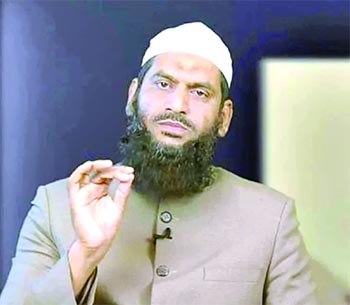 In an exclusive interview with The Daily Observer, Amir of Bangladesh Khelafat Majlis and Joint Secretary-General of Hefazat-e-Islam Mamunul Haque, who is a leading figure of Islamic forces discussed the uncertainties and challenges surrounding the forthcoming national elections, the implementation of proportional representation (PR) system in polls and the need of creating a level playing field in the country's political arena. He emphasised that while the PR system is not a pre-condition for participation in the next election but the July Charter must be legally institutionalised before any credible election can take place. Mamunul Haque also cautioned against the entrenched dominance of BNP and Awami League in the state apparatus. He spoke on the prospects of Islamic unity and dismissed the possibility of Awami League's immediate political revival following the July Uprising. He did not clarify whether they will form alliance with Jamaat-e-Islam.
Following is the excerpt of the interview:
DO: Do you think that the next national election will be held within the declared timeframe by February next, given the prevailing political environment and lack of consensus among the political parties?
MH: There is a strong possibility that the election will be held on schedule, though certain uncertainties still remain.
DO: If the election is held without introducing the Proportional Representation (PR) system, will you still participate?
MH: Our party has made its position on the PR system very clear. If an Upper House is constituted in line with the discussions of the National Consensus Commission (NCC), it must be based on
proportional representation (PR) through votes, not constituencies as proposed by the BNP. We opposed BNP's model because it distorts representation. We did not demand a full PR system in the Lower House but rather a Mixed-PR framework. If there is no PR in the Upper House, then we see no justification for having one at all. However, PR is not a pre-condition for us to contest the polls. There are other pressing priorities we consider more fundamental than PR.
DO: What are those priorities?
MH: The foremost issue is the implementation of the July Charter. Its draft must be legally recognised and institutionalised at any cost. Establishing its legitimacy before the election is non-negotiable in our view.
DO: What legal basis do you propose for July Charter implementation?
MH: There are three possible avenues. First, the formation of a Constituent Assembly, which could provide the July Charter with constitutional legitimacy. Second, a nationwide referendum. Third, by Presidential Order, though that option carries significant weaknesses.
DO: It is being said that all Islamic parties are moving toward an alliance with Jamaat-e-Islami. What is your stance?
MH: At this moment, our focus is on realising the demands of the people and institutionalising the aspirations of the July Uprising, rather than rushing into alliance-building. Besides, alliances are closely tied to the PR system. According to the July Charter of the NCC, the Upper House is to be formed on PR, though BNP issued a note of dissent. If PR is ensured, the entire calculation of alliances changes fundamentally.
* Uncertainties remain on election in February
* We oppose BNP's stand, demand PR in Upper House
* Implementation of July Charter a must before polls
* Interim govt weak to guarantee level playing field
* If parties fail to reach consensus on July Charter the military or army-backed setup can intervene like 1/11
DO: Some parties have already announced their candidates. Have you finalised yours?
MH: We have declared candidates in 268 constituencies. In 32 seats, multiple aspirants are still under consideration. Our plan is to field candidates in all 300 constituencies.
DO: Do you believe reforms in the state alone are sufficient, or do political parties themselves need internal reforms?
MH: If fundamental changes are made in the electoral system and the political framework, then parties will be compelled to reform internally to adapt. Issues of party democratisation have already surfaced in the Reform Commission, where opinions differ, especially from an Islamic standpoint. If a credible electoral and reform framework is established, then entrenched practices like money politics and muscle power will naturally come under control.
DO: Many say BNP is a dominant political force and smaller parties feel insecure. How do you view this?
MH: The current electoral system resembles a game where only a few players dominate while the rest remain as spectators. BNP and the ousted Awami League turn elections into their own arrangement, where their candidates are players and the people mere spectators. The use of black money, muscle power, vote rigging, intimidation of opposition voters and partisan administration are the standard features of this game. Party loyalists have captured the administration-BNP loyalists dominate at present while Awami League loyalists occupy weaker positions. In such a partisan structure, a truly fair election is difficult. We have already submitted proposals to the NCC to curb over-expenditure, minimize showdowns and reduce the need for candidates to deploy agents at every polling centre.
DO: There is a perception that Awami League commands a significant vote bank. Where do you see those votes would tilt if AL does not contest the next election?
MH: BNP is working aggressively to capture it. Another possibility is that Awami League leaders may contest under different banners or through allied fronts, which could redirect this vote bank toward them indirectly.
DO: Do you think the current interim government has the capacity to ensure a level playing field?
MH: No. The interim government suffers from structural weaknesses and lacks the capacity to guarantee a level playing field.
DO: What is your suggestion to the interim government in this regard?
MH: Administrative neutrality is the key. Large-scale recruitment or reshuffling is not feasible within a year or two. The only realistic way is to create a neutral administrative environment where no party dominates.
DO: Do you think Islamic parties can increase their vote share in the post-August 5 context?
MH: If all Islamic parties unite, it is not impossible for the Islamic forces to secure a majority. A survey conducted by the NCC revealed that 69 per cent of respondents supported a Shariah-based state system. The people have trust in Islam and Shariah. The failure lies with us-we could not institutionalise this sentiment politically.
DO: If there is such public support, why have Islamic parties do not forge unite?
MH: That is not entirely true. Islamic parties have united in the past including in 1991, 1996 and 2001, when many contested jointly. Even now, there is a strong possibility of unity for the coming election and discussions are ongoing. But the prevailing political culture favours those with muscle and money. Thus, despite their affection for Islamic leaders, people often vote for otherwise powerful forces.
DO: On August 5 last year, when leaders gathered to form an interim government, what was discussed?
MH: It is not accurate to say that we went to form a government that day. When Sheikh Hasina resigned and fled, the Army Chief called us urgently, along with leaders of BNP, Jamaat, Jatiya Party and others. We discussed the unfolding situation. Later that evening, the Army Chief addressed the nation and inform about the interim government.
DO: What was the agenda of that meeting?
MH: The agenda was not government formation. It was about managing the state after Sheikh Hasina's departure. Earlier that day, emergency consultations took place under the President's initiative at Bangabhaban. Between August 5 and August 8, the framework of the interim government was finalised primarily through discussions between the Bangabhaban and July Uprising leaders. We only insisted that a religious representative be included, which was accepted. The student leaders played a decisive role in shaping the interim arrangement.
DO: A proposal for a National Government was also floated. What was your position?
MH: That proposal never formally reached to us. It remained confined to discussions between BNP and the student leadership. From what we learned, BNP did not agree, which prevented it from materialising. Had they agreed, we and others would have joined in a second phase.
DO: During your past movement, the last government tried to discredit you with personal controversies. How do you respond?
MH: It was nothing but a politically motivated conspiracy. Like any citizen, I have a personal life beyond my political and professional identity. The state machinery was deployed against me with its full force, breaking down my small personal security setup, arresting my people and orchestrating harassment. It was condemnable and exposed the vindictive nature of that regime.
DO: Jamaat demands PR while BNP opposes it. Do you think a third force could emerge amid such a deadlock?
MH: The possibility cannot be ruled out. If parties remain uncompromising, the military or an army-backed interim setup could intervene, as happened during the one-eleven scenario.
DO: How do you see Awami League's political future?
MH: I do not see their comeback in the near future. The people have not forgotten their authoritarian excesses, especially the brutality witnessed during the July Uprising. It may take decades for them to regain trust. Only if a future government deliberately creates space for them could they attempt a limited comeback, but their road to recovery is very long.
DO: Do you think any Islamic party could give space to Awami League?
MH: No. The Islamic parties have no soft corner for Awami League. BNP might be pressured internationally to negotiate, but given Awami League's consistent hostility toward Islamic politics, it is unlikely that Islamic parties will extend them any political space.
Loading...
Loading...
Also read


Editor : Iqbal Sobhan Chowdhury
Published by the Editor on behalf of the Observer Ltd. from Globe Printers, 24/A, New Eskaton Road, Ramna, Dhaka.
Editorial, News and Commercial Offices : Aziz Bhaban (2nd floor), 93, Motijheel C/A, Dhaka-1000.
Phone: PABX- 41053001-06; Advertisement: 41053012; 01793317829, 01550707291, E-mail: [email protected], [email protected] Online: email: [email protected] 41053014; 01550707297 Advertisement: 01550707296
Published by the Editor on behalf of the Observer Ltd. from Globe Printers, 24/A, New Eskaton Road, Ramna, Dhaka.
Editorial, News and Commercial Offices : Aziz Bhaban (2nd floor), 93, Motijheel C/A, Dhaka-1000.
Phone: PABX- 41053001-06; Advertisement: 41053012; 01793317829, 01550707291, E-mail: [email protected], [email protected] Online: email: [email protected] 41053014; 01550707297 Advertisement: 01550707296


