



| HEADLINE |

|
Historic cane industry fights for survival in Rajshahi
Published : Friday, 3 October, 2025 at 12:00 AM
Rafiqul Hasan Firoz


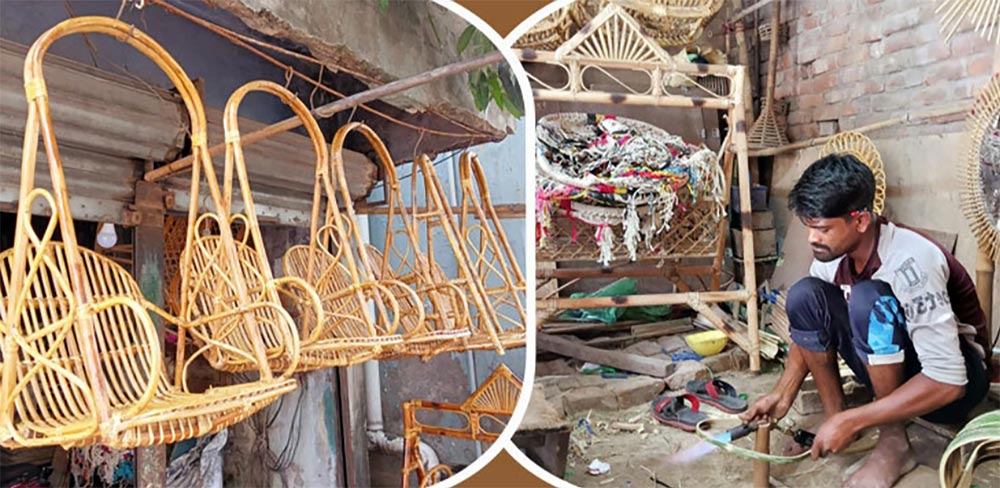 RAJSHAHI, Oct 2: Hoseniganj area in the Rajshahi City was once renowned for its exquisite cane products. Even before independence, the area boomed as a 'Cane Patti' (Cane Market), with 15 to 20 shops producing a stunning array of decorative and essential household items. From elegant home decor to essential furniture, this market catered to all.
The craft was initially brought to life by skilled artisans who migrated from Sylhet. Their exceptional craftsmanship captivated the local community, who gradually embraced and mastered the art themselves. Over time, cane weaving became an integral part of the city's cultural heritage. It was a tradition for brides in Rajshahi to receive ornately crafted cane trays, baskets, or chairs as wedding gifts, a custom that also served as a symbol of social status.
However, that era of prosperity is now a distant memory. The once-thriving Cane Patti stands today as a silent witness to time, with only three shops remaining. The vibrant, festive atmosphere has vanished.
Mohammad Liton Sheikh, who has been associated with this craft for over 30 years, laments the decline. "Before, there were 15-20 shops; now there are only three," he says. "If a hand-crafted item costs Tk 300 to make, synthetic alternatives are available in the market for much less. People are losing interest in buying cane products. Even if someone buys for aesthetic reasons, it's now considered expensive. These cheap, chemical-based products are dealing a severe blow to our craft."
The challenges are multi-faceted. Beyond synthetic competition, space constraints pose a significant threat. Liton explains that the proliferation of coaching centres and multi-storied buildings in the area has made landlords reluctant to rent to them. Many long-term tenants have been forced to relocate. Furthermore, low wages are driving skilled artisans to other professions. "Where 50-60 artisans once worked, we now don't even have five across all three shops," he adds.
Mohammad Ali, a once-prominent businessman in Hoseniganj, shares a similar story. "I had over ten artisans working for me before; now I have only three," he states. "Artisans demand higher wages, but with the decline in market demand, it's impossible to meet. People are unwilling to pay the fair price that reflects the labour involved. We are merely struggling to survive; it's hard to say for how long."
Artisan Sohag highlights the issue of raw material scarcity. "It's difficult to source bamboo now. We have to bring it from the hilly areas of Chattogram and Sylhet, and the supply is often delayed," he says. "The products also get damaged during the monsoon. Moreover, if developers continue to encroach on the land for high-rises, even these three shops won't survive. Without government support, we see no future."
Artisans point out that surviving on a daily wage of Tk 300 is unsustainable, especially when one can earn more as a security guard or by driving an auto-rickshaw. Consequently, many are abandoning the craft, breaking a tradition where skills were passed down through generations.
Despite the challenges, a significant advantage of the cane industry is its eco-friendly nature. Cane products are 100 per cent natural, biodegradable, and hygienic. Preserving this craft is crucial for sustainable development.
Locals believe that revitalisation is possible by linking the industry with the tourism sector, blending traditional techniques with modern designs, and exploring new marketing strategies.
Essential steps include government patronage, easy-term loans, artisan training, and market expansion. Showcasing Hoseniganj's cane products at local handicraft fairs and international exhibitions could rekindle buyer interest, while a robust online marketing platform could play a pivotal role.
The historic Cane Patti of Hoseniganj, once the heart of artistic creation and commerce in Rajshahi, is now gasping for breath in a battle for survival. The combined pressures of cheaper alternatives, raw material shortages, a disinterested next generation, and the threat of eviction are causing this traditional craft to fade away.
If timely government and societal initiatives are not undertaken, the cane craft of Hoseniganj will be relegated to the pages of history, taking with it the creative handiwork and a once-proud heritage of Rajshahi.
Loading...
Loading...
Also read



Editor : Iqbal Sobhan Chowdhury
Published by the Editor on behalf of the Observer Ltd. from Globe Printers, 24/A, New Eskaton Road, Ramna, Dhaka.
Editorial, News and Commercial Offices : Aziz Bhaban (2nd floor), 93, Motijheel C/A, Dhaka-1000.
Phone: PABX- 41053001-06; Advertisement: 41053012; 01793317829, 01550707291, E-mail: [email protected], [email protected] Online: email: [email protected] 41053014; 01550707297 Advertisement: 01550707296
Published by the Editor on behalf of the Observer Ltd. from Globe Printers, 24/A, New Eskaton Road, Ramna, Dhaka.
Editorial, News and Commercial Offices : Aziz Bhaban (2nd floor), 93, Motijheel C/A, Dhaka-1000.
Phone: PABX- 41053001-06; Advertisement: 41053012; 01793317829, 01550707291, E-mail: [email protected], [email protected] Online: email: [email protected] 41053014; 01550707297 Advertisement: 01550707296


