



| HEADLINE |

|
Draft ACC ordn fails to do away with political influence
Published : Saturday, 8 November, 2025 at 12:00 AM
Ahasan Uddin Bhuiyan


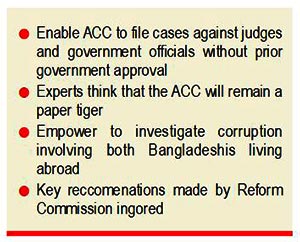 The the draft Anti-Corruption Commission (Amendment) Ordinance 2025 approved in principle by the Advisory Council recently, was initially expected to serve as a decisive step toward ending political interference and restoring the Anti-Corruption Commission's independence. Instead, it has raised concerns that the ACC will remain a paper tiger-independent in theory but subordinate in practice.
The interim administration, which came to power after the July Student-people Upsurge to root out corruption and overhaul the state machinery and the ACC Reform Commission constituted after the change of regime, which submitted 47 recommendations to ensure that the ACC functioned as a constitutionally empowered and politically neutral body.
The Ordinance strengthens the ACC by repealing Section 32(a) of the 2004 Act-a controversial clause that required government permission before filing cases against judges and government officials. Now the ACC will be able to file cases without prior government approval. Besides, the new ordinance broadens the ACC's jurisdiction to investigate corruption involving both Bangladeshis living abroad and foreign nationals residing in the country, while also clarifying that "known income" means legal income.
However, experts argue that these measures, though positive, only scratch the surface of the deeper structural weaknesses. The appointment process for the ACC chairperson and commissioners remains vulnerable to political manipulation. The proposed seven-member selection committee, headed by a senior judge of the Appellate Division, includes members nominated by the Speaker and the President-an arrangement critics say compromises neutrality. By granting the Speaker, rather than the Leader of the Opposition, the authority to nominate a parliamentary representative, the ordinance effectively tilts the balance of power toward the ruling authority.
Transparency International Bangladesh (TIB) Executive Director Dr Iftekharuzzaman, who also chaired the ACC Reform Commission, observed that "a powerful anti-reform clique within the bureaucracy and even within the ACC itself" obstructed the implementation of key recommendations. "If the ACC becomes truly effective, the interests of that clique will be harmed," he said.
"They want the organization to remain hostage to political influence and bureaucratic control." He lamented that several widely supported recommendations-such as the formation of a Selection and Review Committee, six-monthly performance evaluations, and an expansion of the commission from three to five members-had been deliberately dropped. "This is disappointing and self-contradictory for a government that claims to represent reformist ideals," he remarked.
Former ACC Director General (Legal & Prosecution) Moidul Islam welcomed the repeal of Section 32(a), calling it "a long-overdue correction of a discriminatory clause," but cautioned that without transparency in appointments and accountability in operations, "the ACC will continue to be seen as an institution manipulated for political convenience."
The Reform Commission had also proposed legal frameworks to ensure inter-agency cooperation with bodies such as the National Board of Revenue, Bangladesh Bank, the Election Commission and the Financial Intelligence Unit-measures aimed at expediting investigations and improving data access. None of these proposals were incorporated in the ordinance. Similarly, the recommendation to require public disclosure of shortlisted candidates for commissioner positions and the proposal to lower the experience threshold for eligibility from 25 years to 15 were both ignored. Critics say these omissions reflect the influence of entrenched bureaucratic interests that prefer opacity over reform.
According to ACC insiders, the ordinance does contain some procedural advancements, including the establishment of special courts where ACC offices are located and the introduction of verification mechanisms at district level to fast-track preliminary complaints. The law also provides for at least one female commissioner and reduces the term of commissioners from five years to four. Yet, these cosmetic changes are unlikely to address the fundamental problem of institutional dependence on political authority.
Civil society groups and anti-corruption activists have described the ordinance as "a slightly improved version of the existing law" rather than a genuine reform measure. Many believe individuals who wish to preserve the system that protects politically connected offenders while leaving the institution incapable of pursuing high-profile corruption cases influenced the draft.
As disappointment mounts, TIB and other advocacy organizations have urged the government to revise the ordinance in light of the Reform Commission's recommendations and emphasized the need for constitutional recognition of the ACC, establishment of an Ombudsman to oversee corruption cases and enactment of conflict-of-interest laws to ensure transparency in governance. Unless such measures are taken, experts warn, the ACC will remain a politicized apparatus, serving as a shield for the powerful rather than a sword against corruption.
Loading...
Loading...
Also read




Editor : Iqbal Sobhan Chowdhury
Published by the Editor on behalf of the Observer Ltd. from Globe Printers, 24/A, New Eskaton Road, Ramna, Dhaka.
Editorial, News and Commercial Offices : Aziz Bhaban (2nd floor), 93, Motijheel C/A, Dhaka-1000.
Phone: PABX- 41053001-06; Advertisement: 41053012; 01793317829, 01550707291, E-mail: [email protected], [email protected] Online: email: [email protected] 41053014; 01550707297 Advertisement: 01550707296
Published by the Editor on behalf of the Observer Ltd. from Globe Printers, 24/A, New Eskaton Road, Ramna, Dhaka.
Editorial, News and Commercial Offices : Aziz Bhaban (2nd floor), 93, Motijheel C/A, Dhaka-1000.
Phone: PABX- 41053001-06; Advertisement: 41053012; 01793317829, 01550707291, E-mail: [email protected], [email protected] Online: email: [email protected] 41053014; 01550707297 Advertisement: 01550707296


