



| HEADLINE |

|
Ashraful Hasan: A trailblazer in innovative creations
Published : Thursday, 20 November, 2025 at 5:56 PM
Takir Hossain


Ashraful Hasan is undoubtedly one of the most groundbreaking artists of our time, having overcome systematic barriers through artistry and a mindset that inspired creative works. Deep philosophical ideas and concepts have profoundly influenced him for years, until they found fruition through his artistic presentations. For him, art is too sacred to be corrupted by materialistic desires.
Ashraful’s paintings provoke us to contemplate innovative ideas. His creations, which utilise acrylic, charcoal, and pastel mediums, exhibit exceptional detail through striking illustrations, showcasing his profound ability to articulate and compose semi-figurative representations. He has applied his finely honed understanding of craftsmanship and skill to depict images that frequently address themes of deforestation and the inhumane aspects of humanity. He prefers to delve into the intricacies of his subjects, selecting to construct his narrative by focusing primarily on the significant details present on the surfaces of the depicted objects.
Asraful began his experimentation in 2002. Before this, he engaged in still-life, academic works, and nature-themed subjects. He has persistently continued his experimentation up to the present day, with his artworks being conceptually driven. His themes consistently address socio-economic challenges, political turmoil, unplanned urban development and industrialization, deforestation, the harsh realities of capitalist society, inhumanity, societal brutality, societal violence, and the destruction of natural greenery.
A notable aspect of the years 2002 to 2025 is that many works by the artist address a range of social, cultural, and environmental concerns, including the discrimination faced by human beings, deforestation, communalism, and social intolerance, among others. The artist expressed his creative vision through various styles such as surrealism, semi-realism, figurative, symbolism, abstraction, semi-abstraction, and conceptual. Some of his pieces delve deeply into narrative and absurdist themes. He is regarded as a socially conscious painter, with his primary focus on diverse social issues, and his voice resonates with anti-establishment sentiments. His paintings convey his personal insights, experiences, and profound reflections on societal anomalies. The canvases highlight human regrets, needs, despair, and frustration. His works are populated with protesting and tormented figures that illustrate the common and unfortunate aspects of life. He addresses a wide array of topics, including corruption, misplaced idealism, and religious intolerance.
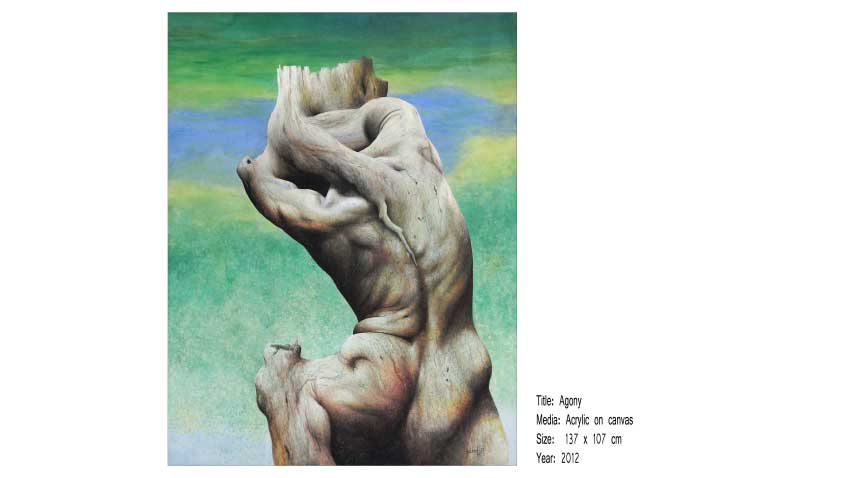
Ashraful expresses significant concern regarding the harmful effects on nature. Uncontrolled urban development leads to deforestation and a shortage of cultivable land. The artist is also worried about the harm caused by urbanisation and industrialisation. Some of these damages affect individuals directly, while others occur through natural processes. Additionally, he emphasises the increasingly pressing global issue of wildfires. The decline in the health of plants and trees is a significant concern. Therefore, he showcased the importance of this interdependence in his remarkable artwork, where the tree and human figure are seamlessly integrated to create a single entity.
Ashraf is engaged in work, demonstrating a strong awareness and negotiating matters such as identity and tradition with a more objective perspective. He is striving to tackle significant national and international concerns, including globalization, communalism, environmental issues, and economic and social discrimination, using a language that is both current and distinctly unique. Many works by Ashraf tackled issues such as superstition, and both political and social discrimination. In his art, he has emerged as a voice opposing various forms of malevolent actions. His language is different from the so-called mandatory approaches like “Art is Beauty”. He is regarded as an anti-establishment figure.
The series titled "The Roots", and "Nature"—created in 2002 and 2003—serves as a continuation of Ashraf's exploration of the relationship between humanity and trees. Many pieces within this collection depict trees that take on human-like forms, emerging from the confines imposed by a wall. The red wall serves as a symbol of challenging times, while the figure embodies a being yearning for freedom from societal limitations. Indeed, the overarching theme is consistent across all works in the series.
In the years 2004 and 2005, Ashraf created two series of works entitled "Burn" and "Image of Agony Time," which center on distorted human figures. At times, robust roots intertwine with the powerful muscles of humanity. The series emphasizes the internal suffering of individuals, and the artist consistently strives to illuminate the anguish and distress experienced by people. Ashraf has always aimed to shed light on the internal torment of humanity. He believes that every individual carries a pain that can occasionally be explored, while at other times, it remains unexplored.
Ashraf identifies parallels between humans and trees, which is why their relationship has been a persistent theme throughout his years of work on canvas. Although trees are indeed living beings, they are unable to convey their emotions. In a similar vein, there are times when humans also struggle to express their feelings to others. He endeavors to illustrate the challenge of suppressing one's emotions by drawing comparisons between the two.
In 2006, Ashraf produced several series of works. Titled "Traveler", "Worker", "Falling Leaf", "Flee", "Romance with Broken Image", and "Broken Tree, Broken Wall", Ashraf consistently employs his unique personal language. The series exhibits a significant degree of similarity among the pieces. The human figures are depicted with indistinct forms, and the colours are strikingly vivid throughout the series of works. The artist dedicated a substantial amount of time to the creation of these artworks. He adeptly laid the groundwork before concentrating on the evolution of the images, which also address contemporary issues, emphasising the relationship between man and tree.
In 2007, Ashraf mainly did three series of works titled “Bondage”, “Paper Man”, and “Tree Man and Wall”. At first glance, “Bondage” presents a geometric structure divided into segments of muted colours — earthy greens, reds, and greys. Emerging from the intersection of these angular planes is a textured, organic form resembling twisted, restrained flesh or a contorted mass. The use of dark space around the form enhances a sense of confinement or compression, while the small red specks scattered across the white form add emotional tension and perhaps suggest pain or struggle.
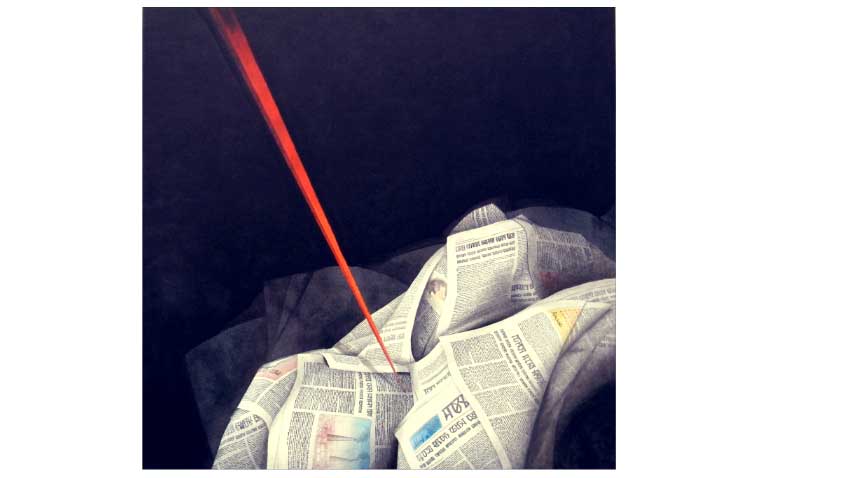
Ashraf's series of work, titled "Paper Man," depicts a human form that is either enveloped or nearly formed from sheets of newspaper. The limbs — arms, legs, and torso — are partially discernible through the layers of paper, evoking a sense of delicacy and distortion. The colour scheme predominantly features subdued whites, greys, and gentle hues, interspersed with sporadic touches of red, green, and text from the newspaper prints. The backdrop is a stark black, which enhances the contrast and separates the figure within an ambiguous space.
Ashraf's "Tree Man and Wall" is a series that depicts semi-human forms across various dimensions. The wall features a variety of colours and geometric designs. The human figures are not fully formed; instead, various body parts are highlighted. The overall composition conveys a message of freedom and liberty.
In 2008, Ashraf produced many works, yet the series "Wounded Tree" stands out significantly. This series features trees marked by deep wounds or cuts—frequently located in the trunk—oozing red sap that resembles blood. The backgrounds are typically dark, cloudy, and emotionally intense, evoking feelings of pain and sorrow. Despite the injury, the tree often continues to stand tall, with some leaves still vibrant green, symbolising resilience and perseverance.
Ashraful’s paintings provoke us to contemplate innovative ideas. His creations, which utilise acrylic, charcoal, and pastel mediums, exhibit exceptional detail through striking illustrations, showcasing his profound ability to articulate and compose semi-figurative representations. He has applied his finely honed understanding of craftsmanship and skill to depict images that frequently address themes of deforestation and the inhumane aspects of humanity. He prefers to delve into the intricacies of his subjects, selecting to construct his narrative by focusing primarily on the significant details present on the surfaces of the depicted objects.
Asraful began his experimentation in 2002. Before this, he engaged in still-life, academic works, and nature-themed subjects. He has persistently continued his experimentation up to the present day, with his artworks being conceptually driven. His themes consistently address socio-economic challenges, political turmoil, unplanned urban development and industrialization, deforestation, the harsh realities of capitalist society, inhumanity, societal brutality, societal violence, and the destruction of natural greenery.
A notable aspect of the years 2002 to 2025 is that many works by the artist address a range of social, cultural, and environmental concerns, including the discrimination faced by human beings, deforestation, communalism, and social intolerance, among others. The artist expressed his creative vision through various styles such as surrealism, semi-realism, figurative, symbolism, abstraction, semi-abstraction, and conceptual. Some of his pieces delve deeply into narrative and absurdist themes. He is regarded as a socially conscious painter, with his primary focus on diverse social issues, and his voice resonates with anti-establishment sentiments. His paintings convey his personal insights, experiences, and profound reflections on societal anomalies. The canvases highlight human regrets, needs, despair, and frustration. His works are populated with protesting and tormented figures that illustrate the common and unfortunate aspects of life. He addresses a wide array of topics, including corruption, misplaced idealism, and religious intolerance.
Ashraful expresses significant concern regarding the harmful effects on nature. Uncontrolled urban development leads to deforestation and a shortage of cultivable land. The artist is also worried about the harm caused by urbanisation and industrialisation. Some of these damages affect individuals directly, while others occur through natural processes. Additionally, he emphasises the increasingly pressing global issue of wildfires. The decline in the health of plants and trees is a significant concern. Therefore, he showcased the importance of this interdependence in his remarkable artwork, where the tree and human figure are seamlessly integrated to create a single entity.
Ashraf is engaged in work, demonstrating a strong awareness and negotiating matters such as identity and tradition with a more objective perspective. He is striving to tackle significant national and international concerns, including globalization, communalism, environmental issues, and economic and social discrimination, using a language that is both current and distinctly unique. Many works by Ashraf tackled issues such as superstition, and both political and social discrimination. In his art, he has emerged as a voice opposing various forms of malevolent actions. His language is different from the so-called mandatory approaches like “Art is Beauty”. He is regarded as an anti-establishment figure.
The series titled "The Roots", and "Nature"—created in 2002 and 2003—serves as a continuation of Ashraf's exploration of the relationship between humanity and trees. Many pieces within this collection depict trees that take on human-like forms, emerging from the confines imposed by a wall. The red wall serves as a symbol of challenging times, while the figure embodies a being yearning for freedom from societal limitations. Indeed, the overarching theme is consistent across all works in the series.
In the years 2004 and 2005, Ashraf created two series of works entitled "Burn" and "Image of Agony Time," which center on distorted human figures. At times, robust roots intertwine with the powerful muscles of humanity. The series emphasizes the internal suffering of individuals, and the artist consistently strives to illuminate the anguish and distress experienced by people. Ashraf has always aimed to shed light on the internal torment of humanity. He believes that every individual carries a pain that can occasionally be explored, while at other times, it remains unexplored.
Ashraf identifies parallels between humans and trees, which is why their relationship has been a persistent theme throughout his years of work on canvas. Although trees are indeed living beings, they are unable to convey their emotions. In a similar vein, there are times when humans also struggle to express their feelings to others. He endeavors to illustrate the challenge of suppressing one's emotions by drawing comparisons between the two.
In 2006, Ashraf produced several series of works. Titled "Traveler", "Worker", "Falling Leaf", "Flee", "Romance with Broken Image", and "Broken Tree, Broken Wall", Ashraf consistently employs his unique personal language. The series exhibits a significant degree of similarity among the pieces. The human figures are depicted with indistinct forms, and the colours are strikingly vivid throughout the series of works. The artist dedicated a substantial amount of time to the creation of these artworks. He adeptly laid the groundwork before concentrating on the evolution of the images, which also address contemporary issues, emphasising the relationship between man and tree.
In 2007, Ashraf mainly did three series of works titled “Bondage”, “Paper Man”, and “Tree Man and Wall”. At first glance, “Bondage” presents a geometric structure divided into segments of muted colours — earthy greens, reds, and greys. Emerging from the intersection of these angular planes is a textured, organic form resembling twisted, restrained flesh or a contorted mass. The use of dark space around the form enhances a sense of confinement or compression, while the small red specks scattered across the white form add emotional tension and perhaps suggest pain or struggle.
Ashraf's series of work, titled "Paper Man," depicts a human form that is either enveloped or nearly formed from sheets of newspaper. The limbs — arms, legs, and torso — are partially discernible through the layers of paper, evoking a sense of delicacy and distortion. The colour scheme predominantly features subdued whites, greys, and gentle hues, interspersed with sporadic touches of red, green, and text from the newspaper prints. The backdrop is a stark black, which enhances the contrast and separates the figure within an ambiguous space.
Ashraf's "Tree Man and Wall" is a series that depicts semi-human forms across various dimensions. The wall features a variety of colours and geometric designs. The human figures are not fully formed; instead, various body parts are highlighted. The overall composition conveys a message of freedom and liberty.
In 2008, Ashraf produced many works, yet the series "Wounded Tree" stands out significantly. This series features trees marked by deep wounds or cuts—frequently located in the trunk—oozing red sap that resembles blood. The backgrounds are typically dark, cloudy, and emotionally intense, evoking feelings of pain and sorrow. Despite the injury, the tree often continues to stand tall, with some leaves still vibrant green, symbolising resilience and perseverance.
In 2009, Ashraf created many paintings; however, his two series titled "Nature" and "Dull Nature" depict serene landscapes illuminated by soft tones and gentle light. The artist employs muted browns, greys, and faded greens to convey a feeling of tranquility and fatigue within the natural environment. Trees remain still, their leaves appearing pale and lifeless, while the sky is shrouded in a misty layer of clouds that dulls the sunlight. There is minimal activity — no birds soaring in the sky, no ripples disturbing the water — merely a quiet, melancholic stillness that mirrors the waning beauty of nature. The restrained color scheme and uncomplicated composition foster an atmosphere of contemplation, solitude and eternal silence.
In 2010, Ashraf created several paintings exploring diverse themes. His work titled "Newspaper and Rope" depicts a figure resembling a human, entirely made from newspapers, tightly secured by a rope that bisects the composition. The dark backdrop highlights the stark contrast between the vibrant, intricate textures of the paper and the tension of the rope. The figure seems constrained and nearly lifeless, enveloped and restricted within layers of printed material.
Ashraf’s artwork titled "Tree Man, Newspaper and Brick" is an acrylic piece created in 2011. It depicts a human figure shaped like a tree, seated atop a stack of newspapers. The painting's background features red brick. In his piece "Frustrated Tree," Ashraf illustrates a tree with contorted, tormented branches that gradually resemble a human form — reflecting the way nature embodies human feelings. The tree's frustration is evident in its twisted bark, broken branches, and outstretched limbs, as it struggles to express or liberate the human being confined within. The tree’s warped shape symbolizes inner conflict, struggle, or suffering — emotions that twist and mold us over time.
In the years 2012, 2013, 2014, and 2015, Asraf’s prominent series of works includes "Unreadable Newspaper", "The Pen", and "Agony".
"Unreadable Newspaper" presents a surreal composition in which newspapers are twisted, curled, and folded into a shape resembling a pen, pointing skyward against a tranquil blue backdrop. The papers appear lifelike, filled with printed text and images; however, their arrangement renders them unreadable — reflecting the title "Unreadable Newspaper." This piece also represents the distortion of truth and information prevalent in modern media. Newspapers are conventionally intended to convey knowledge and truth, yet in this instance, they are contorted and illegible, highlighting the manipulation of facts or media bias, where clarity of information is compromised. The inundation of information in today’s society complicates the task of distinguishing truth from noise. It serves as a commentary on communication, where words are present but meaning is obscured or lost. The pen-like structure at the top symbolizes journalism and the influence of writing.

Between 2016 and 2020, Asraf created many paintings of different sizes throughout these five years. His notable series includes works titled "Nature", “The Newspaper”, "The Roots", and "Pyre of Green".
The series of paintings titled "Nature" emphasises the profound and inseparable connection between nature and humanity. Nature offers life, beauty, and equilibrium, while humans rely on it for their survival and creative inspiration. This collection of artworks illustrates the harmony that exists between the natural world and human life. The depiction of the human figure appears to blend seamlessly with nature, representing unity and a sense of belonging. The gentle hues and fluid shapes imply that humanity is not distinct from nature but rather an extension of it — coexisting, experiencing, and evolving in unison.
The series of paintings “The Newspaper” — is a powerful and thought-provoking works executed in acrylic on canvas. It portrays a human-like figure made entirely of folded and layered newspapers, suspended by two red strings against a dark, almost void-like background. The figure resembles a mannequin or puppet, devoid of distinct facial or bodily features. The newspapers form its body and head, suggesting fragility and artificiality. The red strings, attached from above, create the sense that the figure is being controlled or manipulated — like a marionette or a person hanging in helplessness. The newspapers are printed in Bangla, grounding the artwork in a specific socio-political context. The series of paintings explores the relationship between media, truth, and humanity. It raises questions about how individuals are shaped, controlled, or even silenced by the information they consume. The use of newspapers as the material for the human form symbolizes how modern identity and perception are constructed through media narratives.
The series of paintings titled "The Roots" represents the profound relationship between life, nature, and identity. The depiction of roots illustrates the hidden foundation of existence — robust, intertwined, and essential. The roots extend across the canvas akin to veins, symbolising development, resilience, and the link between the visible and the concealed realms. They delve deep into the soil, signifying stability, heritage, and the origin of sustenance. Concurrently, the interwoven shapes of the roots imply human emotions or connections — how individuals are linked, how their histories influence them, and how all living beings rely on the same earth. The artwork inspires a sense of depth and contemplation, reminding observers that the elements that support life often reside beneath the surface, unseen yet crucial.
The series of paintings titled "Pyre of Green" — created using charcoal and acrylic on canvas — represents a profoundly stirring piece that merges human and natural elements to convey themes of devastation, metamorphosis, and the delicate relationship between humanity and the environment. Upon initial observation, the primary figure seems to resemble a tree; however, its outlines mimic the torso and arms of a human figure, symbolizing the inseparability of humans from the natural realm. The gray and black shades of the charcoal impart a feeling of lifelessness and desolation, while the vibrant orange and red tones in the backdrop imply a forest consumed by fire — potentially serving as a metaphor for ecological destruction, climate change, or spiritual decline. From a stylistic perspective, the artist's application of charcoal accentuates texture and contrast, endowing the tree-body with a sense of both strength and fragility. The acrylic flames contrast sharply against the monochromatic forest, heightening the tension between life and annihilation.
Between 2021 and 2025, Ashraf has created multiple series of paintings. Notable among them are "Reincarnation" and "Spring."
"Reincarnation," a painting centered on the theme of reincarnation, is rich in symbolism — it frequently delves into the cycle of life, death, and rebirth, illustrating how the soul evolves and persists in its journey across various forms or realms. This series of paintings depicts the perpetual rhythm of existence — birth, death, and rebirth — through a vortex of interconnected shapes. At its core, a radiant human silhouette disintegrates into a spiral of energy that harmonises with nature: blossoming flowers, meandering rivers, and blazing suns. Rising from the remnants of a former existence, a new figure starts to ascend, representing the soul's infinite journey through time. Furthermore, this series of paintings encourages contemplation on continuity, aura, and spiritual growth — serving as a reminder that every conclusion is simultaneously a new beginning.
The series titled "Spring" consists of paintings that elegantly depict the essence of the season, highlighting its themes of renewal, vitality, and vibrant colours. Each artwork radiates freshness and energy, symbolising nature's rebirth. The canvas is predominantly adorned with soft greens and gentle pinks as tender leaves emerge on the branches of trees. Blossoms dance lightly in a warm breeze, while butterflies and birds add movement to the composition. A stream sparkles beneath the golden sunlight, mirroring the clear blue hues of the sky. The atmosphere is filled with a sense of hope and joy — a tribute to growth and new beginnings. This collection of artworks also embodies rejuvenation, harmony, and the cyclical nature of life. Spring signifies not only the awakening of nature but also a renewal of the human spirit — serving as a reminder that beauty reemerges following every phase of stillness or adversity.
The soft-spoken Ashraful possesses a scholarly demeanour and profound insights into his subject matter. Preserving individuality feels essential to him. This is because beauty is found in uniqueness. For him, art is an ongoing journey. Consequently, he consistently upholds his personal language, which he strives to develop. An artist must cultivate a distinct language that aids in understanding his creations. While his themes may vary over time, his style remains consistently unique and unmatched.
-The writer is an art critic and cultural curator.
Loading...
Loading...
Also read






Editor : Iqbal Sobhan Chowdhury
Published by the Editor on behalf of the Observer Ltd. from Globe Printers, 24/A, New Eskaton Road, Ramna, Dhaka.
Editorial, News and Commercial Offices : Aziz Bhaban (2nd floor), 93, Motijheel C/A, Dhaka-1000.
Phone: PABX- 41053001-06; Advertisement: 41053012; 01793317829, 01550707291, E-mail: [email protected], [email protected] Online: email: [email protected] 41053014; 01550707297 Advertisement: 01550707296
Published by the Editor on behalf of the Observer Ltd. from Globe Printers, 24/A, New Eskaton Road, Ramna, Dhaka.
Editorial, News and Commercial Offices : Aziz Bhaban (2nd floor), 93, Motijheel C/A, Dhaka-1000.
Phone: PABX- 41053001-06; Advertisement: 41053012; 01793317829, 01550707291, E-mail: [email protected], [email protected] Online: email: [email protected] 41053014; 01550707297 Advertisement: 01550707296


