



| HEADLINE |

|
Record surge in Ordinances during interim govt raises political debate
Published : Tuesday, 2 December, 2025 at 12:00 AM
Ahasan Uddin Bhuiyan


 In an unprecedented display of executive lawmaking, the interim government issued 17 Ordinances in 2024 and 71 in 2025 so far, with five adopted by the Advisory Council. Such a surge of ordinances was never seen in the country's history, even in 1972, when 60 ordinances were issued to stabilise the newborn state.
During its 15-month tenure, the government crafted 28 new ordinances, repealed 2 older laws, and amended 60.
The ordinances fall into seven thematic clusters: political reforms and suppression of fascism, administrative restructuring, electoral reforms, economic and fiscal directives, public security and legal reforms, agriculture and employment, and energy and social-sector interventions.
Political Reforms: The political reform ordinances focus on recognising July fighters, implementing the July Charter, and reshaping political discourse. The government amended 24 laws to remove the names of Sheikh Mujibur Rahman, Sheikh Hasina, and their family members from state institutions. The Security of the Family Members of the Father of the Nation (Repeal) Ordinance 2024 ended a long-standing legal guarantee, while amendments to the Special Security Force Act redirected the SSF for the protection of the Chief Adviser.
Other ordinances include the Sheikh Hasina National Youth Development Institute (Amendment) Ordinance 2024, the National Parliament Secretariat (Interim Special Provisions) Ordinance 2024, amendments to multiple Bangabandhu and Sheikh Hasina academies and medical universities, the National Freedom Fighters Council (Amendment) Ordinance 2025, the July Uprising Martyrs' Families and July Fighters Welfare and Rehabilitation Ordinance 2025, and the July Uprising Memorial Museum Ordinance 2025.

Among these, the Freedom Fighters Council Ordinance redefined freedom fighters, while the National Parliament Secretariat Ordinance legitimised all acts of the interim government with an open-ended tenure, drawing criticism for enabling institutionalised impunity and expanding executive authority.
Administrative Ordinances from Elected Bodies to Bureaucratic Control: Days after taking office on August 8, the interim government dismissed all elected representatives of local government institutions and replaced them with bureaucrats. Key administrative ordinances include the District Council (Amendment) Ordinance 2024, the Upazila Parishad (Amendment) Ordinance 2024, the Local Government (City Corporation) (Amendment) Ordinance 2024, the Local Government (Municipality) (Amendment) Ordinance 2024, the Water Supply and Sewerage Authority (Amendment) Ordinance 2024, the Maximum Age Limit for Direct Appointment in Government Ordinance 2024, and the development authority ordinances for Maheshkhali, Barisal, Mymensingh, and Rangpur in 2025.
Despite sweeping bureaucratisation, law and order remains fragile, with rising crime, administrative inertia, and growing public dissatisfaction.
Electoral Reforms: Constitutional or Questionable?: The government introduced changes to core electoral laws, including the Delimitation of Constituencies of the Third Parliament (Amendment) Ordinance 2025, the Voters' Roll (Amendment) Ordinance 2025, the Election Commission Secretariat (Amendment) Ordinance 2025, the Election Officers (Special Provisions) (Amendment) Ordinance 2025, the Representation of the People (Amendment) Ordinance 2025, and the Referendum Ordinance 2025.
Economic Reforms: The interim authority restructured financial governance through ordinances such as the Bangladesh Bank (Amendment) Ordinance 2024, the VAT and Supplementary Duty (Amendment) Ordinance 2025, the Bank Resolution Ordinance 2025, the Grameen Bank (Amendment) Ordinance 2025, the Revenue Policy and Revenue Management Ordinance 2025, Customs (Amendment) Ordinance 2025, Income Tax (Amendment) Ordinance 2025, the Finance Ordinance 2025, and other supplementary ordinances.
Public Safety and Legal Reforms: Major legal ordinances include the Special Security Force (Amendment) Ordinance 2024, amendments to the International Crimes (Tribunals) Act in 2024 and 2025, the Supreme Court Judges Appointment Ordinance 2025, the Code of Criminal Procedure (Amendment and Second Amendment) Ordinances 2025, the Cyber Security (Amendment) Ordinance 2025, the Personal Data Protection Ordinance 2025, the National Data Management Ordinance 2025, the Anti-Terrorism (Amendment) Ordinance 2025, and the Provision of Legal Aid (Amendment) Ordinance 2025.
Amendments to the ICT Act now permit trials of offences committed abroad and require international observers and live broadcasts of proceedings.
Agriculture, Employment, and Social Sectors: Key interventions include the Government Employment (Amendment) Ordinance 2025, the Protection and Conservation of Fish (Amendment) Ordinance 2025, several university and public welfare-related ordinances, the Human Organ Transplantation Ordinance 2025, and the National Sports Council (Amendment) Ordinance 2025.
Energy measures include the Bangladesh Energy Regulatory Commission (Amendment) Ordinance 2024 and the Rapid Increase in Electricity and Fuel Supply (Special Provisions) (Repeal) Ordinance 2024.
What Was Overlooked: Key issues remain unaddressed. No ordinance deals with press freedom, media rights, or wage-board reforms. Mob violence, including forced resignations of nearly 2,000 teachers and multiple lynchings, remains unaddressed. Rising prices amid surging inflation also lack legal measures.
Constitutional Uncertainty: Article 93 of the Constitution empowers the President to issue an ordinance in an emergency when Parliament is dissolved or not in session. However, an ordinance cannot enact provisions beyond what Parliament can legally pass or alter the Constitution. This raises questions about the Election Commission Secretariat Ordinance and Referendum Ordinance.
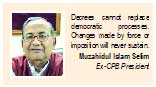
Former Communist Party of Bangladesh (CPB) President and a legendary political figure Muzahidul Islam Selim termed these Ordinances as "Decrees" and said, "Decrees cannot replace democratic processes. Changes made by force or imposition will never sustain."
He believes that their aim is to seek indemnity for actions and to prevent prosecution by a future elected government. "Their desperation stems from fear. These are not about reform, there are about escaping justice," he contended.
Another major challenge is Ordinances must be presented at the first parliamentary session after promulgation.
If passed within 30 days, they become law; otherwise, they lapse. This creates a possibility of a legal vacuum if the next government fails to convert them into law, leaving the future of the interim government's sweeping ordinances suspended between legality, legitimacy, and uncertainty.
Loading...
Loading...
Also read


Editor : Iqbal Sobhan Chowdhury
Published by the Editor on behalf of the Observer Ltd. from Globe Printers, 24/A, New Eskaton Road, Ramna, Dhaka.
Editorial, News and Commercial Offices : Aziz Bhaban (2nd floor), 93, Motijheel C/A, Dhaka-1000.
Phone: PABX- 41053001-06; Advertisement: 41053012; 01793317829, 01550707291, E-mail: [email protected], [email protected] Online: email: [email protected] 41053014; 01550707297 Advertisement: 01550707296
Published by the Editor on behalf of the Observer Ltd. from Globe Printers, 24/A, New Eskaton Road, Ramna, Dhaka.
Editorial, News and Commercial Offices : Aziz Bhaban (2nd floor), 93, Motijheel C/A, Dhaka-1000.
Phone: PABX- 41053001-06; Advertisement: 41053012; 01793317829, 01550707291, E-mail: [email protected], [email protected] Online: email: [email protected] 41053014; 01550707297 Advertisement: 01550707296


