



| HEADLINE |

|
Alliances galore to mark Feb polls
Published : Sunday, 7 December, 2025 at 12:00 AM
Ahasan Uddin Bhuiyan


With barely a week left before the Election Commission (EC) is expected to announce the schedule for the 13th National Parliament Election, political corridors are abuzz with frenetic calculations, tactical posturing and last-minute bargaining.
Under electoral law, any coalition intending to contest jointly must formally notify the EC before the announcement. Consequently, the shape, size and strength of each emerging alliance is set to crystallize within days.
This election cycle is witnessing a renewed push to structure the political battlefield around five major coalition axis-centred respectively on BNP, Jamaat-e-Islami, the uprising-born National Citizen Party (NCP), Communist Party of Bangladesh (CPB) and a factionalized but active section of the Jatiya Party (JP and JAPA).
The withdrawal of the long-standing Awami League-led 14-party alliance from electoral visibility-due to the ban on AL activities-has created a vacuum, prompting an upsurge in competing claims to the mantle of a 'third alliance.'
BNP-Led Grand
Alliance Push
The BNP is making what several observers call a "deliberate bid for a grand coalition," drawing in groups that shared the streets during the anti-government movement. Their circle already includes-Ganatantrik Mancha (6-party alliance), Jamiat-e-Ulama-e-Islam, 12-party alliance, Bangladesh Jatiya Party (BJP), Liberal Democratic Party (LDP), Jatiyatabadi Sammana Jot, Jatiyatabadi Ganatantrik Andolon (NDM), Bangladesh Labour Party and Gono Forum BNP source said the strategy is to "consolidate every anti-regime platform under one electoral roof."
Jamaat-e-Islami's 'Electoral Agreement' Bloc
Parallel to BNP, Jamaat has mobilized an eight-party unity drive, intentionally branded as an "Islamic electoral agreement." Partners include-Islami Andolon Bangladesh, Bangladesh Khelafat Majlis, Khelafat Majlis, Jamiat-e-Ulama-e-Islam Bangladesh, Khelafat Andolon, Islami Oikya Jot and Nezame Islam Party.
NCP and the Elusive Third Force
Outside BNP and Jamaat, the NCP, born out of the July youth-led uprising, remains the most-watched variable. Talks with the AB Party, Gana Odhikar Parishad, Bangladesh Rashtra Sanskar Andolan and JSD have stalled "for the time being."
NCP leaders strongly objected to the inclusion of AAP Bangladesh (United People's Bangladesh), a political platform formed by a section of former leaders of Islami Chhatra Shibir, in the alliance. As a result, the alliance talks collapsed. They are still hopeful of joining the alliance.
NCP Joint Chief Coordinator Khan Muhammad Morsalin said, "We will choose parties that are in favour of reforms and believe in liberal democratic trends in the larger interest."
Left-Democratic Bloc: The Democratic United Front
On November 29, nine left-leaning, progressive parties launched the Democratic United Front, pledging joint participation in both elections and movements. The alliance comprises-CPB, Socialist Party of Bangladesh (BSD), Democratic Revolutionary Party, Revolutionary Communist League of Bangladesh, Socialist Movement of Bangladesh, BSD (Marxist), Bangladesh JSD (Sharif Nurul Ambia-led), Oikya NAP.
Alliance leaders called it "a long-overdue consolidation of democratic resistance forces."
Fragmented Jatiya Party: Multiple Factions, One Political Centre of Gravity
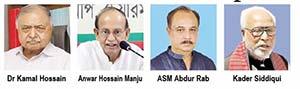
Perhaps the most fluid zone is the Jatiya Party's field, marked by repeated splits-six to date. A new 16-party coalition, provisionally titled the 'Nationalist Democratic Alliance', is being finalized under the joint leadership of Anwar Hossain Manju (JP Chairman) and Anisul Islam Mahmud (JAPA Faction Chairman). JAPA Secretary General ABM Ruhul Amin Howlader is the spokesperson. A liaison committee is in formation, with formal launch expected on December 8.
Ruhul Amin Howlader claimed that the alliance aims to bring together parties "believing in Bangladeshi nationalism, the spirit of the Liberation War, Islamic values, and interfaith harmony."
However, the faction led by GM Quader appears absent from visible electoral preparation. Analysts say persistent internal fractures-exacerbated by the illness of Raushan Ershad and the incarceration of her secretary general-have left the group "organizationally immobilized."
The Strategic Logic and Vote-Bank Calculations
Political analysts attribute the pre-election coalition surge to several structural factors like legal compulsion, symbol access for unregistered parties, psychological optics and strategic vote bank expansion.
Under electoral procedure, unregistered parties cannot contest alone but may field candidates using a registered partner's symbol. Besides, the number of parties in an alliance matters more than the actual organizational strength. It creates psychological weight among grassroots voters. Moreover, larger parties court smaller ones to diversify voter segments, widen local networks, project electoral momentum and present themselves as broad national platforms.
With 56 registered parties and the ruling Awami League symbol suspended, the relative worth of smaller groups has increased. The alliance game is no longer about ideology-it is about survival, symbolism and securing every possible vote. The value of even marginal parties has risen sharply in this election cycle.
Under electoral law, any coalition intending to contest jointly must formally notify the EC before the announcement. Consequently, the shape, size and strength of each emerging alliance is set to crystallize within days.
This election cycle is witnessing a renewed push to structure the political battlefield around five major coalition axis-centred respectively on BNP, Jamaat-e-Islami, the uprising-born National Citizen Party (NCP), Communist Party of Bangladesh (CPB) and a factionalized but active section of the Jatiya Party (JP and JAPA).
The withdrawal of the long-standing Awami League-led 14-party alliance from electoral visibility-due to the ban on AL activities-has created a vacuum, prompting an upsurge in competing claims to the mantle of a 'third alliance.'
BNP-Led Grand
Alliance Push
The BNP is making what several observers call a "deliberate bid for a grand coalition," drawing in groups that shared the streets during the anti-government movement. Their circle already includes-Ganatantrik Mancha (6-party alliance), Jamiat-e-Ulama-e-Islam, 12-party alliance, Bangladesh Jatiya Party (BJP), Liberal Democratic Party (LDP), Jatiyatabadi Sammana Jot, Jatiyatabadi Ganatantrik Andolon (NDM), Bangladesh Labour Party and Gono Forum BNP source said the strategy is to "consolidate every anti-regime platform under one electoral roof."
Jamaat-e-Islami's 'Electoral Agreement' Bloc
Parallel to BNP, Jamaat has mobilized an eight-party unity drive, intentionally branded as an "Islamic electoral agreement." Partners include-Islami Andolon Bangladesh, Bangladesh Khelafat Majlis, Khelafat Majlis, Jamiat-e-Ulama-e-Islam Bangladesh, Khelafat Andolon, Islami Oikya Jot and Nezame Islam Party.
NCP and the Elusive Third Force
Outside BNP and Jamaat, the NCP, born out of the July youth-led uprising, remains the most-watched variable. Talks with the AB Party, Gana Odhikar Parishad, Bangladesh Rashtra Sanskar Andolan and JSD have stalled "for the time being."
NCP leaders strongly objected to the inclusion of AAP Bangladesh (United People's Bangladesh), a political platform formed by a section of former leaders of Islami Chhatra Shibir, in the alliance. As a result, the alliance talks collapsed. They are still hopeful of joining the alliance.
NCP Joint Chief Coordinator Khan Muhammad Morsalin said, "We will choose parties that are in favour of reforms and believe in liberal democratic trends in the larger interest."
Left-Democratic Bloc: The Democratic United Front
On November 29, nine left-leaning, progressive parties launched the Democratic United Front, pledging joint participation in both elections and movements. The alliance comprises-CPB, Socialist Party of Bangladesh (BSD), Democratic Revolutionary Party, Revolutionary Communist League of Bangladesh, Socialist Movement of Bangladesh, BSD (Marxist), Bangladesh JSD (Sharif Nurul Ambia-led), Oikya NAP.
Alliance leaders called it "a long-overdue consolidation of democratic resistance forces."
Fragmented Jatiya Party: Multiple Factions, One Political Centre of Gravity
Perhaps the most fluid zone is the Jatiya Party's field, marked by repeated splits-six to date. A new 16-party coalition, provisionally titled the 'Nationalist Democratic Alliance', is being finalized under the joint leadership of Anwar Hossain Manju (JP Chairman) and Anisul Islam Mahmud (JAPA Faction Chairman). JAPA Secretary General ABM Ruhul Amin Howlader is the spokesperson. A liaison committee is in formation, with formal launch expected on December 8.
Ruhul Amin Howlader claimed that the alliance aims to bring together parties "believing in Bangladeshi nationalism, the spirit of the Liberation War, Islamic values, and interfaith harmony."
However, the faction led by GM Quader appears absent from visible electoral preparation. Analysts say persistent internal fractures-exacerbated by the illness of Raushan Ershad and the incarceration of her secretary general-have left the group "organizationally immobilized."
The Strategic Logic and Vote-Bank Calculations
Political analysts attribute the pre-election coalition surge to several structural factors like legal compulsion, symbol access for unregistered parties, psychological optics and strategic vote bank expansion.
Under electoral procedure, unregistered parties cannot contest alone but may field candidates using a registered partner's symbol. Besides, the number of parties in an alliance matters more than the actual organizational strength. It creates psychological weight among grassroots voters. Moreover, larger parties court smaller ones to diversify voter segments, widen local networks, project electoral momentum and present themselves as broad national platforms.
With 56 registered parties and the ruling Awami League symbol suspended, the relative worth of smaller groups has increased. The alliance game is no longer about ideology-it is about survival, symbolism and securing every possible vote. The value of even marginal parties has risen sharply in this election cycle.
Loading...
Loading...
Also read


Editor : Iqbal Sobhan Chowdhury
Published by the Editor on behalf of the Observer Ltd. from Globe Printers, 24/A, New Eskaton Road, Ramna, Dhaka.
Editorial, News and Commercial Offices : Aziz Bhaban (2nd floor), 93, Motijheel C/A, Dhaka-1000.
Phone: PABX- 41053001-06; Advertisement: 41053012; 01793317829, 01550707291, E-mail: [email protected], [email protected] Online: email: [email protected] 41053014; 01550707297 Advertisement: 01550707296
Published by the Editor on behalf of the Observer Ltd. from Globe Printers, 24/A, New Eskaton Road, Ramna, Dhaka.
Editorial, News and Commercial Offices : Aziz Bhaban (2nd floor), 93, Motijheel C/A, Dhaka-1000.
Phone: PABX- 41053001-06; Advertisement: 41053012; 01793317829, 01550707291, E-mail: [email protected], [email protected] Online: email: [email protected] 41053014; 01550707297 Advertisement: 01550707296


