



| HEADLINE |

|
NCP in dilemma over alliance
Published : Sunday, 28 December, 2025 at 12:00 AM
Ahasan Uddin Bhuiyan


 With the 13th general election approaching, the National Citizen Party (NCP)-a youth-led political force born from the mass uprising-is facing a critical moment that could define its future. Despite announcing candidates in 125 constituencies, the party is struggling to contain widening internal rifts over a possible electoral alliance with Jamaat-e-Islami. Ideological divisions, leadership disagreements, and questions of political identity have combined to create a three-fold crisis that now threatens party unity and coherence.
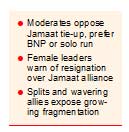
A growing split within the NCP has emerged between a moderate, anti-Jamaat faction and right-leaning leaders who favor cooperation with Jamaat-e-Islami. Moderates argue that aligning with Jamaat could revive contentious issues related to the Liberation War and 1971, potentially damaging the party's credibility and alienating its support base. Many in this group favor contesting the election independently or forming an alliance with the BNP instead.
"Our moderate group does not want to fall into 'framing' and 71 issues by entering into an alliance with Jamaat-e-Islami," said a party source, reflecting fears that such a partnership could undermine the NCP's founding principles.
In contrast, right-leaning leaders within the party argue that an alliance with Jamaat could yield better seat-sharing outcomes than a deal with the BNP. They claim that BNP alliances often result in fewer seats and the risk of rebel candidates, whereas Jamaat lacks the capacity to field such challengers.
However, internal discussions have revealed strict conditions for any potential Jamaat alliance. A joint member secretary of the NCP said Jamaat must clearly explain its role during and after the Liberation War, publicly acknowledge any controversial actions, and apologize to the nation if necessary. The party also demands firm commitments on women's rights, political participation, and abstention from anti-national activities. Many NCP leaders warned that excessive concessions could gradually erode the party's independence and make it subservient to Islamist influence.
Concerns have also been raised that Jamaat has yet to clarify its position, instead using NCP figures as proxies to promote its ideology. Party leaders fear this could allow Jamaat to exploit the NCP for its own political objectives. Meanwhile, early campaigning by pro-Jamaat nominees and uncertainty among other candidates have further strained internal unity.
The crisis has deepened with signs of fragmentation. A group of former anti-discrimination student movement coordinators has already broken away to form the Trinamool NCP. Gender-related tensions have also surfaced, with senior female leaders strongly opposing any Jamaat alliance and threatening resignation if such a decision is finalized. Among the top ten NCP leaders, five are reportedly against aligning with Jamaat, prompting efforts by party leadership to placate dissent through promises of candidacies. Adding to the uncertainty, allied platforms are showing signs of strain. The Democratic Reforms Alliance may face defections, and the National Reforms Movement has announced it could withdraw from the NCP-led coalition.
Candidate selection disputes further complicate the picture. Jamaat-e-Islami has reportedly objected to endorsing former interim government advisers Mahfuz Alam and Asif Mahmud Sajeeb Bhuiyan, citing concerns over their past actions. The NCP, however, insists on their inclusion, while both leaders remain unwilling to support an alliance without guaranteed positions.
Their supporters continue to push for renewed talks with the BNP, though those discussions have stalled.
As election day nears, the NCP finds itself at a crossroads-caught between ideological integrity, electoral pragmatism, and mounting internal dissent. Whether the party can reconcile its factions and define clear strategic and ethical boundaries may determine not only its electoral prospects, but its long-term political identity.
Loading...
Loading...
Also read


Editor : Iqbal Sobhan Chowdhury
Published by the Editor on behalf of the Observer Ltd. from Globe Printers, 24/A, New Eskaton Road, Ramna, Dhaka.
Editorial, News and Commercial Offices : Aziz Bhaban (2nd floor), 93, Motijheel C/A, Dhaka-1000.
Phone: PABX- 41053001-06; Advertisement: 41053012; 01793317829, 01550707291, E-mail: [email protected], [email protected] Online: email: [email protected] 41053014; 01550707297 Advertisement: 01550707296
Published by the Editor on behalf of the Observer Ltd. from Globe Printers, 24/A, New Eskaton Road, Ramna, Dhaka.
Editorial, News and Commercial Offices : Aziz Bhaban (2nd floor), 93, Motijheel C/A, Dhaka-1000.
Phone: PABX- 41053001-06; Advertisement: 41053012; 01793317829, 01550707291, E-mail: [email protected], [email protected] Online: email: [email protected] 41053014; 01550707297 Advertisement: 01550707296


