The new calendar year begins with the economy under strain, as the government grapples with a long list of challenges-runaway inflation, a dollar crunch, thinning foreign exchange reserves, mounting non-performing loans, shaky export and remittance flows, and stalled economic activity amid political uncertainty.
At the top of the 2026 agenda bringing down inflation as living costs bite harder, and curbing money laundering and corruption.
Economists say recovery will hinge on political stability and firm policy action. While exports and remittances have shown modest growth, they stress that restoring overall stability-and some breathing space for ordinary people-must now take priority.
These challenges can be addressed through political stability and specific policy measures, they believe.
Sources said that Bangladesh could reach an important milestone by the end of this year. That is, if everything goes well, Bangladesh will graduate from the Least Developed Country (LDC) list next November.
However, businessmen are demanding that the LDC transition be postponed by three to six years. The government's position is still clear. That is, the government wants to exit the LDC within the stipulated time.
Businessmen and exporters argue that the government may take three to five years to exit the LDC status, considering the country's situation due to various reasons including mass uprisings, election preparations, US counter-tariffs, trade and commerce, and investment drought. In addition, there is a lack of preparation to face the challenges. The export sector is not in a good condition. Bangladesh's export sector will face the most problems if it exits the LDC status. Duty-free trade benefits under the World Trade Organization will be closed.
Sources said that intellectual property regulations on the pharmaceutical industry will be stricter. Cash assistance and subsidies cannot be given on manufactured goods or services after the transition. After the transition, duties of up to 12 per cent may be imposed on Bangladeshi products in major markets including the European Union and the United Kingdom. As a result, exports may decrease by 6 to 14 per cent. The rules of origin of raw materials will be stricter. As a result, the ready-made garment sector will be the most affected.
Dr Zahid Hossain, former chief economist at the World Bank's Dhaka office, said, Businessmen are demanding postponement of the LDC transition. This is not a matter of the government's sole decision. A strong argument must be made for the postponement. Support from UN institutions will also be needed.
Industry insiders say that the widespread import controls will exacerbate the crisis in the industrial sector, while the pursuit of a contractionary monetary policy to control high inflation will further reduce the flow of money into the market, increase interest rates on loans, hinder investment, and slow down the pace of new employment. Increasing revenue in the economic downturn, eliminating and strengthening the banking sector, and establishing good governance in the financial sector will be major challenges for the interim government. It is expected that high inflation will continue in the new year as well, like in the outgoing year.
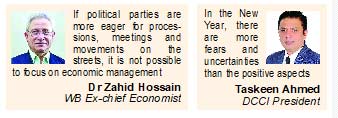
Dr Zahid Hossain said that it is not correct that it will change radically in a year. The possibility that the economy will become fully operational and prosperous in 2025 is very low. If political parties are thirsty for processions, meetings and movements on the streets, it is not possible to focus on economic management. I think this is the big challenge of the new year.
Dhaka Chamber of Commerce and Industry (DCCI) President Taskeen Ahmed said that the future of Bangladesh is a possibility. In the New Year, there are more fears and uncertainties than the positive aspects of that possibility. He said that the economy has been facing various global and domestic challenges throughout the past year, none of which could be left behind in the outgoing year.
According to the latest estimates of the Bureau of Statistics, overall inflation in 2024 was more than 10 per cent. There was controversy over the calculation of this inflation. After the change of government, this inflation has stood at an average of 11 per cent. And food inflation has recently reached 13.88 per cent. But the national wage rate has been stuck at 8 per cent for several months. People's income is increasing at a lower rate than inflation, and people's suffering is increasing. After the new government came to power, it took other steps, including increasing interest rates and reducing some taxes, but the inflation rate could not be brought down. Later, the situation had to be dealt with by printing money.
Economists believe that inflation will become even more unbearable if money printing continues in the New Year.
Fahmida Khatun, executive director of the Center for Policy Dialogue (CPD), a private research organization, said that the extent to which the economy has deteriorated in the last two to three years will continue next year as well. It will take time to recover from the bad state the economic situation has become. After the July Uprising, the Ministry of Finance and the Bangladesh Bank have taken several steps. Inflation, declining reserves, looting of the financial sector, and stagnation in investment - all of these have weakened the macroeconomic situation. However, not all the steps taken after the coup are effective.
She said also said that investment is already decreasing, and interest rates have also been increased significantly. As a result, investment will decrease further. Business and trade will be affected. Small businesses will suffer the most. This situation must be addressed. Strong steps must be taken to restore order in the banking sector. Not only these 10 banks, but many other banks are in a precarious situation. Weak banks must be merged.





