
Concluding Part
Greenlanders, who have lived on this land for millennia and developed a distinct Inuit culture, reject the notion of being treated as a commodity. The idea that Washington might "acquire" Greenland conjures echoes of the colonial past, centuries of Danish rule that many wish to transcend, not least as Greenland's Indigenous population accounts for about 90 percent of its 56,000 residents. Their political discourse emphasizes self-determination, cultural preservation, and economic development through resource governance, rather than geopolitical barter.
Despite provocative language from some U.S. quarters, there is no legal or institutional basis for American annexation under international law. Any change in sovereignty would require the consent of Denmark and, crucially, the people of Greenland themselves, a political transformation that is far from inevitable. Indeed, Denmark's government and European partners have insisted that decisions about Greenland's future lie solely with Denmark and Greenland.
The current debate reflects broader tensions in global politics. With the collapse of the Soviet Union decades ago, the United States emerged as the greatest military power. That status has emboldened some policymakers to pursue objectives that appear unilateralist or domineering. Military interventions in the Middle East and elsewhere have fostered interpretations of U.S. foreign policy as imperialistic.
Yet Greenland's case differs in critical respects. The islands' status under Danish sovereignty, the strong preference of Greenlanders to remain autonomous rather than be subsumed by a foreign power, and the active engagement of European allies all constrain any unilateral action by Washington.
Furthermore, contemporary U.S. interest in Greenland appears rooted less in direct territorial conquest and more in securing strategic partnerships and economic opportunities during a period of intensifying competition with Russia and China in the Arctic.
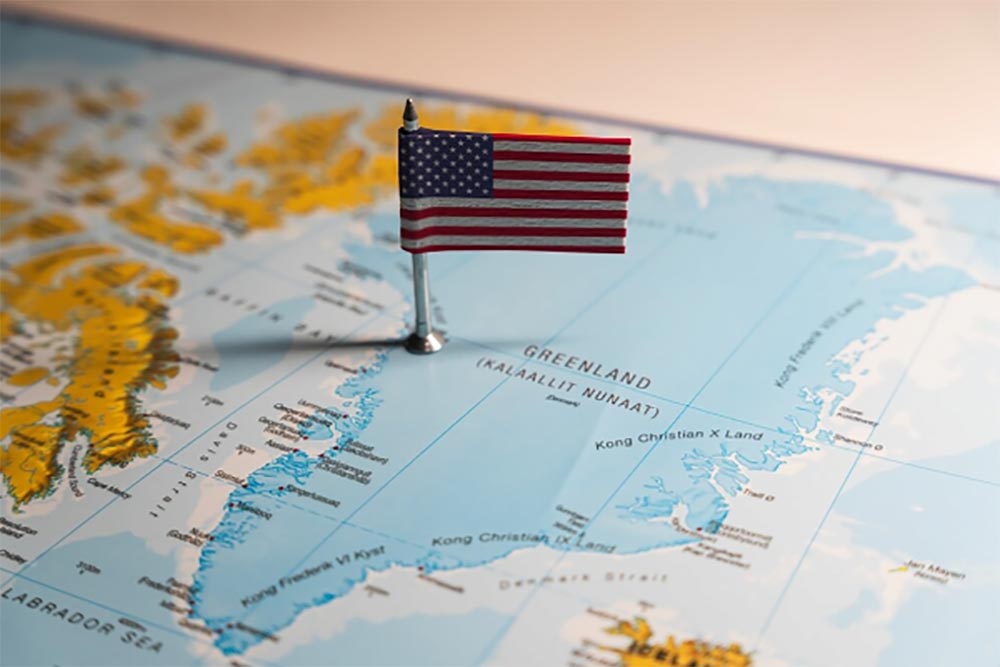
A Test for International Order: The Greenland controversy has broader implications. It is now a litmus test for how states manage sovereignty, security, and resource competition in an era of climate change. If great powers respect legal norms and the expressed wishes of local populations, Greenland may become a model of collaborative Arctic governance. If not, the consequences could destabilize not only North Atlantic relations but also the norms underpinning sovereignty and self-determination.
For the United States, the challenge lies in reconciling strategic aims with respect for international law and the voices of smaller nations. Washington can pursue cooperation without coercion; leadership does not require hubris. For Denmark and Greenland, the task is to navigate this moment without sacrificing autonomy or becoming a pawn in larger geopolitical rivalries.
In an era where climate transformation accelerates, and the race for resources intensifies, Greenland may be less a prize to seize than a test of whether the international community can adapt its institutions to a rapidly changing world.
The writer is a Dean, School of Business, Canadian University of Bangladesh





