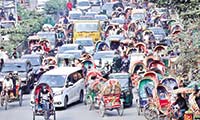
Dhaka, one of the most densely populated metropolises in the world, is currently facing an unprecedented crisis in urban management. While the city has historically struggled with traffic congestion, a new and unregulated factor has pushed the situation toward a total standstill: the proliferation of battery-operated auto-rickshaws. Once considered a "poor man's solution" for last-mile connectivity, these vehicles have now evolved into a primary cause of road anarchy and a silent perpetrator of a burgeoning public health crisis in 2026.
According to reports and related studies, Bangladesh generate 77%-78% of the country's used lead-acid battery (ULAB) waste, with roughly 90,000 to 118,000 metric tons produced annually, with 86% of recycling done informally. These batteries, which power over 4 million vehicles, have a short 6-month lifespan, leading to massive toxic lead pollution and high blood lead levels in children.
Infrastructure under siege the primary challenge posed by these auto rickshaws is their fundamental incompatibility with Dhaka's existing road infrastructure. Designed for low speeds and narrow lanes, these vehicles now dominate major arterial roads and highways. Their erratic movement patterns, lack of standardized braking systems, and tendency to drive against the flow of traffic have rendered modern traffic management systems ineffective.
The sheer volume of these vehicles-estimated to be in the hundreds of thousands-has reduced the average speed of motorized traffic to a crawl. In 2026, commuters report that distances that previously took thirty minutes now take over two hours. This "urban paralysis" is not just a matter of inconvenience; it is a massive economic drain, costing billions in lost productivity and wasted fuel for registered public transport and private vehicles.
While the number of authorized or licensed rickshaws in Dhaka city is around 80,000 to 182,000, the actual number, including unregistered and battery-operated ones, is estimated to be over 500,000 to 1.5 million. Among them, there are several lakh illegal battery-operated rickshaws.
This is the city with the highest number of rickshaws in the world, which is a major cause of traffic congestion. Of the authorized rickshaws, there are about 52,000 in Dhaka South City Corporation (DSCC) and about 28,000 in North City Corporation (DNCC), totaling over 80,000.
More alarmingly, the disposal and recycling of these batteries occur in unregulated, backyard smelters located within or near residential areas. This has led to severe lead poisoning among Dhaka's residents. Lead is a potent neurotoxin; for children, exposure can lead to permanent cognitive impairment and developmental delays. For adults, it causes cardiovascular issues and kidney damage. The soil and air in neighborhoods surrounding these "battery graveyards" are now heavily contaminated, creating a long-term health time bomb for the city.
Children are severely affected with some in Dhaka having blood lead levels nearly ten times higher than normal. Lead exposure causes irreversible brain damage, cardiovascular disease, and death.
UNICEF has identified over 300 highly contaminated sites, a number expected to be higher, creating a silent, long-lasting health crisis.
Health experts warn that we are facing a "silent pandemic." While the physical symptoms of lead poisoning-such as abdominal pain or headaches-might be subtle at first, the long-term impact on a nation's human capital is devastating. A generation with impaired cognitive abilities will struggle to contribute to the economy, creating a cycle of poverty and disability.
The economic paradox proponents of battery-run rickshaws argue that they provide employment for thousands and offer an affordable transport option. However, this is a short-sighted perspective. The hidden costs-health expenditures for lead-related illnesses, the economic loss from traffic congestion, and the strain on the power sector-far outweigh the individual earnings of the drivers. Furthermore, the industry is often controlled by local "syndicates" that bypass government taxation, ensuring that the state receives no revenue while bearing all the social costs.
The Need for decisive action as we navigate through 2026, the status quo is no longer sustainable. Dhaka cannot function as a modern global city if its primary transport artery is clogged by unregulated, unsafe, and toxic vehicles. The solution requires more than just a ban; it demands a comprehensive strategy.
The convenience of battery-powered rickshaws cannot come at the expense of our children's brains and bodies. If immediate action is not taken to regulate the lifecycle of lead-acid batteries, the "green" promise of electric transport will leave behind a dark legacy of toxic illness. It is no longer just an environmental issue; it is a battle for the survival of the next generation.
Without immediate and rigorous intervention, the battery-operated auto rickshaw will continue to be the catalyst for Dhaka's urban and biological decay. The time has come to prioritize the collective health and mobility of 20 million citizens over the unregulated convenience of a few.
The writer is a Conservator, Wildlife and Environment





