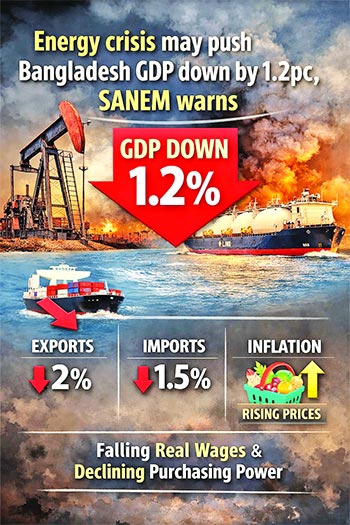
The Bangladesh economy may face pressure due to the energy crisis triggered by ongoing unrest in the Middle East, potentially causing a 1.2 percent decline in real GDP. Exports could fall by 2 per cent and imports by 1.5 per cent, while inflation may rise, pushing up consumer prices, reducing real wages, and eroding purchasing power.
This outlook was highlighted in a study published by the South Asian Network on Economic Modeling (SANEM) on Thursday.
Since February 28 of this year, the conflict between Iran and the US-Israeli alliance has created deep instability in the global energy market. As a result of this conflict, energy production, oil tanker traffic and maritime security in the Arabian Gulf region are at serious risk. In particular, the indefinite closure of the Strait of Hormuz has caused major disruptions in the global energy supply system, which has a direct impact on Bangladesh.
According to energy consultancy Kepler, about 20 percent of the world's liquefied natural gas (LNG) transported through the Strait of Hormuz is now at risk. The crisis has become more acute after Qatar suspended LNG production in the wake of the recent attacks.
This situation is particularly worrying for Bangladesh, as about 72 percent of the country's LNG imports come from Qatar and the United Arab Emirates. This important sea route is currently virtually non-existent. As a result, the country has experienced a severe energy crisis.
SANEM's research shows that the Middle East conflict is affecting the Bangladeshi economy through three main channels-fuel, remittances, and trade and supply chains. Of these, the energy channel is the most significant. Due to an import-dependent energy system, an abnormal increase in oil and gas prices will increase the country's import costs, increase production costs, widen the current account deficit, and intensify inflationary pressures.
To analyze the potential economic impact, SANEM simulated various scenarios using the Computable General Equilibrium (CGE) model of the Global Trade Analysis Project. According to this analysis, if the price of crude oil in the world market increases by about 40 percent and the price of LNG by 50 percent, the economy of Bangladesh could be significantly affected.
In this case, the country's real GDP is expected to decline by about 1.2 percent. Exports may decrease by about 2 percent and imports by 1.5 percent. At the same time, inflation may take a sharp turn, where prices of goods at the consumer level may increase by about 4 percent. As a result, real wages will decrease by about 1 percent, reducing the purchasing power of the common man.
A sector-wise analysis shows that production in the ready-made garment (RMG) sector may decrease by about 1.5 percent. There is a possibility of a production decrease of about 3 percent in the transport sector and about 1 percent in the agriculture sector. In addition, production in the energy-intensive industrial sector may decline by about 2.5 percent, which will have a negative impact on the overall industrial sector.
The government has already taken some measures such as austerity policies and energy rationing. However, these measures have seen mixed reactions. In this context, SANEM has made some important recommendations to strengthen the country's energy security.
Concentrate on the low hanging fruit of the renewable energy sector in light of land and other limitations, accelerate commercial and industrial rooftop solar by fast-tracking net-metering clearances and supporting private sector initiatives.
With a significant, earmarked budget allocation for renewable infrastructure and specific implementations, the government could pivot the country away from the dependence on disruptive imported fuels.
Bangladesh aims to strengthen energy security by boosting renewables, diversifying fuel imports, and building a strategic fuel reserve. Short-term measures include digital fuel rationing and shifting industrial operations, while medium-term plans focus on accelerated domestic gas exploration to ensure reliable power and reduce LNG dependence.





