Deputy Speaker Barrister Kaysar Kamal demanded the immediate formation of a national-level task force dedicated to child protection, as a roundtable on child abuse in Bangladesh concluded Saturday with urgent calls for systemic reform.
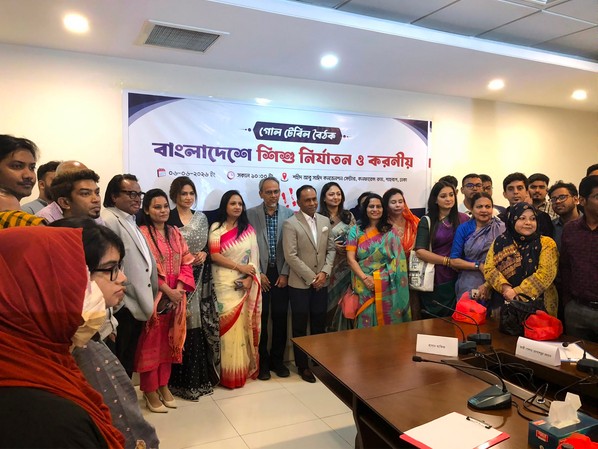
The event, titled “Child Abuse in Bangladesh and the Way Forward,” was held at the Shaheed Abu Sayed Convention Centre in Shahbagh, Dhaka.
It was organized by the Legal and Health Assistance Cell for Abused Women and Children. BNP health affairs secretary Dr. Mohammad Rafiqul Islam moderated the roundtable. The event brought together lawmakers, legal experts, mental health professionals, journalists, and civil society representatives.
The Deputy Speaker called on the relevant ministries to immediately form a task force and establish a National Commission for Child Protection by consulting experts and prominent citizens from all walks of life.
He questioned why the child helpline 1098 remains virtually unknown to the general public, asking whether it represented a failure of government outreach. He also pushed for the introduction of a child offender registry, noting that Bangladesh’s claim of building a digital state rings hollow if such fundamental child safety mechanisms are still absent.
Kaysar Kamal called for fast-track investigation and trial procedures for child abuse cases from lower courts all the way to the highest court, arguing this could be implemented through a simple gazette notification from the Ministry of Law. He closed with a direct message to the ministries involved, saying the people of the country expect practical, realistic work and not political statements.
The discussion drew on alarming statistics that underscored the scale of the problem. According to data presented at the event, roughly 85.7 percent of children between the ages of one and fourteen have experienced violent discipline. By December 2025, 456 cases of child rape had been reported, which was 234 more than the total recorded in all of 2024. A UNICEF report cited at the forum revealed that over 5,600 cases of sexual violence against children were reported between 2013 and 2024, yet only 20 convictions were secured in Bangladesh. The conviction rate currently stands below two percent.
State Minister for Social Welfare Farjana Sharmin acknowledged the paradox of Bangladesh’s legal landscape, noting that the more laws are added, the more loopholes seem to emerge. She emphasized that responsibility for child protection does not rest with the government alone, arguing that families, schools, corporations, and civil society must all play active roles. She noted that a rapist is not born a rapist, pointing to family environment and a crisis of values as contributing factors.
Human rights lawyer Barrister Rashna Imam highlighted that the core problem is not a lack of laws but a failure of enforcement, citing the absence of an effective witness protection program as a major obstacle to securing convictions.
WHO representative Dr. Towhid Islam stressed that the abuse of women and children carries consequences that extend well beyond physical harm, affecting society and the broader economy of the state. He urged that instead of reacting emotionally to individual incidents, a systemic approach must be developed and sustained.
Mental health expert Professor Dr. Saifun Nahar noted that survivors of abuse often experience what she described as a form of spiritual death, breaking down entirely from within and frequently falling into self-blame that can lead to suicidal tendencies.
Managing Editor of The Daily Observer Mohammad Mahtab Uddin stressed the urgent need for reliable baseline data and smarter data execution, noting that connecting missing pieces of data makes future decision-making significantly more effective, particularly in an era where artificial intelligence can assist in that process.
MP Nipun Roy Chowdhury warned that with the spread of smart technology, crimes including cyber bullying, online harassment, and the creation of obscene content involving children have multiplied sharply, meaning children are no longer safe even within the walls of their own homes. She proposed the launch of a national child protection dashboard and a mobile application alongside the existing 1098 helpline, through which children or guardians could submit complaints directly to authorities. She also called for child protection committees at the union and ward level, involving teachers, youth, imams, and religious leaders.
The roundtable also heard from Bangladesh Open University Vice Chancellor Dr. Dil Rowshan Zinnat Ara Nazneen, Kaler Kantho editor Hasan Hafiz, Oracle Country Director Rubaba Dowla, and film actor Ashraf Uddin Ahmed Ujjal, among other notable professionals, academics, and medical experts.
The roundtable concluded with a set of formal recommendations, including mandatory child protection policies in every school, the creation of child protection case management desks in every upazila and district, and the development of a national database integrating records from police, courts, hospitals, and NGOs. Participants also called for compulsory medical training to help doctors identify and document abuse, and stricter media guidelines to protect victims’ identities.