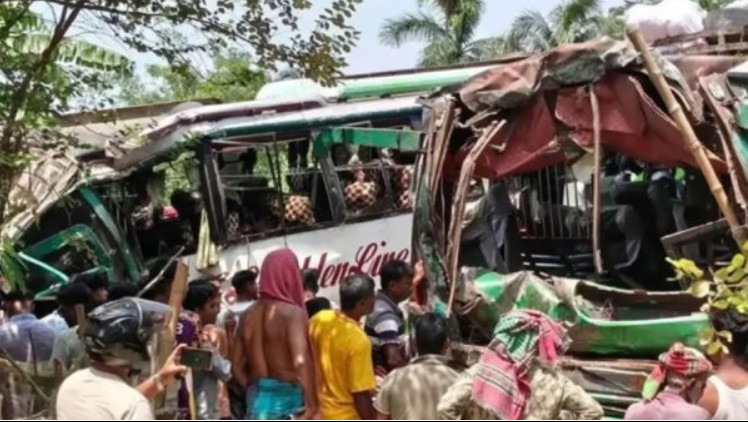
A total of 438 people were killed and 1,340 injured in 442 accidents on roads, railways and waterways
across the country during the Eid-ul-Azha travel period, according to the Passenger Welfare Association of Bangladesh (PWAB).
Of the total incidents, 394 road accidents claimed 402 lives and left 1,294 people injured, the organization revealed at a press conference held at Dhaka Reporters Unity on Sunday.
Presenting findings from the association’s Accident Monitoring Cell, PWAB Secretary General Mozammel Hoque Chowdhury said compared to the last year’s Eid-ul-Azha period, road crashes, fatalities and injuries all increased.
According to the report, rail transport recorded 31 accidents that killed 23 people and injured 30 others, while 17 waterway accidents resulted in 13 deaths and 16 injuries.
Compared to the previous, road accidents increased by 3.95 per cent, fatalities by 3.07 per cent, and injuries by 9.47 per cent. During last year's Eid celebrations, 379 road accidents left 390 people dead and 1,182 injured.
Motorcycles once again emerged as the deadliest mode of transport during the holiday period. The report documented 153 motorcycle crashes that killed 159 people and injured 180 others, accounting for nearly 38.83 percent of all road accidents recorded during Eid travel.
Among the identified victims were 80 drivers, 89 transport workers, 59 pedestrians, 64 women, 45 children, and 66 students. Members of law enforcement agencies, teachers, physicians, journalists, and engineers were also among those killed or injured in various incidents.
The association attributed the high number of accidents to multiple factors, including rain-damaged roads, potholes, poor road infrastructure, reckless driving, violations of traffic laws, and a shortage of qualified drivers. It also alleged that many drivers were forced to operate vehicles continuously for extended periods without adequate rest, significantly increasing the risk of crashes.
Addressing the press conference, Chowdhury stressed the need for long-term reforms rather than seasonal measures during major holidays. He called for improvements in public transportation services, professional driver training, the removal of unfit vehicles from roads, and the establishment of internationally recognized road safety corridors on national highways.
An analysis of accident patterns showed that 46.44 percent of crashes resulted from head-on collisions, while 29.18 percent involved vehicles running over pedestrians or colliding with other vehicles. Another 17.25 percent occurred after vehicles lost control and plunged into roadside ditches or embankments, while 1.52 percent involved train-vehicle collisions. The remaining accidents were attributed to various other causes.
The report further highlighted that traffic congestion on major highways, excessive working hours for drivers, inadequate rest facilities, and the operation of unfit vehicles contributed significantly to the rise in accidents during the Eid travel season. Weak traffic management, insufficient enforcement, and a lack of awareness among both drivers and passengers were also identified as key factors.
According to the association, longstanding irregularities in the country's transport sector become more pronounced during major holiday periods. Competition among transport operators, pressure to complete trips quickly, and the pursuit of higher profits often encourage risky driving behavior, increasing the likelihood of fatal accidents.
The organization also pointed to the growing use of motorcycles among young people, combined with speeding, failure to wear helmets, and disregard for traffic regulations, as major contributors to road fatalities. In addition, the uncontrolled movement of three-wheelers, locally made vehicles, and other slow-moving transport on highways continues to pose serious safety risks.
Among those present at the press conference were former Secretary Dr. A.Y.M. Ekramul Haque, Joint Secretary Arpona Roy Das, Finance Secretary Mahmudul Hasan Russell, and Office Secretary Alamgir Kabir Bitu, among others.
The Passenger Welfare Association urged the government, transport owners, law enforcement agencies, and road users to work together to improve road safety and prevent the recurring loss of lives during major holiday travel periods.
TR