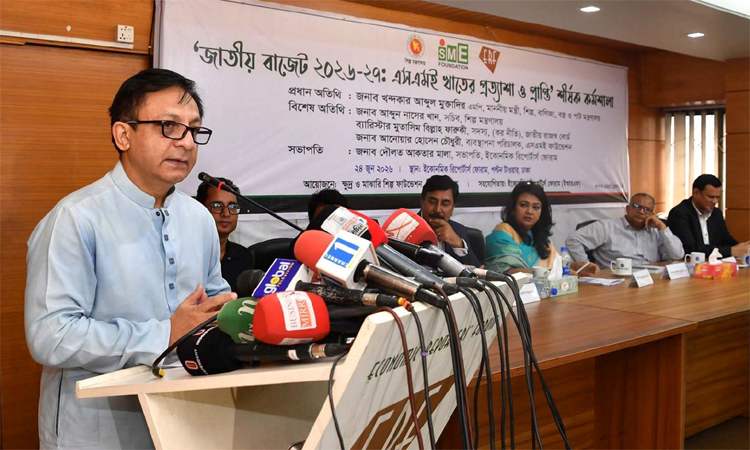
Industries, Commerce, Textiles and Jute Minister Khandakar Abdul Muktadir on Wednesday said the government is working to make Bangladesh a more investment-friendly, competitive and employment-oriented economy.
“To achieve this goal, the Small and Medium Enterprise (SME) sector is being given the highest priority. The greater the number of small and medium enterprises in the economy, the broader the economic activities and the stronger the overall economic flow will be,” he said.
The commerce minister made the remarks while addressing a workshop titled “National Budget 2026-27: Expectations and Achievements of the SME Sector” as the chief guest in the capital.
The Economic Reporters’ Forum (ERF) organised the workshop with its President Daulat Akhtar Mala in the chair.
National Board of Revenue (NBR) Member (Tax Policy) Barrister Mutasim Billah Faruqui and SME Foundation Managing Director Anwar Hossain Chowdhury, among others, attended the workshop as special guests.
SME Foundation General Manager Mohammad Jahangir Hossain presented the keynote paper.
Muktadir said that according to the Economic Census conducted by the Bangladesh Bureau of Statistics (BBS), the country has around 11.7 million economic establishments, the majority of which belong to the SME sector.
The sector contributes around 34 per cent to the national GDP, he added.
He further said that the proposed budget for FY2026-27 includes various incentive and support programmes worth nearly Tk7,800 crore for the SME sector.
In addition, he said, Tk5,000 crore has been earmarked for the CMSME sector from Tk60,000 crore stimulus package announced by Bangladesh Bank.
Of the allocation, he mentioned that Tk2,000 crore will be distributed as low-interest loans on easy terms.
Separate special funds of Tk500 crore for startups and women entrepreneurs and Tk300 crore for the creative economy have also been formed, he added.
The minister said the government is implementing a range of initiatives, including the “One Village, One Product” programme, creation of a national designers’ pool, updating SME cluster mapping, youth entrepreneurship development, startup support, mentorship programmes, skills development and establishment of an entrepreneur database.
Referring to Bangladesh’s graduation from the Least Developed Country (LDC) category, he said the country has already met all three criteria required for graduation.
However, further preparation is necessary to ensure a smooth and sustainable transition, he said, adding that the government has requested a three-year extension of the graduation timeline.
Muktadir also said the government would ensure uninterrupted energy supply to enable existing industries to utilise their full production capacity.
He added that there is a plan to gradually transfer underperforming state-owned industrial enterprises to the private sector.
The minister further said strategic reserves of import-dependent commodities and energy resources would be built to protect the economy from global crises and supply disruptions.
Emphasising the need to reduce logistics costs, he noted that Bangladesh’s logistics expenses currently account for around 16 per cent of GDP, compared to the global average of 10 per cent.
The government will take measures to reduce the cost through improved port management, enhanced supply chain efficiency and greater product traceability, he added.