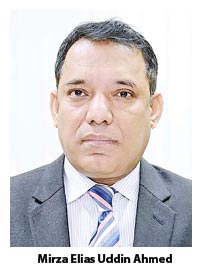
As Bangladesh's banking sector grapples with soaring non-performing loans, persistent economic uncertainty and tightening liquidity conditions, Jamuna Bank PLC is charting a cautious but resilient growth path, placing greater emphasis on small and medium enterprises (SMEs) and remittance inflows to strengthen its long-term position.
In an exclusive interview with the Daily Observer, Mirza Elias Uddin Ahmed, Managing Director and Chief Executive Officer of Jamuna Bank PLC, said the third-generation private commercial bank is focusing on financial discipline, prudent lending and balance-sheet strength rather than pursuing aggressive expansion in an increasingly challenging banking landscape.
"The banking industry has remained under pressure since the Covid-19 pandemic, while the burden of bad loans continues to weigh heavily on the sector. Despite these challenges, Jamuna Bank has maintained a stable financial footing through cautious lending, robust liquidity management and steady deposit growth," he said.
The CEO said the bank's key financial indicators continue to reflect resilience and sound risk management.
"Our non-performing loan ratio remains below 3 per cent, while our Capital to Risk-Weighted Assets Ratio (CRAR) stands above 17 per cent. Earnings per share exceed 30 per cent, supported by a strong capital buffer and adequate provisioning against classified loans," he said.
Ahmed described deposits as the backbone of the bank's operations and said maintaining customer confidence remains a top priority.
Focus Shifts to SMEs and Remittance
With Bangladesh's economy increasingly reliant on domestic entrepreneurship and overseas earnings, Jamuna Bank is sharpening its focus on SMEs and remittance-linked business activities.
"We are highly selective in our lending decisions. Our financing is concentrated on productive sectors, trade finance, SMEs and well-structured corporate loans. Going forward, SMEs and remittance earnings will receive even greater strategic attention," he said.
According to the CEO, the bank's deposit base has continued to grow steadily, driven by customer trust and a diversified portfolio of deposit products.
"Our liquidity position remains comfortable. We are carefully managing the loan-to-deposit ratio and maintaining adequate liquidity buffers in full compliance with regulatory requirements," he added. To safeguard liquidity and generate stable returns, the bank has also invested a portion of its funds in government treasury bills and bonds.
"These investments help us maintain the statutory liquidity ratio while providing secure returns in a volatile interest-rate environment," Ahmed said.
Prudent Lending Amid Economic Headwinds
The CEO emphasised that Jamuna Bank is deliberately avoiding aggressive credit expansion, particularly in sectors exposed to elevated risks.
He noted that loan demand has remained uneven due to inflationary pressures, import restrictions and subdued private-sector investment.
"We are closely monitoring the quality of loan disbursements to ensure that today's growth does not become tomorrow's problem," he said.
Tightening Grip on Bad Loans
Acknowledging the growing asset-quality concerns across the banking sector, Ahmed said Jamuna Bank is intensifying efforts to keep bad loans under control through stronger recovery initiatives, restructuring where appropriate and more rigorous credit assessment.
"Our NPL ratio remains under control despite mounting industry-wide pressure. However, we are not complacent. Recovery efforts have been strengthened and credit risk evaluation has become more stringent," he said.
The bank has also increased provisioning in line with Bangladesh Bank regulations to absorb potential losses and reinforce financial resilience.
"Provision coverage remains a critical focus area. We want to ensure that expected credit losses are properly reflected in our balance sheet and that the bank remains well prepared for future uncertainties," he added.
Strong Capital Buffer Supports Stability
Ahmed said Jamuna Bank continues to maintain capital adequacy comfortably above the regulatory minimum, positioning it well to withstand market shocks and credit risks.
"Our capital base remains strong. Through prudent capital management and retained earnings, we have maintained CRAR well above the required threshold," he said.
Retained profits are being reinvested to strengthen Tier-1 capital and enhance the bank's shock-absorption capacity.
He added that the bank's dividend policy is being managed carefully to ensure that shareholder returns do not come at the expense of capital strength.
Building Long-Term Strength Over Short-Term Gains
While higher provisioning costs and cautious lending have placed pressure on profitability, Ahmed said operating performance remains stable, supported by interest income and fee-based earnings from trade finance and remittance services.
"Provisioning requirements have increased, but this is essential for long-term financial stability. Our focus is on building a stronger balance sheet rather than maximising short-term profits," he said.
Retained earnings, he noted, are being channelled towards strengthening capital rather than aggressive dividend distribution.
Digital Transformation Gathering Pace
The bank is also accelerating investments in technology to enhance customer experience and operational efficiency.
Ahmed said Jamuna Bank is expanding its digital banking ecosystem, strengthening online services and introducing faster, more seamless transaction-processing capabilities.
"The future of banking will be defined by technology, trust and effective risk management. We are investing in all three areas to remain competitive and relevant," he said.
Stability Before Expansion
Looking ahead, the CEO expects the banking industry to remain under pressure from both domestic and global economic challenges. However, he believes institutions that maintain discipline, strong governance and prudent risk management will emerge stronger.
As Bangladesh's banking sector navigates one of its most challenging periods in recent years, Jamuna Bank is positioning itself as a stability-driven institution focused on asset quality, liquidity management, capital strength and sustainable growth. "We are not rushing growth," Ahmed said. "We are building strength."
That philosophy, he believes, will prove critical in safeguarding the bank's resilience and ensuring long-term success in an increasingly demanding financial environment.





