



| HEADLINE |

|
Govt committed to building investment-friendly environment: PM
Published : Thursday, 23 July, 2026 at 1:56 PM
Observer Online Report


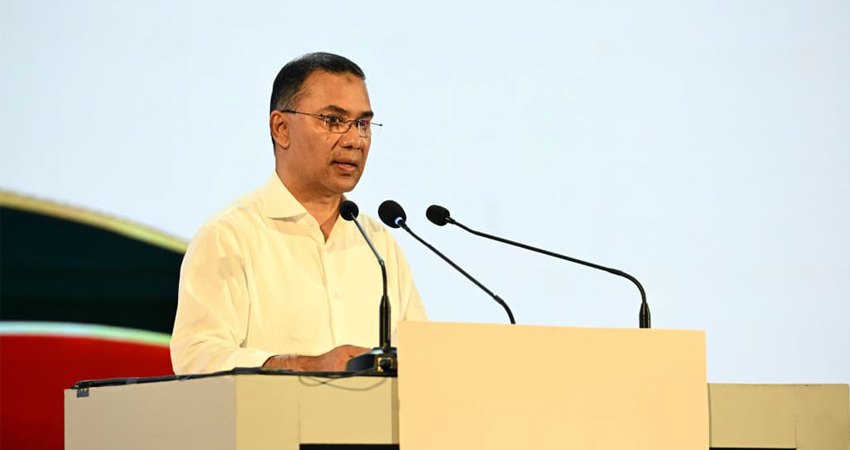
Prime Minister Tarique Rahman has reaffirmed the government’s commitment to ensuring an investment-friendly environment to boost Foreign Direct Investment (FDI) in Bangladesh.
He assured that whether local or foreign, the government will support investors with timely policies, institutional cooperation, and necessary assistance whenever they invest capital in Bangladesh.
The Prime Minister said this as the chief guest at the ‘FICCI FDI Conference 2026,’ titled ‘Accelerating Foreign Investment for Employment and Prosperity in Bangladesh,’ organized by the Foreign Investors' Chamber of Commerce and Industry (FICCI) at the China-Friendship Conference Centre on Thursday.
The Prime Minister noted that investors contribute significantly to Bangladesh by creating new jobs, expanding modern technology, strengthening global supply chains, and driving economic growth. He expressed gratitude to both local and foreign investors.
He shared that before entering politics, he was involved in business himself. From that experience, he realized that business success depends largely on growth-supportive government policies, not just entrepreneurial skill.
Tarique Rahman stated that the new BNP government is working to build a rules-based, globally connected, and private sector-driven economy. He invited investors not only to invest in Bangladesh but also to become partners in the country’s economic transformation.
He mentioned that even before taking office, the government prepared policy measures by taking inputs from investors, entrepreneurs, business leaders, economists, and development partners.
Based on their suggestions, initiatives have been taken to ensure legal protection for investments, modern regulatory frameworks, simplified tax systems, profit repatriation facilities, strong capital markets, and improved infrastructure.
The Prime Minister highlighted that the government is modernizing legal and regulatory frameworks, strengthening investment protection, ensuring fast dispute resolution, simplifying tax and VAT administration, easing profit repatriation, developing capital markets, supporting startups, reducing red tape, and digitizing public services.
Additionally, increasing investment in renewable energy, upgrading port and logistics infrastructure, and ensuring energy security remain top priorities for the government.
Tarique Rahman stated that the government is working with a target to elevate Bangladesh into a $1 trillion economy by 2034. To achieve this, special incentives are being provided to renewable energy, pharmaceuticals, electronics, digital services, agro-processing, high-value textiles, healthcare, and logistics sectors.
He added that the government prioritizes turning Bangladesh into a global manufacturing hub, diversifying the ready-made garment sector, and creating a skilled workforce.
Concluding his speech, the Prime Minister emphasized that the future of Bangladesh depends not just on attracting investment, but on building long-term and credible partnerships. He urged local and foreign investors to become partners in Bangladesh's journey toward development and prosperity.
JB/SA
Loading...
Loading...
Also read








Editor : Iqbal Sobhan Chowdhury
Published by the Editor on behalf of the Observer Ltd. from Globe Printers, 24/A, New Eskaton Road, Ramna, Dhaka.
Editorial, News and Commercial Offices : Aziz Bhaban (2nd floor), 93, Motijheel C/A, Dhaka-1000.
Phone: PABX- 41053001-06; Advertisement: 41053012; 01793317829, 01550707291, E-mail: [email protected], [email protected] Online: email: [email protected] 41053014; 01550707297 Advertisement: 01550707296
Published by the Editor on behalf of the Observer Ltd. from Globe Printers, 24/A, New Eskaton Road, Ramna, Dhaka.
Editorial, News and Commercial Offices : Aziz Bhaban (2nd floor), 93, Motijheel C/A, Dhaka-1000.
Phone: PABX- 41053001-06; Advertisement: 41053012; 01793317829, 01550707291, E-mail: [email protected], [email protected] Online: email: [email protected] 41053014; 01550707297 Advertisement: 01550707296


