



| HEADLINE |

|

UIU brings students, economists and policymakers together to debate national budget
Published : Monday, 27 July, 2026 at 5:26 PM
Observer Online Desk


File Photo
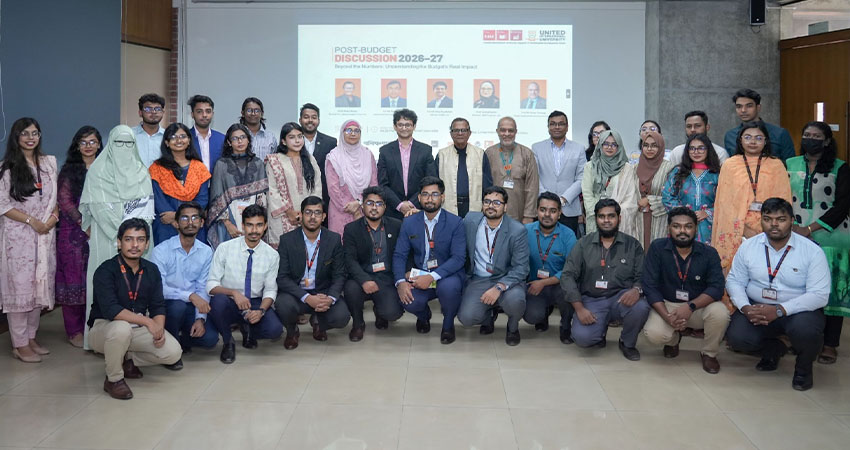
The School of Business and Economics of United International University (UIU) organized a post-budget discussion program for the fiscal year 2026-27 at its campus, bringing together academics, policymakers, tax officials and students to analyze the proposed national budget and discuss its implications for Bangladesh’s economy.
The program featured a debate competition and panel discussion involving students from different universities, including the University of Dhaka, Jahangirnagar University and UIU. The debate focused on the motion, “The proposed tax policy in the National Budget of Bangladesh for the fiscal year 2026-27 will be beneficial to the country’s economy overall.”
Participating students presented data-driven arguments and examined various aspects of the proposed tax policies, highlighting their possible impacts on economic growth, revenue generation and public welfare.
A panel discussion was also held where young women analyzed the budget priorities and shared their perspectives on Bangladesh’s future economic and social development. The students presented expectations and policy suggestions on issues related to the economy, society and development.
During the main discussion session, speakers highlighted key areas of the national budget, including taxation, revenue collection, investment, employment, trade and sustainable economic growth. They stressed the importance of transparency, accountability, efficient public management and public participation for successful budget implementation.
Prof. Abdul Bayes, former Vice-Chancellor of Jahangirnagar University, said the national budget is a key instrument for achieving long-term economic development and inclusive growth. He noted that effective implementation of the budget can help increase productivity, create employment opportunities and improve public welfare.
Dr. Md. Nurul Amin, Additional Tax Commissioner of the National Board of Revenue (NBR), said the government is taking initiatives to modernize the tax system through technology and make it more taxpayer-friendly. He emphasized the importance of increasing awareness about tax compliance and encouraging voluntary tax payment.
Prof. M. Niaz Asadullah, Advisor to the UIU School of Business and Economics, said university-level discussions on national budgets help students develop analytical skills and enhance their understanding of economic policymaking.
Prof. Salma Karim, Director of the UIU BBA Program, stressed the need to expose students to contemporary national and global economic issues beyond classroom-based learning.
In the closing session, Prof. M. Omar Farooq, Head of the Department of Economics at UIU, thanked the participants and said such discussions, along with active student engagement, would contribute to developing skilled economists, policymakers and responsible citizens.
Heads of departments, faculty members, university officials, students and distinguished guests attended the program.
-HIS

Loading...
Loading...
Also read





Editor : Iqbal Sobhan Chowdhury
Published by the Editor on behalf of the Observer Ltd. from Globe Printers, 24/A, New Eskaton Road, Ramna, Dhaka.
Editorial, News and Commercial Offices : Aziz Bhaban (2nd floor), 93, Motijheel C/A, Dhaka-1000.
Phone: PABX- 41053001-06; Advertisement: 41053012; 01793317829, 01550707291, E-mail: [email protected], [email protected] Online: email: [email protected] 41053014; 01550707297 Advertisement: 01550707296
Published by the Editor on behalf of the Observer Ltd. from Globe Printers, 24/A, New Eskaton Road, Ramna, Dhaka.
Editorial, News and Commercial Offices : Aziz Bhaban (2nd floor), 93, Motijheel C/A, Dhaka-1000.
Phone: PABX- 41053001-06; Advertisement: 41053012; 01793317829, 01550707291, E-mail: [email protected], [email protected] Online: email: [email protected] 41053014; 01550707297 Advertisement: 01550707296


