



| HEADLINE |

|
Early-season jute prices encourage farmers in Bogura
Published : Saturday, 1 August, 2026 at 12:00 AM
Our Correspondent


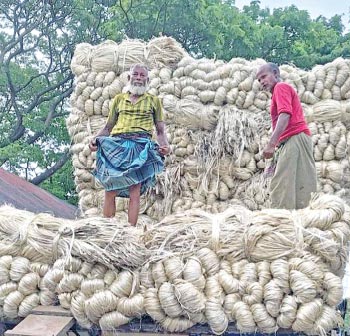 BOGURA, July 31: Freshly harvested jute has started arriving at markets across Bogura, with farmers receiving encouraging prices in the beginning of the harvesting season, agricultural officials said.
They expect the district to surpass this year's production target as jute has been cultivated on a larger area than initially planned.
In the major jute-producing upazilas of Sariakandi, Sonatala, Dhunat and Gabtali, jute is currently selling for Tk 3,800 to Tk 4,000 per maund, according to local agricultural officials. They expect prices to rise further as trading gathers pace, with rates potentially exceeding Tk 4,500 per maund later in the season.
The four Jamuna river basin upazilas account for the largest share of jute production in Bogura. Their fertile alluvial soil is particularly suitable for cultivating high-quality Tossa jute.
Farid Ahmed, assistant agriculture officer (statistics) in Bogura, said the district had set a cultivation target of 9,600 hectares this year, with an estimated production target of 111,886 bales of jute.
He said favourable weather during the growing season and increased cultivation are likely to push production beyond that target.
Sariakandi Upazila Agriculture Officer Mohammad Ali Jinnah said the upazila remains the district's leading jute-producing area and farmers have achieved a good harvest this season.
Agriculture officials said the current market price is allowing farmers to make a reasonable profit, although they expect returns to improve further if prices climb above Tk 4,500 per maund.
Despite the strong harvest, concerns remain over declining domestic demand.
Tofazzal Hossain, owner of a jute mill in Bogura, said many mills across the country have either closed or significantly reduced operations because of raw material shortages in previous years and shrinking demand.
He said increased exports of raw jute to India have affected the local processing industry, while plastic products have increasingly replaced traditional jute goods.
"Plastic twine has largely replaced jute twine, and jute ropes are no longer widely used," he said. "Jute sacks are now mainly used in government food warehouses, while plastic packaging dominates the market."
Industry insiders say unless domestic consumption and industrial use of jute increase, higher production alone may not be enough to ensure long-term stability for the country's traditional "golden fibre" sector.
Loading...
Loading...
Also read



Editor : Iqbal Sobhan Chowdhury
Published by the Editor on behalf of the Observer Ltd. from Globe Printers, 24/A, New Eskaton Road, Ramna, Dhaka.
Editorial, News and Commercial Offices : Aziz Bhaban (2nd floor), 93, Motijheel C/A, Dhaka-1000.
Phone: PABX- 41053001-06; Advertisement: 41053012; 01793317829, 01550707291, E-mail: [email protected], [email protected] Online: email: [email protected] 41053014; 01550707297 Advertisement: 01550707296
Published by the Editor on behalf of the Observer Ltd. from Globe Printers, 24/A, New Eskaton Road, Ramna, Dhaka.
Editorial, News and Commercial Offices : Aziz Bhaban (2nd floor), 93, Motijheel C/A, Dhaka-1000.
Phone: PABX- 41053001-06; Advertisement: 41053012; 01793317829, 01550707291, E-mail: [email protected], [email protected] Online: email: [email protected] 41053014; 01550707297 Advertisement: 01550707296


