



| HEADLINE |

|

Digital gamblers target rural youth thru MFS


 The pitch is deceptively simple: deposit a few hundred taka, place a bet and watch your money multiply miraculously.
For thousands of young people across Bangladesh "particularly in rural areas "that promise has become a fast track to debt, addiction, shattered families and psychological distress, as illegal online betting syndicates exploit the country's booming digital payment ecosystem to reach even the most remote villages.
Cybersecurity experts, law enforcement officials and researchers told The Daily Observer that betting operators are increasingly abusing Mobile Financial Services (MFS), including bKash, along with bank transfers and local agents to collect wagers and move millions of taka every day, turning illegal online gambling into a nationwide
social crisis.
While talking to The Daily Observer Hanif, a tea vendor in Dhaka’s Pantopath area said, “One night I won Tk 10,000 from Tk 2,000. I felt invincible. Later, I lost Tk 3 lakh my father gave me to deposit in the bank. I ruined my family’s trust for a
few clicks.”
Interviews with victims, cybersecurity experts, law enforcement officials and researchers conducted by The Daily Observer reveal a growing underground economy built around online gambling platforms that use MFS accounts, bank transfers and networks of local agents to move millions of taka every day.
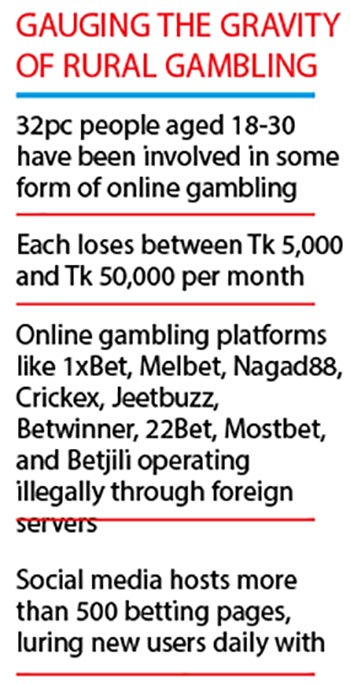
Online gambling platforms like 1xBet, Melbet, Nagad88, Crickex, Jeetbuzz, Betwinner, 22Bet, Mostbet, and Betjili have flooded rural Bangladesh, operating illegally through foreign servers.
Marketed as gaming or sports apps, they entice users with fake wins, rigged games, and false promises of cashouts. Many are outright scams, exploiting digital illiteracy and economic desperation.
These apps�"often using Bangla interfaces and local mobile banking payment channels through intermediaries�"trap rural youths in cycles of debt and addiction. Initial small earnings lure users to invest more, only to face blocked withdrawals, disappearing balances, or demands for further deposits.
Most village youths The Daily Observer interviewed said that they discovered themselves into the gambling sites through various online ads on social media and pornographic sites.
Investigators say the widespread availability of instant digital payments has transformed illegal betting from an urban cybercrime into a nationwide social crisis. While legitimate payment platforms facilitate millions of lawful transactions daily, criminals are increasingly exploiting MFS accounts and intermediaries to collect deposits and transfer gambling proceeds by bKash, making enforcement significantly more challenging.
The betting platforms�"many operating from servers outside Bangladesh�"market themselves as sports or gaming applications. Their advertisements appear on Facebook, YouTube, messaging apps and websites offering pirated movies or adult content, promising effortless profits and instant withdrawals. Behind the flashy promotions, however, investigators say, lies a sophisticated network designed to keep users depositing money rather than withdrawing it.
Victims interviewed for this investigation described a remarkably similar pattern. Most said they were allowed to win small amounts during their first few attempts, encouraging them to invest larger sums. Once their balances grew, withdrawal requests were delayed, accounts were restricted or additional payments were demanded under various pretexts. Many ultimately lost savings, borrowed money from relatives or accumulated heavy debts in unsuccessful attempts to recover their losses.
Cybercrime investigators say betting syndicates rely on layers of local agents who receive deposits through mobile financial service accounts before rapidly transferring the money across multiple accounts, obscuring the financial trail. Officials emphasised that the exploitation of digital payment channels reflects criminal misuse of the financial system rather than evidence of wrongdoing by payment service providers themselves.
The investigation also found that rural communities have become particularly vulnerable. Cheap smartphones, affordable internet packages and limited digital literacy have created fertile ground for betting operators, who increasingly recruit users through referral bonuses, influencer marketing and social media campaigns targeting young people.
Police officials acknowledged that illegal online betting has expanded despite legal restrictions. Cyber monitoring teams are tracking gambling-related pages and accounts, while authorities are working with the Bangladesh Telecommunication Regulatory Commission (BTRC) to identify and block websites linked to betting operations.
Mental health specialists warn that online gambling is no longer merely a financial crime but an emerging public health concern, contributing to addiction, depression, family conflict and social isolation among young users.
Under the Cyber Security Ordinance 2025, participating in, promoting or facilitating illegal online gambling is a criminal offence.
Investigators say dismantling the networks will require coordinated enforcement against operators, payment agents, digital infrastructure and those who profit from recruiting new gamblers into an increasingly lucrative underground industry.
A recent study in Dhaka found that 32 per cent of people aged 18-30 have been involved in some form of online gambling. On average, each loses between Tk 5,000 and Tk 50,000 per month. Social media hosts more than 500 betting pages, luring new users daily with fake success stories and 'winning tips'.

Loading...
Loading...
Also read



Editor : Iqbal Sobhan Chowdhury
Published by the Editor on behalf of the Observer Ltd. from Globe Printers, 24/A, New Eskaton Road, Ramna, Dhaka.
Editorial, News and Commercial Offices : Aziz Bhaban (2nd floor), 93, Motijheel C/A, Dhaka-1000.
Phone: PABX- 41053001-06; Advertisement: 41053012; 01793317829, 01550707291, E-mail: [email protected], [email protected] Online: email: [email protected] 41053014; 01550707297 Advertisement: 01550707296
Published by the Editor on behalf of the Observer Ltd. from Globe Printers, 24/A, New Eskaton Road, Ramna, Dhaka.
Editorial, News and Commercial Offices : Aziz Bhaban (2nd floor), 93, Motijheel C/A, Dhaka-1000.
Phone: PABX- 41053001-06; Advertisement: 41053012; 01793317829, 01550707291, E-mail: [email protected], [email protected] Online: email: [email protected] 41053014; 01550707297 Advertisement: 01550707296


