



| HEADLINE |

|

Mirza Fakhrul Islam Alamgir
From student politics to Bangabhaban
Published : Friday, 14 August, 2026 at 12:00 AM
Walid Khan


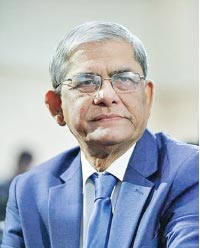 From the streets of the 1960s student movement to the corridors of power, Mirza Fakhrul Islam Alamgir has spent nearly six decades moving through some of the defining chapters of Bangladesh’s political life. Student activist, theatre artist, economics teacher, civil servant, local politician, parliamentarian, minister and BNP secretary general �" he has worn many hats. Now, at 78, he stands on the threshold of an altogether different role: the country’s 23rd president.
BNP Secretary General Mirza Fakhrul Islam Alamgir was nominated by the party on August 13 as its candidate for the presidential election scheduled for August 20, following President Md Shahabuddin’s resignation on July 24.
With BNP holding an absolute majority in parliament, he is widely expected to become the country’s 23rd president, though he remains a candidate until the election is completed.
BORN INTO A POLITICAL FAMILY
Fakhrul was born on January 26, 1948, in Thakurgaon. His father, Mirza Ruhul Amin, was a lawyer and politician who served in the Provincial Legislative Assembly of Pakistan, was elected to parliament twice and later became a cabinet member in the HM Ershad government.
His uncle Mirza Golam Hafiz was a prominent BNP politician who served as minister of land, law and justice and parliamentary affairs, and speaker of parliament. Another uncle, Wing Commander SR Mirza, was associated with the Mujibnagar government during the Liberation War and helped run youth camps for freedom fighters.
His younger brother Mirza Faisal Amin is general secretary of Thakurgaon district BNP and previously served as chairman of Thakurgaon Municipality.
A STUDENT LEADER OF THE 1960S
After completing his secondary education in Thakurgaon, Fakhrul studied at Dhaka College before obtaining bachelor’s and master’s degrees in economics from Dhaka University.
His active political life began in the 1960s when he joined the East Pakistan Students Union, the student organisation associated with the East Pakistan Communist Party.
He became president of its Dhaka University unit during the 1969 mass uprising against the Ayub Khan government and was arrested and imprisoned as a political prisoner.
His university classmate and economist Wahiduddin Mahmud later described him as a meritorious student who remained involved in student politics despite the academic demands of studying economics.
A lesser-known side: theatre
Politics was not Fakhrul’s only interest during his student years. He was also involved in cultural activities and theatre.
He acted in several stage plays and shared the stage with popular actors Rahman and Anwar Hossain. His involvement went beyond acting, as he also took part in directing plays.
The lesser-known chapter offers a different picture of the politician who would later become one of BNP’s most senior leaders, showing a young Fakhrul balancing cultural activities with his studies and political engagement.
FROM CLASSROOM TO GOVERNMENT SERVICE
After completing his studies, Fakhrul chose teaching rather than immediately entering full-time party politics.
In 1972, he joined the education cadre of the Bangladesh Civil Service and began working as a lecturer in economics at Dhaka College. He later taught at several government colleges.
He also served as a deputy director in the government's Inspection and Audit Department and worked at the UNESCO National Commission, gaining experience in government administration and public-sector affairs.
Around late 1979, he joined the administration of President Ziaur Rahman as personal secretary to then Deputy Prime Minister SA Bari. He remained in the post until Bari resigned in 1982, after which Fakhrul returned to teaching.
FROM LOCAL POLITICS TO PARLIAMENT
In 1986, Fakhrul left government service and formally entered active politics.
Two years later, in 1988, he was elected chairman of Thakurgaon Municipality as an independent candidate. His election marked a transition from teaching and government service to elected public office.
He later became involved in BNP politics, with the source material placing his entry around 1990, and became president of Thakurgaon district BNP in 1992.
He rose through the party's organisational structure and was also involved with Jatiyatabadi Krishak Dal, BNP's farmers' wing, serving first as vice-president and later as president.
His breakthrough in national politics came in the 2001 parliamentary election, when he was elected from Thakurgaon-1. After BNP formed the government, he served as state minister for agriculture and later as state minister for civil aviation and tourism.
A KEY FIGURE THROUGH BNP'S DIFFICULT YEARS
Fakhrul's importance within BNP grew after the party left government.
At BNP's fifth national council on December 8, 2009, he was appointed Senior Joint Secretary General. Following the death of BNP Secretary General Khandaker Delwar Hossain on March 20, 2011, Fakhrul became acting secretary general.
He was elected secretary general at BNP's sixth national council in 2016 and has remained one of the party's central figures since then.
His rise came during one of the most difficult periods in BNP's history. He remained active through the political changes surrounding the 1/11 period and subsequent years of opposition politics and confrontation with the Awami League government.
During Khaleda Zia's imprisonment from 2018 and her subsequent illness, while BNP acting chairman Tarique Rahman remained in London, Fakhrul became one of the party's most visible senior leaders operating on the ground in Bangladesh.
His political career also came at a personal cost. He faced numerous cases and was jailed three times during his years in opposition politics.
A RESTRAINED POLITICAL STYLE
Fakhrul has often been regarded as a comparatively restrained and analytical political speaker.
As BNP secretary general, he has regularly represented the party at press conferences, rallies and political programmes, explaining its positions and demands. His political language and long service to BNP have earned him a reputation in some quarters as a "decent politician".
RETURN TO PARLIAMENT AND THE CABINET
Fakhrul contested the 2008 parliamentary election.
In the 2018 election, he contested from Thakurgaon-1 and Bogura-6, winning the latter. However, BNP boycotted parliament over allegations of widespread electoral irregularities, and he did not take his seat.
In the 2026 parliamentary election, Fakhrul returned to parliament after winning Thakurgaon-1 by a large margin.
Following BNP's formation of the government, he was appointed Minister of Local Government, Rural Development and Cooperatives while continuing to serve as BNP secretary general.
FROM OPPOSITION LEADER TO PRESIDENTIAL CANDIDATE
The latest chapter of Fakhrul's political journey began with President Md Shahabuddin's resignation on July 24.
With the presidential election scheduled for August 20, BNP nominated Fakhrul as its candidate on August 13.
His nomination marks a dramatic shift in his political trajectory. For years, he was one of the principal figures of BNP's opposition politics. He then returned to parliament and the cabinet after BNP came to power. Now he is poised to move from active party politics to the country's highest constitutional office.
BNP's parliamentary majority has made his prospects strong, but the final outcome depends on the presidential election. Until the vote is completed, he remains the party's presidential candidate rather than the president.
FAMILY LIFE
Fakhrul is married to Rahat Ara Begum, who studied at Calcutta University and later worked at a private financial institution.
The couple has two daughters, Shamaruh Mirza and Mirza Safaruh.
Their elder daughter, Shamaruh, studied at Dhaka University and was involved in teaching before pursuing postdoctoral research in Australia. Their younger daughter, Safaruh, also studied at Dhaka University and is involved in teaching.
A JOURNEY SPANNING SIX DECADES
Fakhrul's public life has passed through several distinct stages. He began as a student leader in the turbulent 1960s before becoming an economics teacher, civil servant and government administrator.
He then entered electoral politics at the local level, moved into BNP politics and gradually climbed the party hierarchy. He became an MP and state minister in 2001, Senior Joint Secretary General in 2009, acting secretary general in 2011 and secretary general in 2016.
In 2026, he returned to parliament, joined the cabinet as local government minister and continued to lead BNP as its secretary general.
Now, his nomination for the presidency has brought him to another decisive point.
From student politics and theatre to the classroom and government offices, from Thakurgaon Municipality to parliament and the cabinet, and from years in opposition to BNP's top leadership, Mirza Fakhrul Islam Alamgir's career has crossed many layers of Bangladesh's political life.
If elected president on August 20, that long journey will enter a new phase - taking the man who began his public life as a student activist and teacher from the frontline of party politics to Bangabhaban, the country's highest constitutional institution.

Loading...
Loading...
Also read



Editor : Iqbal Sobhan Chowdhury
Published by the Editor on behalf of the Observer Ltd. from Globe Printers, 24/A, New Eskaton Road, Ramna, Dhaka.
Editorial, News and Commercial Offices : Aziz Bhaban (2nd floor), 93, Motijheel C/A, Dhaka-1000.
Phone: PABX- 41053001-06; Advertisement: 41053012; 01793317829, 01550707291, E-mail: [email protected], [email protected] Online: email: [email protected] 41053014; 01550707297 Advertisement: 01550707296
Published by the Editor on behalf of the Observer Ltd. from Globe Printers, 24/A, New Eskaton Road, Ramna, Dhaka.
Editorial, News and Commercial Offices : Aziz Bhaban (2nd floor), 93, Motijheel C/A, Dhaka-1000.
Phone: PABX- 41053001-06; Advertisement: 41053012; 01793317829, 01550707291, E-mail: [email protected], [email protected] Online: email: [email protected] 41053014; 01550707297 Advertisement: 01550707296


